

Bad news for cheese lovers
Meat lovers received bad news a few years ago; now it is the turn of cheese lovers. The Physicians Committee for Responsible Medicine (PCRM) has filed a lawsuit against the U.S. Food and Drug Administration (FDA), arguing that despite medical evidence the agency has not declared cheeses to be products hazardous to health.

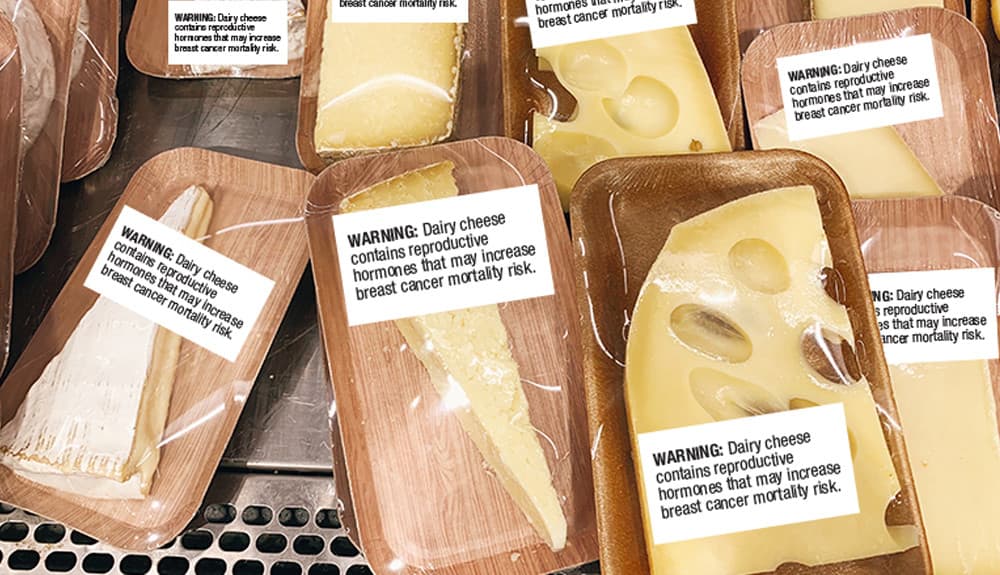
About a year ago, on October 3, 2019, the PCRM submitted a petition to the FDA proposing that cheeses be required to carry a warning label with the following information: “Dairy products contain sex hormones that may increase the risk of developing and dying from breast cancer.”
They also submitted data to support their arguments.
According to the PCRM, several studies in recent years have shown a clear association between breast cancer and regular cheese consumption.
- The insulin-like growth factor (IGF-1), as well as other growth hormones found in dairy products, are among the main risk factors for breast cancer.
- Consumption of aged and cream cheeses increases women’s risk of breast cancer by more than 50%.
- Drinking 2–3 cups of milk daily increases the risk by 80%.
- Among women with breast cancer who regularly consumed high-fat dairy products, the breast cancer mortality rate was 49% higher.
- Those who drank soy milk instead of cow’s milk had a 30% lower risk of breast cancer.
The physicians’ petition dated September 22, 2020 states: “To ensure that people understand the potential significant risks and long-term effects of consuming cheese products, the FDA must ensure that a warning notice is prominently displayed on milk packaging and on the labeling of all cheese products.”
In the shadow of lobbying interests
The doctors concluded that the agency, yielding to the interests of certain lobbying groups, is ignoring the facts.
Current data show that breast cancer is the third most common cancer in the United States. It is proven that healthy dietary habits reduce the risk of cancer (and other diseases), including postmenopausal breast cancer.
The doctors resent that the FDA’s healthy diet recommendation states “three cups of dairy products per day are recommended.” According to current medical data, this increases the risk of breast cancer.
The complaint also points to conflicts of interest related to the dietary guidelines. It has been suggested that experts delegated to the committee that developed the dietary guidelines were actually people from the dairy, egg, and meat industries.
Following the official dietary recommendation may be deadly
“The current healthy eating recommendation — which suggests consuming three cups of dairy products daily, including cheeses — endangers American women’s risk of breast cancer,” says Susan Levin, MS, RD. “People have the right to know whether this potentially deadly departmental recommendation was influenced by committee members who have ties to or profited from the dairy industry.”
The “Beat Breast Cancer” campaign, supported by celebrities such as Alicia Silverstone, encourages women to adopt lifestyle changes to prevent and fight the disease.
“What you eat can either feed cancer or help find and destroy it,” says Kristi Funk, MD, breast cancer surgeon and the campaign’s lead ambassador. “Eating whole, colorful plant foods helps protect you against cancerous changes.”
Explanation
But how do sex and growth hormones get into milk?
All mammals, including humans, whales, dogs and cattle, feed their newborn with milk. Its basic purpose is to be nutritious, stimulate growth, and provide substances that the newborn cannot yet produce after birth — for example, growth hormone. Up to this point this is a normal and natural process.
A cow does not produce milk continuously. Milk production begins as a result of hormonal changes in the last days of pregnancy — just before calving. That means the cow that is producing milk has high levels of sex hormones. Milk production continues as long as the calf suckles. This is the main stimulus that keeps the mother’s hormones at high levels and ensures abundant milk production to feed the calf. Naturally, milk production ceases after some 300–310 days. In industrial milk production, however, calves are separated (not allowed to suckle) and milk production is maintained by regular milking and the administration of hormones.
Hormones are also used to make the cow able to conceive again as soon as possible so that the next offspring arrives and the time out of production is minimized.
Thus, cow’s milk contains natural growth hormones and artificial sex hormones. Their concentration can be especially high in milk fats. Most dairy products, such as butter, sour cream, cream and cheeses, are made from milk fat.
So hormones can enter your body through regular consumption of dairy products, where they can significantly disrupt your hormone balance and lead to unfavorable processes.
Watch this film about industrial milk production. Turn on the Hungarian subtitles!
What is recommended?
Cheeses are tasty and flavorful. They can even create an “addiction,” meaning you may crave them every day.
I do not think you should immediately eliminate these products from your diet, but like everything, eat cheeses in moderation! Don’t overdo it — don’t eat them daily and certainly not in large amounts at once.
Nutrition researchers increasingly recommend the same: reduce both meat and dairy proportions and follow a varied, predominantly plant-based diet. I recommend the same.
[Source]

