Blog
A stroke is an emergency that can only be treated in hospital. Once life-saving interventions have stabilised your condition, you will still usually spend only a few days – or, in a favourable case, a few weeks – in an institution.
You are discharged even though your limbs do not move, and you cannot speak, swallow or care for yourself properly. Your family stands helplessly by because nobody has explained exactly what the next step is. This article of mine aims to fill that gap.

If you need to go to the toilet frequently, get a sudden, urgent need to urinate, wake several times at night because of it, or sometimes cannot reach the toilet in time, you have probably already heard about medication and pelvic floor exercises. TTNS is a third option that is discussed much less, even though it can be done comfortably at home.

If you have just received your report and it says bone oedema or bone marrow oedema, this is probably your first question: what exactly is it, and how serious a problem is it?

There is a lot of misinformation online about magnetic therapy. I put together a concise summary of what you need to know about PEMF.

I believe lymphoedema treatment can be effective only when the patient fully understands what the problem is, knows the therapy's limits and possibilities, and takes control of their own care.

A massage gun is a percussive vibration therapy device that acts on muscle tissue with rapid, repeated tapping movements. Its name comes from the English word “percussion” – and the principle is indeed similar to that of a percussion instrument. The moving head can strike the muscle up to 50 times per second, penetrating the tissues with an amplitude of 5-10 mm.
The word “biohacking” has become a frequently used concept in the last decade: smart, targeted “tuning” of your own body with minimal time and money investment. With work, family and everyday life, often only a few hours per week remain for exercise, while maintaining muscle strength, endurance and body shape would require much more activity. Increasingly, people turn to muscle stimulators (EMS): a longer workout can be supplemented or partly replaced with 20–30 minutes per day.

There is a gap between “I can move it a little now” and “I use it fully”. The load bridges this gap. Rehabilitation is not about resting, but about gradually and intelligently dosed loading – this is what brings the tissue, muscle and nervous system back to normal function.
The most common mistake is choosing one of two extremes: either you exercise too cautiously, essentially without loading, for months (and no meaningful improvement occurs), or you try to progress too quickly and overload yourself. In this article, I’ll show you the logical order in which loading is built up, how to move safely to the next level, and where each device can help.

“Go to physiotherapy.” That’s what you hear at the surgery, and you nod while having no idea who you should actually see. A physiotherapist? A physical therapist? Are they the same? And where does the massage therapist fit in, along with that “medical fitness” trainer your neighbour mentioned? Rehabilitation is teamwork, but if you don’t know who does what, you can easily knock on the wrong door – and lose valuable weeks.
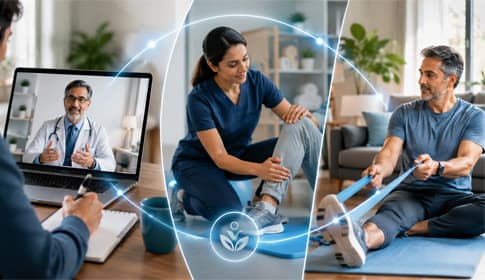
I receive letters every day from people who have been carrying some complaint for weeks, months, sometimes years. Everyone is driven by a single shared hope: perhaps I know something other doctors haven’t said so far. Maybe there’s a shorter route, maybe more precise, maybe finally a solution.
Tinnitus — commonly called ear ringing or ear noise — is a condition in which you perceive a sound in the ear or head without an external source. It can be a ringing, buzzing, humming, hissing, or even a pulsating sound. It is not an independent disease but a symptom that can have many underlying causes.