Who is it recommended for?
Caused by sphincter weakness: urine leakage with physical strain (coughing, laughing, lifting). evoStim E programmes at 35–100 Hz target phasic muscle fibres, while EMG-biofeedback shows whether the pelvic floor muscles are truly activated. This is the most common form of incontinence and often responds well to muscle training.
Caused by bladder muscle hyperactivity: a sudden, overwhelming need to urinate. evoStim E programmes at 5–20 Hz aim to calm the bladder muscle, reducing involuntary contractions. Pulse width is adjustable between 250–400 µs to suit patient comfort.
If stress and urge incontinence occur together, evoStim E's mixed programme addresses both phases: first bladder calming (low frequency), then muscle training (high frequency). It can also be treated with a personalised programme or by applying the two programme types consecutively.
For weakness of the anal sphincter, using evoStim E with an anal probe (PeriProbe Analis or PeriSphera A) enables targeted sphincter training. EMG-biofeedback precisely measures anal sphincter activity here as well.
Childbirth can damage or overstretch the pelvic floor muscles. evoStim E can aid targeted muscle recovery — EMG-biofeedback objectively measures activation and progress. Treatment may begin after the 6–8 week postpartum medical check-up.
Combined effect of EMG-biofeedback and ETS
Conventional electrostimulators deliver impulses but do not measure whether the muscles actually respond. evoStim E's EMG channel senses the electrical activity of muscle fibres directly — so you can see in real time if the patient is using abdominal muscles instead of the pelvic floor.
ETS goes further: if the EMG signal produced by voluntary contraction reaches the set threshold, the device assists the contraction with electrical stimulation. This combined training can produce more focused muscle work than either method alone.
Perineal electrostimulation’s effectiveness stems from excitomotor effects: it can help increase muscle tone and improve local circulation. Studies show stimulation can significantly raise urethral closure pressure and reduce bladder muscle hyperactivity.
Frequently asked questions
No. You feel a mild tingling and a definite muscle contraction. If you experience pain, reduce the intensity. Treatment should never be painful — if it is, check probe position and parameters.
No. Use of electrostimulation devices is forbidden during pregnancy. Treatment can begin after the 6–8 week postpartum medical check-up.
Both are biofeedback-enabled stimulators but operate on different measurement principles. evoStim E uses EMG-biofeedback (measuring the muscle's electrical activity), while the evoStim P uses pressure-biofeedback (measuring pressure exerted by the muscle). EMG-biofeedback has the advantage of directly measuring neural activation — it can detect more subtle muscle activity.
Yes. Men can use evoStim E with an anal probe (PeriProbe Analis or PeriSphera A) — particularly useful for post-prostatectomy incontinence. EMG-biofeedback can support anal sphincter training as well.
With combined EMG-biofeedback and electrostimulation, initial improvements can be felt after 2–4 weeks of regular use. The intensive treatment phase is 8–12 weeks, followed by maintenance therapy (1–2 times weekly) to preserve results.
evoStim E is compatible with a variety of probes: vaginal probes (PeriSphera-O, PeriSphera-U, PeriSphera AT) and anal probes (PeriProbe Analis, PeriSphera A). Electrode surfaces are gold-plated and suitable for metal allergy cases. It can also be used with surface (adhesive) electrodes.
How to use the evoStim E?
1
Select the program
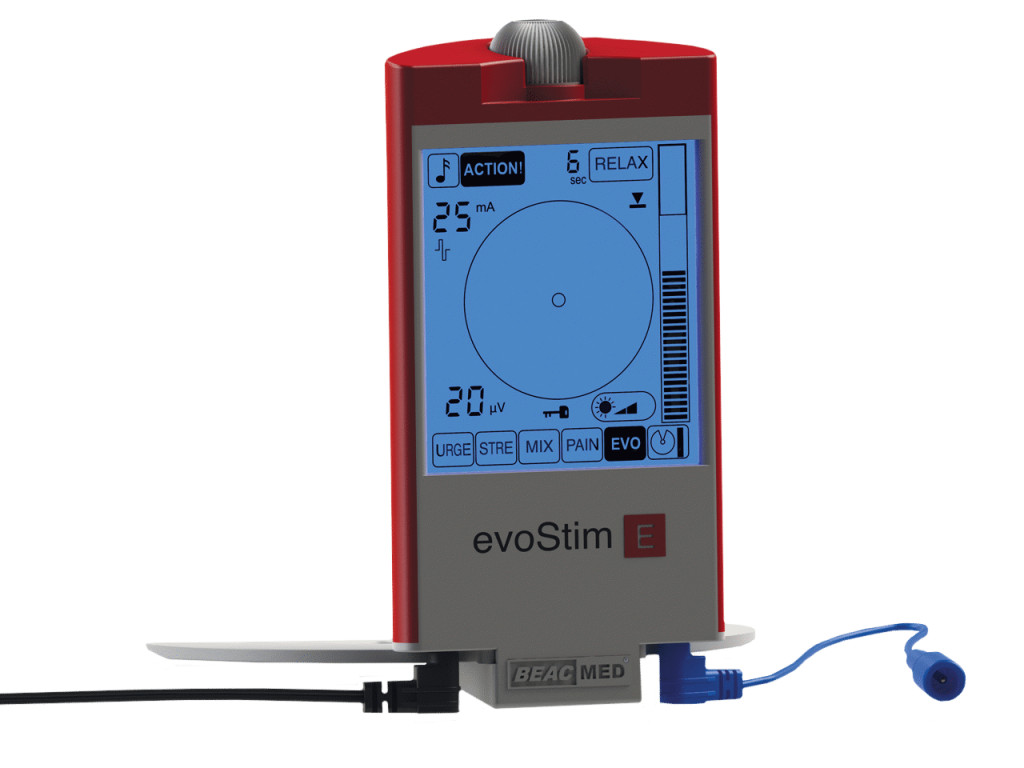
On the touchscreen choose the programme group that matches your type of incontinence (stress, urgency, mixed, pain or relaxation). Any of the 5 quick-access buttons can be assigned one of the 9 programmes.
2
Connect the probe and cables
The device has two channels: the EMG sensor (input) and the stimulation (output) cable. Connect both to the probe. Moisten the probe with water or lubricant gel, then insert it.
3
Set intensity and EMG threshold
Use the rotary knob to set the stimulation intensity (pleasant but producing a definite muscle contraction). In ETS mode set the EMG threshold — this determines what strength of voluntary contraction triggers the assisting stimulation.
4
Exercise with EMG-biofeedback
The screen shows the EMG waveform in real time — your muscle activity. In ETS mode, if your contraction reaches the threshold, the device delivers assisting impulses. Contract your muscles when prompted — your effort and the stimulator combine.
5
Track your progress
EMG values can be compared week by week — increases in muscle activity are objectively measurable. Daily sessions of 20–30 minutes for at least 8–12 weeks are recommended, then maintenance therapy (1–2 times weekly).
Package contents
evoStim E arrives with the following accessories:
- 1 pc evoStim E device (touchscreen and rotary knob)
- 1 pc stimulation cable
- 1 pc EMG-biofeedback cable
- 1 pc PeriSphera-O vaginal electrode
- 3 pcs 1.5V AAA alkaline batteries (LR03)
- 1 pc battery compartment opener
- 1 pc user manual
Probes are intended for personal hygiene use. If multiple users are involved, each person must use their own probe. Electrode surfaces are coated with a thin layer of gold plating, so they are suitable even in cases of metal allergy. Spare probes and accessories (PeriSphera, PeriProbe, contact gel) are available on our category page.
Technical specifications
| Channels | 1× stimulation (output) + 1× EMG-biofeedback (input) |
| Waveform | Symmetric biphasic, selectable alternating |
| Stimulation output | 1–99 mA (1 mA steps, on 1 kΩ load) |
| Frequency | 1–150 Hz (28 steps) |
| Pulse width | 50–400 µs (10 µs steps) |
| Session duration | 5–90 minutes (5-minute steps) |
| Biofeedback type | EMG (measurement of muscle electrical activity) |
| Program groups | 5 (stress, urgency, mixed, pain, relaxation) |
| Programs/group | 9 predefined + customizable |
| Intellistim | Yes – frequency fine-tuning during use |
| User interface | Touchscreen + rotary knob |
| Power supply | 3× 1.5V AAA alkaline batteries (LR03) |
| Certification | CE medical device (MDR) |
 When NOT to use the device?
- Cardiac pacemaker or implanted defibrillator
- Pregnancy
- Active malignancy in the treatment area
- Untreated epilepsy
- Acute inflammation or infection in the pelvis
- Within 3 months postpartum
Not sure? Consult your treating physician before use!
 Important information
evoStim E is a CE-marked medical device (MDR certified) intended as a complement to medical treatment. A medical assessment is required before starting treatment to determine the type of incontinence, as different types require different treatment protocols.
Electrostimulation can be an effective adjunct to pelvic floor muscle training. The Cochrane Collaboration's 2022 comprehensive review found high-level evidence supporting the effectiveness of pelvic floor muscle training (PFMT) for incontinence treatment.1
The information on this page is for guidance only. Home therapeutic devices are intended to complement medical treatment and do not replace it. Consult your treating physician if you have symptoms.
Scientific background
There is high-level clinical evidence supporting the effectiveness of electrostimulation-assisted pelvic floor muscle training combined with EMG-biofeedback:
- Todhunter-Brown A, Hazelton C, Campbell P, et al. (2022). Conservative interventions for treating urinary incontinence in women: an Overview of Cochrane systematic reviews. Cochrane Database Syst Rev. 9(9):CD012337. PubMed
- Ghaderi F, Mohammadi Oskouei A, et al. (2023). Effects of pelvic floor muscle exercise on stress urinary incontinence. Int Urogynecol J. 34(5):1137-1147. PubMed
 Incontinence treatment – complete guide →
 Treatment in practice – step by step →
 Urinary incontinence and treatment →
 Fecal incontinence and treatment →
 Pelvic floor exercise guide →
 evoStim P – pressure-biofeedback alternative →
 All incontinence devices →