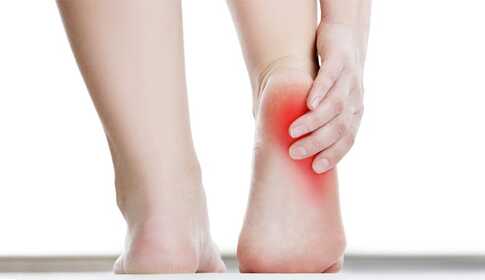

 What is a heel spur — and is it really the cause of the pain?
A heel spur is a bony outgrowth on the heel bone. In popular thinking it is the main cause of heel pain — the reality is more nuanced, and the story starts not with the bone but with a tendon-like sheet. From the heel to the base of the toes a strong, hand-sized connective tissue band stretches across your sole: the plantar fascia. It works like a bowstring: it tightens with every step to keep the arch from collapsing — during running it supports several times your body weight.
If this “string” is exposed to more load than it can handle over time, tiny tears develop at its weakest point — the attachment to the heel bone — and the tissue becomes inflamed. The painful structure is this inflamed attachment — the condition is plantar fasciitis. Over years your bone responds to the constant strain by adding bone at the attachment — thus a heel spur forms. In other words, a heel spur is a footprint of long-term overload, not the primary pain generator — much like a callus on a frequently used hand.
The common misconception here: many imagine the heel spur as a sharp spike poking the sole from inside, like a pebble in a shoe. In fact the outgrowth lies flat in the direction of the fascia pull and usually isn’t painful on its own — heel spurs are visible on X-rays in many people without symptoms, while others suffer the same stabbing pain without any spur. The good news follows: because the complaint comes from soft-tissue inflammation, the pain can resolve even if the bony outgrowth remains — you don’t have to “cut out” the spur to walk without pain again.
 Key point
You don’t need to remove the bone spike; you need to offload and rest the overloaded plantar fascia. This takes persistent work over weeks to months — but in the vast majority of cases it leads to improvement without surgery. Don’t expect a quick miracle. What developed over months or years won’t vanish after one or two treatments in a few days.
 How does the problem develop?
Typical triggers: long periods of standing and walking on hard surfaces, suddenly increased training load, or long hikes in unbroken-in shoes. What they have in common is that the fascia doesn’t get time to adapt — the load rises faster than the tissue can strengthen.
The most common predisposing factors: tight, shortened calf muscles (which pull the fascia tight), overweight, flat feet or very high arches, thin-soled, worn or non-heeled shoes, and all-day standing work. Most of these factors you can influence yourself — that is half the treatment.
At night the foot rests in a slightly downward position and the fascia shortens. The first morning steps suddenly stretch it — hence the typical stabbing “start-up” pain that eases after a few minutes of movement, but returns after prolonged standing or walking — the same happens after long periods of sitting when you stand up.
Is it definitely a heel spur? — other causes of heel pain
The most common cause is indeed overload of the plantar fascia, but it’s not the only one. The table helps orient you — diagnosis of course belongs to the doctor.
| Where and when does it hurt? | What might it indicate? | What to do? |
|---|---|---|
| Lower part of the heel, stabbing pain with the first steps in the morning | Plantar fasciitis / heel spur | This article is for you — start with the home programme |
| Back of the heel, at the tendon attachment, shoe pressure | Achilles tendon–related problem, bursitis | Achilles tendon inflammation article → |
| Sharp pain that increases with load after sport, with swelling | Possible stress fracture | Medical evaluation, stop loading the area |
| Burning, numb, night-time pain | Nerve entrapment, peripheral neuropathy | Peripheral neuropathy article → |
| Multiple joints aching, morning stiffness | Inflammatory rheumatological disease | Rheumatological evaluation |
| Child or adolescent athlete heel pain (8–14 years) | Growth plate inflammation (Sever’s disease) | Pediatric orthopaedic assessment |
 When to see a doctor?
See your doctor if the pain started suddenly after an injury, if it makes walking impossible, if the heel is swollen, warm or red, if fever accompanies the symptoms, if it hurts at rest and at night — or if 2–3 weeks of consistent home treatment bring no improvement.
The three pillars of home treatment
Research and professional guidelines agree today: the basis of treatment is not a single miracle method but the consistent combination of three simple things — offloading, stretching and local anti-inflammatory measures.1 Devices support these three, but do not replace them.
1st pillar: offloading
Change your shoes: wear footwear with a thicker, cushioned sole and a slight heel lift — don’t walk barefoot on cold hard tiles at home. A silicone heel lift or an insole with arch support further reduces tensile load on the fascia. If you are overweight, every kilo lost directly relieves your heel.
2nd pillar: stretching — the backbone of the programme
Targeted stretching of the plantar fascia is consistently supported by research as a basic measure against the “start-up” pain.1 Make these three exercises part of your daily routine:
 The daily stretching routine (about 10 minutes total)
Plantar fascia stretch: sit and place your ankle on the opposite knee, pull your toes toward your shin until you feel the stretch in the sole — hold 30 seconds, repeat 3 times. Do it in the morning BEFORE you step out of bed, and after any long period of sitting. Calf stretch: face a wall and step one foot back, keep the rear heel on the ground and lean forward — 30 seconds, 3 reps per side, twice daily. Ball rolling: roll a tennis ball or a chilled water bottle under your foot for 5 minutes daily.
3rd pillar: local pain and inflammation control
For acute, severe pain ice (an ice pack wrapped in a towel, 15 minutes, several times daily) brings relief; in prolonged, chronic phases a warm foot bath and improved circulation help more. This pillar is also supported by home physiotherapy devices.
 Home devices — where to start?
You don’t need several devices at once. Based on the evidence I recommend a soft laser as the first home device;2 ultrasound and microcurrent play a supplementary role, and shockwave is a clinic-level step if conservative care is insufficient.
B-Cure Laser Classic soft laser device
A simple, wide-treatment-area home soft laser. Hold it directly over the painful area — the plantar surface of the heel and the two sides of the heel bone — once daily. Daily treatment time is 20–25 minutes. The effect builds over a course of 2–4 weeks; don’t judge it after the first few sessions.
 Before you start device-based treatment
 Important to know
 What do the studies say?
 Summary – Quick overview