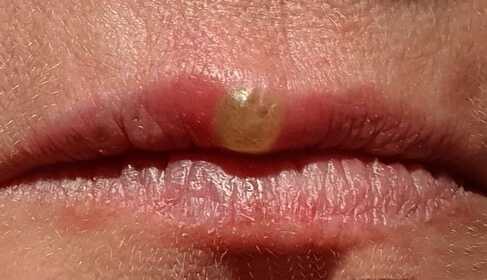

 Soft laser treatment for cold sores – case study with photos, hour by hour
Research data are one thing – seeing the process is something else. In this article, I present a real case documented with photographs: one of our patients, who experiences recurrent cold sores, agreed to have an emerging recurrence treated with soft laser, while we photographed the changes hour by hour. You can see the result below in six images – from the first redness to a dried scab, over 48 hours.
This article deliberately focuses on the case. If you are looking for the full background – why herpes returns, what clinical studies show, the exact acute and preventive protocols, and contraindications – you will find it in our main article: treating herpes with soft laser – complete guide.
 Key point
In this patient, herpes recurrences had previously lasted 5–7 days. With laser treatment – started at the first tingling sensation – the process reached the dried scab stage within 48 hours. One case is not statistics, but the direction is consistent with clinical studies: in the comparative study, laser-treated herpes resolved in an average of 2.2 days, compared with 3.4 days with aciclovir cream.1
 The patient and the treatment
Starting point: our patient experienced cold sores 5-6 times a year; with creams, recurrences typically ran their course within 5–7 days, with unpleasant days of tightness and pain. Treatment: Personal-Laser L400 device (808 nm, 400 mW), scanning technique – slowly moving the laser light over the blister and its immediate surroundings, without contact –, 2-3 minutes per session, 2-3 treatments per day. The first treatment took place at the first tingling sensation, before the blister had formed – this timing is the key to the method.
 How the symptoms changed – a photographic diary
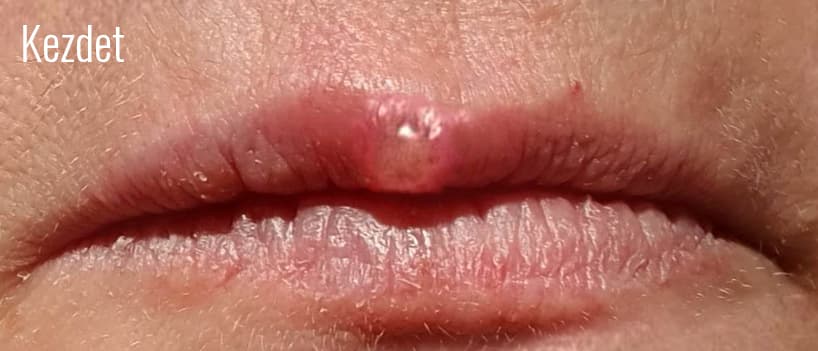
Starting point (hour 0) – the first signs
A red, tight swelling on the upper lip, with the characteristic tingling sensation – the herpes is starting. This is when the first laser treatment was given.
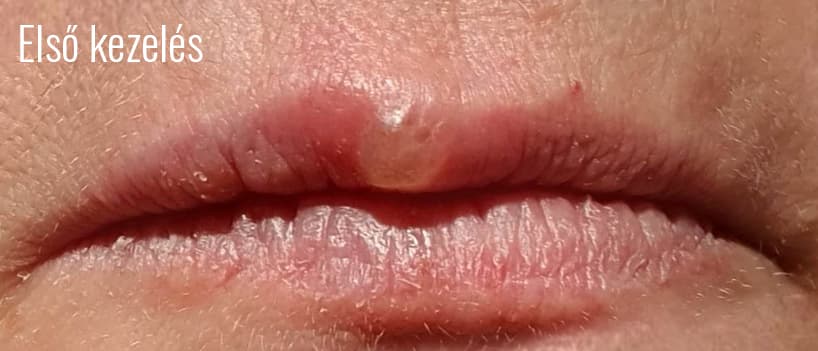
1 hour later – the blister forms
Early treatment does not always stop the process: a blister filled with straw-coloured fluid appeared, and the pain became more intense. Treatment continued according to the protocol.
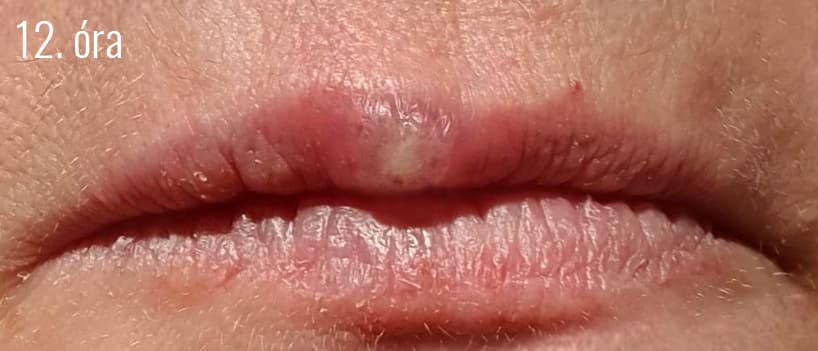
12 hours later – the first turning point
After the second treatment, the appearance of the blister had visibly changed: the tightness had eased and the spread had stopped.
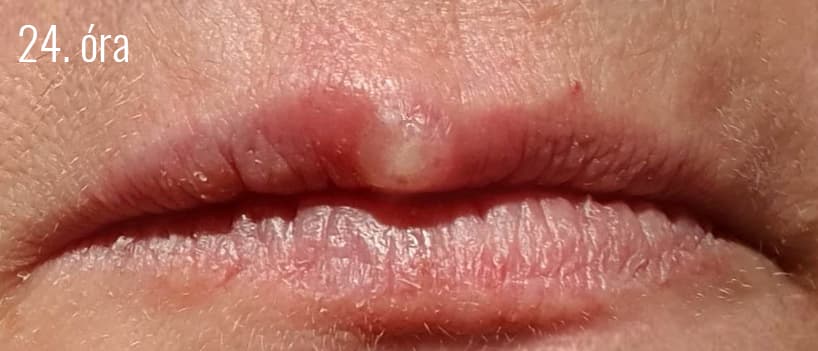
24 hours later – the pain decreases
After three treatments, the blister was no longer tight and the pain had eased significantly – the process had turned towards recovery.
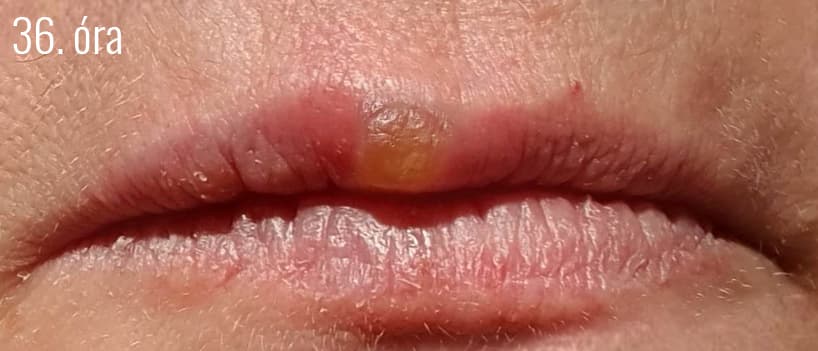
36 hours later – drying
The blister had dried and the pain had stopped. In the usual course, this stage typically occurs only several days later.
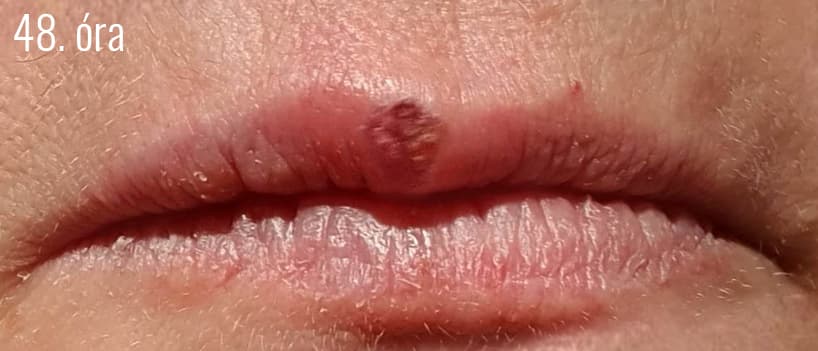
48 hours later – scabbed, healing stage
Two days after the first treatment, only the dried scab was visible – the most infectious, weeping stage had ended quickly. In the patient's words: “It usually takes 5-7 days to recover; this time I felt the effect almost immediately, and I had got through the worst of it within two days.”
 What should you know about this case?
Let us put three things into perspective. One: this is a single case – scientific evidence comes from controlled studies, not individual experiences. The good news is that those studies are consistently favourable: in the systematic review of the field, all six clinical studies supported laser treatment2, and in the study comparing it with aciclovir, laser treatment proved faster.1 You will find the full research background in the main herpes article. Two: timing was also key in this case – treatment started at the first tingling sensation. Three: faster drying also shortens the infectious period, but while the wound is weeping, the hygiene rules – separate towel, hand washing and protecting the eyes – still apply.
 When should you not treat it at home?
For herpes around the eye, an extensive rash or a rash accompanied by fever, a weakened immune system, or if the wound has not healed within 2 weeks – consult a doctor. You will find the detailed list of restrictions in the soft laser contraindications article, and the complete treatment protocol in the main herpes guide.
The device shown in the photographs
Personal-Laser L400
808 nm, 400 mW diode laser – the treatments in this case study were carried out with this device. It is pocket-sized, so the rule of “starting at the first tingling sensation” is easy to follow; besides herpes, it can also be used for joint and muscle complaints.
For surface skin complaints specifically, the 660 nm Personal-Laser L200 is also a fully suitable choice – the soft laser category and the main herpes article can help you choose a device.
Summary
What is this article about? A photographic case study: soft laser treatment of an emerging cold sore, from the first tingling sensation to the dried scab, photographed hour by hour.
Who is it for? People who want to see for themselves what laser treatment for herpes looks like in practice before they start.
Main message: With laser treatment started early – at the first tingling sensation – this recurrence reached the healing, scabbed stage within 48 hours instead of the usual 5-7 days. One case is not proof – but the direction is consistent with the results of clinical studies.
Next step: Read the complete treatment and prevention protocol in our main herpes guide – and if you experience recurrent herpes, keep the device ready for the first sign.
Read more
Scientific sources
- Honarmand M, Farhadmollashahi L, Vosoughirahbar E. (2017). Comparing the effect of diode laser against acyclovir cream for the treatment of herpes labialis. Journal of Clinical and Experimental Dentistry. DOI: 10.4317/jced.53679
- Al-Maweri SA, Kalakonda B, AlAizari NA, et al. (2018). Efficacy of low-level laser therapy in management of recurrent herpes labialis: a systematic review. Lasers in Medical Science. DOI: 10.1007/s10103-018-2542-5