

Lumbago – the pain immobilizes you
Lumbago, also known as a pinched nerve, is the term for sudden pain in the lower back. It typically occurs with a "wrong move." Lifting a piece of furniture or a heavy weight can trigger it with lightning-like suddenness. Afterwards it can be so strong and stabbing for a longer or shorter time that it hardly lets you move. You curl up in the fetal position, knees drawn up, trying to get rid of it. Getting up or standing upright also becomes very difficult […]

Lumbago, also called a pinched nerve, is the term for sudden pain in the lower back. It usually develops after a "wrong move." Lifting a piece of furniture or another heavy object can cause it suddenly, like a lightning strike. For a longer or shorter time the pain is so strong and stabbing that it scarcely allows you to move. You curl into the fetal position, knees drawn up, trying to relieve it. Getting up and maintaining an upright posture becomes very difficult. Then it slowly disappears, only to reappear at the most unexpected moment. To get rid of it, you must do a lot!
What is the role of the spinal column?
Your spine supports the weight of your body while you walk. Your spine consists of 7 cervical, 12 thoracic, 5 lumbar and 5 fused sacral vertebrae. The tailbone is also counted among them, but it is not relevant for lumbago.
From the space between each pair of vertebrae one spinal nerve exits to the right and left. From there they run to muscles, organs, skin, etc.
The vertebrae are held in place by ligaments and the so-called spinal-supporting muscles.
With every step, your weight presses down on the spine, which, thanks to its flexibility, absorbs the vibrations caused by movement.
That is, as long as your spinal-supporting muscles are sufficiently strong.
How does lumbago develop?
If your spinal-supporting muscles weaken or you lift something very heavy, a greater load is placed on your spine and two vertebrae are pressed together. In fortunate cases this causes no problem, but sometimes they come together in such a way that they compress the nerve fiber exiting between them. For a moment the nerve is "pinched" between the two bones.
This causes sudden, lightning-like, severe, stabbing pain that can sometimes radiate into the leg.
The area around the nerve fiber becomes edematous, and the surrounding muscles stiffen as a defensive reaction because of the pain. These further increase the pain and may lead to a compensatory posture.
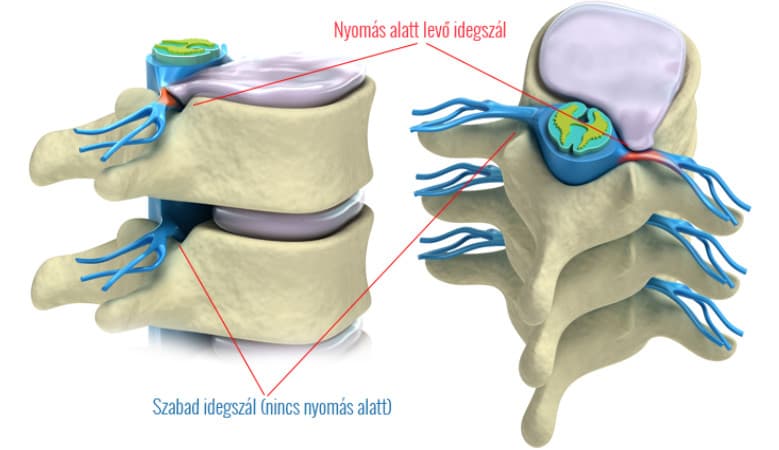
Lumbago is the "anteroom" of a herniated disc
If it happens repeatedly, it's time to take it seriously, because it warns you that there is still time to "undo" it.
Lumbago is a warning that you have a weak point. If you ignore prevention, the next stage is a herniated disc! And you won't get off that so easily.
Causes of lumbago
Most often the cause is very simple: an absolute or relative decrease in the strength of the spinal-supporting muscles.
- Nowadays the most common cause is a decrease in absolute muscle strength, primarily due to lifestyle, sedentary or standing work, and lack of exercise. You sit in the office, on the bus, the subway, in the car, in front of the TV, in the cinema, at the theater… everywhere. Meanwhile you avoid the gym; your spinal-supporting and back muscles weaken so much that they can barely support your own weight. That is how lifting your chair can cause lumbago. And this is not a joke!
- Relative muscle weakness is caused by obesity. If you are overweight, more load falls on your muscles than they were "designed" to carry. It is as if you were constantly carrying a sack on your shoulder. You can imagine that your spine (and of course your hips, knees, ankles) were not designed for that!
Overweight combined with relatively weak muscles is a direct cause of lower back pain, and similarly of neck and back pain.
This also applies to athletes with relative muscle weakness. Intensive training and heavy weightlifting in sports can lead to the same result as excess weight. - It is very typical for lumbago to be preceded by moving house or rearranging furniture. A man otherwise free of spinal complaints can be "done in" by unexpected heavy lifting. His muscles hold his normal body weight and routine activities, but they are not prepared for such additional load.
Can lumbago be prevented?
If you know the above, then yes!
With regular exercise—30–40 minutes daily with exercises that thoroughly work the back muscles—you could avoid weakening of the spinal-supporting and back muscles. Of course few people pay attention to this… until there is trouble.
If you do standing or sitting work, you feel very tired by the end of the shift. But it is not really physical fatigue; it is the monotony and sameness that is exhausting. If you do not exercise, your progressively weakening back and spinal-supporting muscles are supposed to hold your weight.
The problem can worsen if your body weight also increases. Weaker muscles would have to bear the increasing weight. That is obviously impossible.
Back muscles are weak, and it is no wonder that even an "innocent move" can produce lumbago that then keeps you from moving for a few days.
Proper lifting with correct posture can help prevent back pain and other injuries.
Other causes can also lead to lumbago
What I mentioned above is the most general and common cause of lumbago. But it is not the only one! Therefore, if it occurs for the first time and not because you had to move a heavy object—say you moved a large wardrobe from the upstairs to the basement—see a doctor so the cause can be investigated!
Among other things, the following can also cause it:
- inflammation resulting from injury to the spinal-movement muscles
- changes in the small joints of the spine (e.g., calcium deposits pressing on the nerve)
- osteoporosis and the consequent approximation of the vertebrae
- various spinal infections
- tumorous changes affecting the vertebrae
- an indirect cause can be an organ disease: for example, diseases of organs in the lower abdomen or pelvis can cause pain radiating to the lower back that may be mistaken for lumbago. (Kidney diseases, urological problems, gynecological diseases, etc., can cause this.)
Lumbago can also be caused by excessive load and stress
It is less well known that what "happens in your head" affects the functioning of your whole body.
Daily stress, a high-paced workload and depression can play a role in the development of lower back pain and lumbago. If you feel you are carrying more burden than you can bear, it may manifest as real back and lower back pain!
If you can, reorganize your life. Consider how much is reasonable to take on.
What to do when acute lumbago appears
Pain is your body's signal trying to tell you that "something is wrong." Do not ignore this signal—find out the cause before the situation becomes more serious!
Although mild lumbago may resolve on its own within a few days, there are cases when you must seek medical attention immediately. See a doctor if you feel numbness in your leg; if you suddenly cannot control your stool or urine; or if the lower back pain is accompanied by a high fever. It is also worth seeing a specialist if your pain does not subside within 4–5 days, or if your symptoms lessen but persist for weeks and return after a short break when performing certain movements.
During the hours after the onset of lower back pain avoid physical exertion, because any physical effort will increase your complaints. Lie on your side on a firm mattress (soft, sagging ones are not good). Pull your knees up, "round" your lower back, and relieve the pressure on the lumbar discs.
Medication aims to relieve pain and relax the muscles. However, orally taken drugs do not act only at the painful spot; they spread throughout your body. They affect areas where you do not need them—this can lead to undesirable side effects, especially if you need to take them for a longer period, more than a few days.
If you are not a fan of medications, choose from various physiotherapy methods. These provide completely safe yet effective treatment. Some produce rapid effects (TENS, muscle stimulation, microcurrent), while other methods require more sessions to reduce lumbago symptoms but also accelerate healing (microcurrent, ultrasound, softlaser, magnetotherapy).
Physiotherapeutic methods for home treatment of lumbago
You can choose from several treatments. Although each helps by itself, it is best to combine 2–3 treatments.
Muscle stimulation – in my opinion this is the best method
If you have read this far, you already know: lumbago is most often caused by the spinal-supporting muscles not being strong enough for some reason to maintain the distance between vertebrae. Thus the vertebrae come together and press, "pinching" the nerve fiber exiting between them—this causes the excruciating lumbago pain.
It is obvious that weak back muscles can be strengthened with regular spine-strengthening exercises and thus the complaints can be resolved. However, in acute lumbago, and even in chronic back pain, exercise can be risky and should even be avoided at that time! If you begin back-strengthening exercises with the very weak muscles that led to the development of lumbago, you may worsen the situation or even cause a herniated disc.
Globus Cycling Pro multifunctional electrotherapy device
- Dedicated Lumbago, Back Muscle, Spine-strengthening programs
Magnetotherapy treatment
 Magnetotherapy treatment
Pulsed magnetic field treatment is a standard modality in Western physiotherapy. It has been sidelined in our country due to fraudulent companies that deceived many people. That is not the fault of magnetotherapy itself, so the method deserves to regain recognition.
Its effect is not as rapid as some of the previously mentioned methods, but it would be very useful in prevention and in ensuring long-term results.

