

 What is Peyronie's disease?
Peyronie's disease (medically known as induratio penis plastica, or IPP for short) is a condition affecting the penis in which hard lumps – known as plaques – develop in the penile tissue. These plaques are made of scar tissue. Because the scarred area does not stretch along with the surrounding elastic tissue, the penis curves towards the plaque during an erection. The condition may also cause pain and, in an advanced stage, may make sexual intercourse difficult or impossible.
The disease was first described in the 18th century by a French surgeon, François de la Peyronie – it was named after him. Although many people feel they are alone with it, it is actually a common condition: according to some surveys, it may affect a large proportion of men over the age of 40. Yet many of those affected do not see a doctor – typically because of embarrassment – even though early recognition can make a significant difference.
 The key point in brief
Peyronie's disease is a benign but uncomfortable scarring process in the penis that may cause curvature and pain. It is not infectious, and there is nothing to be ashamed of – it is more common than you might think. The most important message is: if you suspect the disease, see a urologist. The earlier treatment begins, the greater the chance of stopping the process and reducing symptoms.
 How does it develop, and what are the symptoms?
An erection occurs when sexual stimulation causes blood to flow into the spongy corpora cavernosa running along the length of the penis. The corpora cavernosa expand, the pressure inside them increases, and the penis becomes hard. If a scarred plaque forms in the wall of this structure, that area cannot expand properly – which is why the penis curves towards the scar during an erection.
The exact cause is still not fully understood, but current knowledge suggests that inflammation of the fine vessels in the corpora cavernosa, repeated minor injuries (microtrauma) and the abnormal scarring that follows may be involved. The disease is more common in people who also develop connective-tissue scarring elsewhere, such as thickening of a tendon in the palm, and in people with diabetes or atherosclerosis.
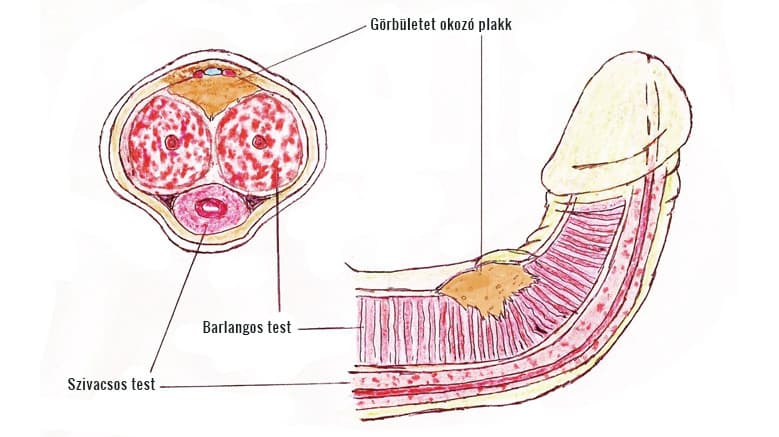
The most typical symptom is that the penis curves in one direction during an erection, most often upwards. The degree of curvature may change over time and may increase during the active phase of the disease.
The plaque can often be felt as a hard lump beneath the skin of the penis. This is often the first sign noticed by the person affected.
During the active, early phase of the disease, erections are often painful. The good news is that in most cases the pain gradually eases on its own as the process stabilises.
In more severe cases, the disease may also be accompanied by erectile dysfunction. This may be partly due to the curvature itself and partly to the vascular processes underlying it.
 Degree of curvature and stages
The disease has an early, active phase, when the plaque is still developing, the curvature may change and erections are often painful. This is followed by a stable phase, when the process settles: the pain usually disappears and the curvature becomes more or less constant. Treatment options are greatly influenced by the stage of the disease – another reason why an early medical examination is important.
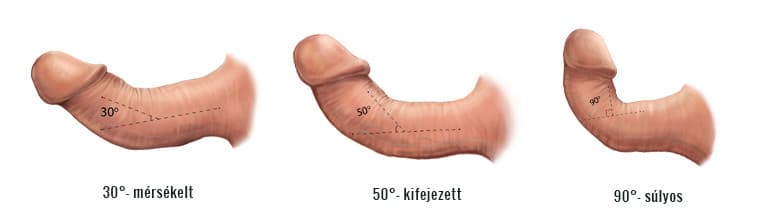
The severity of symptoms depends primarily on the degree of curvature:
| Degree of curvature | What does this mean in practice? |
|---|---|
| Approx. 5–20 degrees | Mild curvature; sexual intercourse is typically possible. |
| Approx. 20–45 degrees | Marked curvature; intercourse may become difficult or impossible. |
| More than 45 degrees | Significant curvature; intercourse is typically not possible. |
These values are for information only – the actual situation and the appropriate next steps must always be assessed by the urologist carrying out the examination.
 When should you see a doctor?
If you suspect the disease – if you notice curvature, a palpable lump, pain or difficulty achieving an erection – see a urologist or andrologist. Do not wait for the symptoms to worsen: signs of the disease often appear 1–1.5 years before the person affected seeks medical help, even though early treatment offers the best chance of stopping the process. Do not let embarrassment hold you back – urologists see this condition regularly and deal with it discreetly and objectively.
 What treatment options are available?
Treatment depends on the severity and stage of the disease. Some treatments can only be carried out by a doctor, while others may be continued at home after examination and under medical supervision. The overview below presents the main approaches for completeness.
The aim of oral medicines is to reduce the size of the plaque, pain and curvature. An important limitation is that a significant proportion of the active ingredient breaks down in the digestive system, and only a small amount reaches the area where it is needed – the penis. The doctor decides on medication.
With this method, the medicine is injected directly around the plaque. This is strictly a medical procedure and must be performed by a qualified professional under the highest standards of sterility.
Several physiotherapy methods may be continued at home after examination and under medical supervision: therapeutic ultrasound, iontophoresis, soft laser and vacuum stretching. Their aim is to break down the plaque, reduce curvature and pain, and make the tissue more flexible. We describe the associated devices in detail on a separate page.
Surgery should only be considered when the condition is stable, typically after at least three months without change. In such cases, either the plaque is removed or the tissue is adjusted on the opposite side. Surgery can have complications, so it is generally a last resort – the urologist decides.
Home-use devices in detail
If you want to know which devices can be used at home for physiotherapy methods – therapeutic ultrasound, iontophoresis, soft laser and vacuum stretching – and when each may be appropriate, we have summarised this on a separate page: Home treatment devices for Peyronie's disease →
 Important precautions
Home physiotherapy methods may only be started after the diagnosis has been established and under the direction of the treating doctor. Individual devices have their own contraindications – the following also require general attention:
- Self-treatment without a diagnosis – examination is mandatory before any home method; what is recommended depends on the stage.
- Implanted electrical device (pacemaker) – electrotherapy methods, such as iontophoresis, are generally not suitable in this situation.
- Damaged or inflamed skin in the treatment area – treatment is not recommended in the presence of an open wound or dermatitis.
- Suspected tumourous lesion – an unexplained lump or lesion requires medical examination first.
Consult your doctor
Before using any home device, discuss with your treating doctor whether it is safe and appropriate for your condition. Always take into account the contraindications listed in the device's instructions for use.
The emotional side – something we rarely talk about
Peyronie's disease can be not only a physical problem but also a significant emotional burden. People affected often feel anxious, lose their self-confidence and withdraw in their relationships – and low mood and depression are also common. These are natural reactions to a disease that affects how a man experiences his masculinity.
It is important to know that you are not alone and have nothing to be ashamed of. The disease is common and treatable. If you feel that the symptoms are also affecting you emotionally, talk to your treating doctor – they can help you find appropriate support, such as couples or psychological therapy. Open communication with your partner can also make the situation much easier.
Frequently asked questions
The course of the disease varies. During the active phase, the curvature may worsen, then the process usually stabilises and the pain often eases on its own. However, the curvature rarely resolves completely by itself. This is why it is worth seeing a doctor at an early stage, when the greatest range of treatment options is available.
Urologists and andrologists specialise in investigating and treating Peyronie's disease. They can assess the degree of curvature, the condition of the plaque and the stage of the disease, then recommend the appropriate treatment, whether medication, physiotherapy or surgery.
A palpable lump and curvature can also point to other conditions, which is why medical examination is important. Any unexplained lesion should always be assessed by a specialist to rule out more serious causes and provide an accurate diagnosis. Do not rely on self-diagnosis.
Some physiotherapy methods can be continued at home, including therapeutic ultrasound, iontophoresis, soft laser and vacuum stretching, but only after examination and under medical supervision. You can read more about the associated devices and when each may be appropriate on a separate page.
Yes. In more severe cases, Peyronie's disease may also be associated with erectile dysfunction – partly because of the curvature and partly because of the underlying vascular processes. If this affects you too, be sure to tell your treating doctor, as it influences the treatment plan.
Summary – The essentials
Sources
- Di Stasi SM, Giannantoni A, Stephen RL, et al. (2004). A prospective, randomized study using transdermal electromotive administration of verapamil and dexamethasone for Peyronie's disease. The Journal of Urology, 171(4):1605–1608. PubMed: 15017231
- Hatzimouratidis K, Eardley I, Giuliano F, et al. (2012). EAU guidelines on penile curvature. European Urology, 62(3):543–552. PubMed: 22658761