

 What is torticollis – and why is it not just one condition?
At one end of the scale is the harmless “I slept awkwardly on my neck” episode that settles within a few days. At the other is infantile muscular torticollis, where starting physiotherapy early makes almost all the difference. The third is adult cervical dystonia – a neurological disorder that many people mistake for poor posture for years, and therefore receive appropriate treatment late. In this article, I will clarify all three, so you know what to do in your situation.
 Key point
A tilted neck can mean three very different things. Acute “slept-on” neck settles on its own within a few days. With infantile torticollis, time matters: the earlier physiotherapy starts, the greater the chance of complete resolution. Persistent, involuntary head turning in an adult, however, may be cervical dystonia – a neurological disorder that is managed not through willpower, but with medical treatment.
 Which form do you have? The three main types
| Form | Who is it typical of? | How can you recognise it? | What to do |
|---|---|---|---|
| Acute torticollis (“slept-on neck”) | Anyone, typically in the morning after waking or after a sudden movement or draught | Sudden, painful, one-sided neck stiffness; moving the head hurts, so you protect it | Can be treated at home: rest, warmth and pain relief if needed – it settles within days |
| Infantile muscular torticollis (congenitalis muscularis torticollis) | Newborns and infants – often after a difficult birth or breech presentation | The baby’s head always tilts or turns to the same side; turning in one direction is difficult; sometimes a small lump can be felt in the sternocleidomastoid muscle | See a paediatrician and physiotherapist as soon as possible – early treatment gives excellent results3 |
| Cervical dystonia (spasmodic torticollis) | Adults, most often over 30, more commonly women | Gradually developing, involuntary turning or tilting of the head, with muscle spasms, often pain and head tremor; worsens with stress | See a neurologist – the first choice is botulinum treatment, supplemented by physiotherapy1,2 |
| Secondary torticollis | Any age | Forced posture developing after injury, infection, inflammation or a medicine side effect | Always seek medical assessment – treating the underlying cause is the key |
 Cervical dystonia in more detail
Cervical dystonia is not a disease of the muscles, but of movement control: the brain’s movement-control centres send incorrect commands, so some neck muscles contract persistently against your will. In most cases, the exact cause is unknown; a combination of inherited susceptibility and environmental factors may be involved, and a previous head, neck or shoulder injury may also play a role in some cases. It is important to say this clearly: it is not a “bad habit” or emotional weakness – it is a genuine neurological disorder.
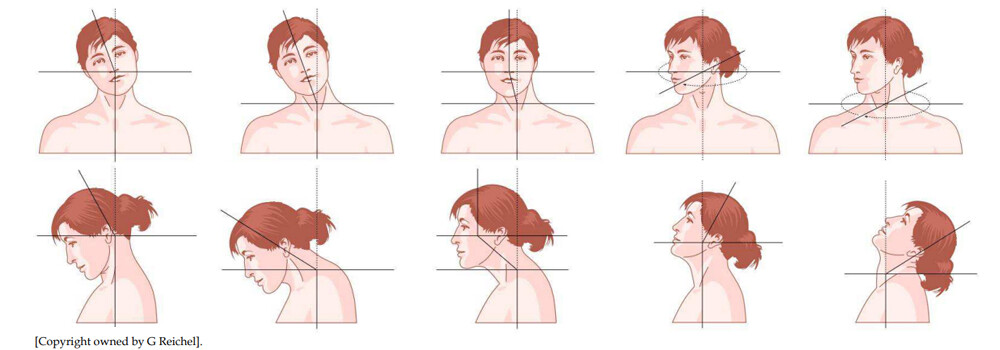
The most common pattern is that the chin turns towards one shoulder, but the head may also tilt to the side or bend forwards and backwards, and the patterns may combine. Neck pain, pain radiating into the shoulder, head tremor and tension headaches are common accompanying symptoms. A characteristic feature that greatly helps recognition is the so-called sensory trick (geste antagoniste): if the person gently touches their face or places a finger under their chin, the forced posture temporarily eases. Symptoms worsen with stress and tiredness and ease with rest.
The condition typically develops slowly over several months, reaches its characteristic severity within a few years, and then usually remains stable. Without treatment, persistent forced posture may lead to chronic pain, faster wear of the cervical spine and restrictions in everyday activities such as driving, work and social life. So you should not simply “live with it”; it should be treated. With today’s options, meaningful relief can be achieved for most symptoms.
 How is cervical dystonia treated?
Botulinum treatment – the first choice. Targeted botulinum toxin injections into overactive muscles are the first-line treatment for cervical dystonia according to international recommendations: research shows that they meaningfully improve head posture and reduce pain.1 The effect is temporary, so treatment usually needs to be repeated every 3–4 months. A neurologist provides it – if your symptoms sound familiar, this is your first port of call.
Medicines. Muscle relaxants and medicines that reduce faulty nerve–muscle signalling may be considered as an adjunct – adjusting these medicines is also the neurologist’s responsibility.
Physiotherapy and therapeutic exercise – an important adjunct. Research suggests that movement therapy – stretching, posture exercises and EMG biofeedback – added to botulinum treatment may further improve head posture, pain and everyday function.2 This includes gentle methods that can also be used at home: heat treatment and massage may help release muscle tension, therapeutic ultrasound and microcurrent treatment may help treat painful, tight muscle areas, while muscle stimulation can exercise weaker muscles on the opposite side – always in consultation with your treating physiotherapist.
Surgical options. In severe cases that do not respond to treatment, deep brain stimulation (DBS) or – as a last resort – nerve section may be considered. These decisions are made by specialist centres; most patients do not need them.
 My advice
Use the sensory trick deliberately: notice which touch eases the forced posture and use it in demanding situations – in the car, at work or in company. And because symptoms worsen with stress, stress management here is not wellness, but part of treatment: the steps described in my article about persistent stress – exercise, relaxation and regularising sleep – may also help dystonia-related complaints.
 Infantile torticollis – time is the key factor
With infantile muscular torticollis, the sternocleidomastoid muscle (the muscle running from behind the ear to the collarbone) becomes shortened on one side – often after a difficult birth or a forced position in the womb. The signs are that the baby’s head always tilts or turns to the same side, looks with difficulty in the opposite direction, and sometimes a small, pea- or hazelnut-sized lump can be felt in the muscle.
The good news is that, according to the international physiotherapy guideline, treatment started early – ideally in the first months – (stretching, positioning, supervised tummy time while awake, and rearranging the surroundings so the baby turns towards the “less favoured” direction) leads to complete resolution in the overwhelming majority of cases, without surgery.3 The bad news is that the later it starts, the longer treatment takes and the greater the chance of residual symptoms – skull asymmetry and persistent postural deviation. So if you see these signs in your baby, do not wait for them to “grow out of it”: arrange a paediatric assessment and physiotherapy referral as soon as possible.
Home device – strictly as an adjunct
SonicRelief – therapeutic ultrasound
In adult forms – acute muscular torticollis and the painful, tense muscle areas associated with cervical dystonia – the micromassage effect of therapeutic ultrasound may help improve local circulation and release muscle tension. Use it with gel, in slow circular movements, for a few minutes a day. I consider it important to say this clearly: no home device treats cervical dystonia. The device may be used alongside neurological treatment and physiotherapy to ease painful muscle tension. A home device must not be used on an infant.
 Before starting home treatment
- Torticollis in infants and young children – treatment with a home device must not be used; treatment is the responsibility of a paediatric physiotherapist
- Uninvestigated forced posture of unknown cause – obtain a medical diagnosis before any home treatment
- The front of the neck and the area of the carotid arteries – neither an ultrasound head nor an electrode may be placed here
- Pacemaker or other implanted electronic device – electrotherapy must not be used
- Cancer, inflammation or skin injury in the treatment area – local treatment is prohibited
 When should you see a doctor immediately?
If neck stiffness is accompanied by fever, headache or nausea (possible meningitis); if the tilted neck posture appears after an injury or accident; if swallowing or breathing difficulties occur; if arm numbness or weakness is present; or if your child suddenly develops a painful forced posture – these are not situations for home treatment.
Frequently asked questions
Literally, yes – this is acute torticollis – but there is no reason to worry: with rest, warmth and pain relief if needed, this form settles on its own within a few days. If it lasts for more than a week, keeps returning or is accompanied by numbness, see a doctor.
Usually not – temporary improvement occurs in a small proportion of cases, but in most patients the symptoms persist without treatment. The good news is that treatment with botulinum injections and physiotherapy can provide meaningful, lasting relief for most complaints. The aim is not resignation, but well-adjusted treatment.
Overall, research shows that it is well tolerated. The most common side effects are temporary: neck muscle weakness, difficulty swallowing and tiredness. These usually settle on their own as the effect wears off. An experienced neurologist provides the treatment and adjusts the dose and injection sites to your muscles.1
Arrange a paediatric assessment as soon as possible – do not wait for the baby to “grow out of it”. If it is muscular torticollis, physiotherapy started early leads to complete resolution in the overwhelming majority of cases. At home in the meantime: provide plenty of tummy time while the baby is awake and supervised, and arrange the cot and toys so the baby turns towards the “less favoured” direction.
Not with the cause of the condition – faulty brain movement control – but they may help with its consequences: massage, heat and ultrasound may ease painful muscle tension, while physiotherapy may improve posture. In other words, these are adjuncts alongside neurological treatment, not alternatives to it. If someone promises a miracle device for your dystonia, look elsewhere.
Susceptibility can be inherited: some patients have an identifiable gene mutation or family clustering, and research suggests a combination of hereditary and environmental factors. This does not mean certainty, however – a family history is not a prediction, only a reason to stay alert.
 What does the research say?
“Is an injection really the most I can receive for cervical dystonia?”
At present, yes – and that is significant. According to the most rigorous scientific review, even a single botulinum treatment produces clinically noticeable improvement in head posture and pain in a significant proportion of patients, and the treatment is well tolerated. The most common side effects – temporary neck weakness and difficulty swallowing – resolve on their own.1 This is why it is the first choice in international recommendations.
“What can physiotherapy and therapeutic exercise add?”
Studies suggest that movement therapy – stretching, posture exercises, biofeedback and electrotherapy as an adjunct – added to botulinum treatment may further improve head posture, pain and everyday function. The researchers add that the quality of the studies is mixed, so physiotherapy should be used as an adjunct, not as a standalone treatment.2 This is exactly how I recommend it: injection plus physiotherapy.
“How much does early treatment matter in infantile torticollis?”
A great deal – this is the most important lesson. According to the international professional guideline for physiotherapists, early conservative treatment (stretching, positioning and teaching parents) is the first choice and leads to complete resolution without surgery in the overwhelming majority of infants. Treatment started late takes longer and carries a greater risk of residual symptoms.3 So the rule is: if you suspect it, do not wait; arrange an assessment.
 Summary – Quick overview
Read more
Scientific sources
- Rodrigues FB, Duarte GS, Marques RE, et al. (2020). Botulinum toxin type A therapy for cervical dystonia. Cochrane Database of Systematic Reviews, 11(11), CD003633. DOI: 10.1002/14651858.CD003633.pub4
- De Pauw J, Van der Velden K, Meirte J, et al. (2014). The effectiveness of physiotherapy for cervical dystonia: a systematic literature review. Journal of Neurology, 261(10), 1857–1865. DOI: 10.1007/s00415-013-7220-8
- Sargent B, Coulter C, Cannoy J, Kaplan SL (2024). Physical Therapy Management of Congenital Muscular Torticollis: A 2024 Evidence-Based Clinical Practice Guideline From the American Physical Therapy Association Academy of Pediatric Physical Therapy. Pediatric Physical Therapy, 36(4), 370–421. DOI: 10.1097/PEP.0000000000001114