
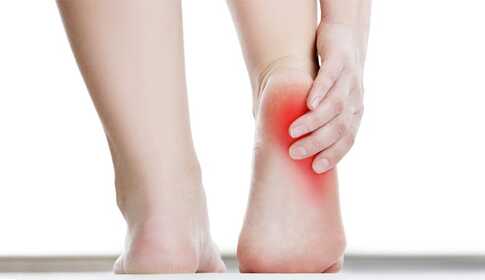

 Heel pain and heel spurs – what can acetic acid iontophoresis do, and what can’t it do?
If a sharp, “knife-stabbing” pain has been shooting through your heel every morning for months when you first stand on your foot, you are probably dealing with a heel spur or plantar fasciitis. You may find information claiming that “acetic acid iontophoresis dissolves heel spurs” – in this article, I will explain what you can expect from it, and what you cannot. You can read about how iontophoresis works in general in my article on iontophoresis.
 Key point
The phrase “dissolving the heel spur” is a marketing slogan and clinically inaccurate. The main effects of treatment are pain relief and reducing inflammation in the surrounding soft tissues – not removing the calcified bony outgrowth. According to recent research [1], iontophoresis combined with an anti-inflammatory medicine may provide meaningful pain relief within 6 weeks in plantar fasciitis (similarly to extracorporeal shockwave therapy). Treatment works best as part of a comprehensive package: stretching exercises, suitable insoles, weight control, and iontophoresis alongside these measures.
 What is a heel spur, and why does it hurt?
A “heel spur” (calcaneus spur, heel-bone spike) is a bony outgrowth on your heel bone, typically where the plantar fascia or Achilles tendon attaches. It is clearly visible on an X-ray – but it has an important secret: a heel spur often causes no pain at all. It is found incidentally in a significant proportion of adults and never causes them any symptoms.
So what causes the pain? Heel pain is almost always due to chronic plantar fasciitis – inflammation of soft tissue resulting from repeated micro-injuries to the plantar fascia and inflammation around its attachment to the heel bone. The heel spur is usually only an incidental X-ray finding, not the direct cause of the pain.
That is why precise wording matters: the main aim of acetic acid iontophoresis is not to “dissolve the heel spur”, but to reduce inflammation in the surrounding soft tissues and relieve pain. Related reading:
 How might acetic acid work on your heel?
According to research [5], acetic acid iontophoresis may ease your symptoms in three different ways. It is important to understand, however, that none of these is an instant miracle cure – the effect builds up over several weeks, and the method works reliably only as part of a combined physiotherapy package.
The theory is that, once acetic acid enters the tissue, it reacts with calcium deposits and converts them into calcium acetate, which is more soluble in body fluids. The reality is more nuanced: this process can be demonstrated under laboratory conditions, but in living human tissue it is difficult to measure, and there is no reliable evidence that it removes the visible bony outgrowth of your heel spur. Research [4] suggests that most relevant studies have methodological limitations. In other words: do not expect your X-ray to be “clear” after treatment – the pain may ease, but the calcification will usually remain.
The treatment’s genuine, measurable effect most likely does not depend on dissolving the calcification, but on reducing inflammation in the soft tissues around your painful heel. According to a recent review [5], acetic acid iontophoresis may be an effective part of a comprehensive physiotherapy package for heel pain and plantar fasciitis (combined with stretching exercises, insoles and changing to suitable sports footwear). Research from 2025 [6] found that adding physiotherapy (exercises + iontophoresis) provides meaningful improvement and favourable cost-effectiveness compared with usual specialist care.
A recent clinical trial [1] in plantar fasciitis compared extracorporeal shockwave therapy with iontophoresis using a local anaesthetic (lidocaine) and anti-inflammatory medicine (dexamethasone) instead of acetic acid. Complete pain relief was achieved in both groups – within 3 weeks with shockwave therapy and 6 weeks with iontophoresis. This suggests that, for heel pain, iontophoresis may be most effective when it is used not with acetic acid alone, but after medical consultation and combined with a locally acting anti-inflammatory medicine.
 Which symptoms might acetic acid iontophoresis help with?
Find your symptoms in the list below. In each section, you will see what you may expect from treatment and what you should NOT expect.
If a sharp pain shoots through your heel with your first step in the morning and the problem has continued for weeks or months, it is probably caused by a heel spur or plantar fasciitis. According to recent research [1], iontophoresis combined with an anti-inflammatory medicine may provide meaningful improvement within 6 weeks (similarly to shockwave therapy). Research from 2025 [6] suggests that physiotherapy (exercises + iontophoresis) is a useful addition to standard specialist care. What is important to know: iontophoresis alone rarely provides lasting results – an effective package includes stretching exercises, insoles and suitable footwear, along with weight loss if you are overweight. Clarifying the cause of the symptoms is a medical task.
If a calcium deposit in your shoulder joint is causing pain (shown on an X-ray or ultrasound), acetic acid iontophoresis should be considered cautiously. According to recent research [3][4], the evidence is low quality, and studies have not shown a convincing benefit over placebo. One rare case [2] documented a significant reduction in calcium deposits after a longer course of treatment. What is important to know: the usual treatments for calcific shoulder tendinopathy are shockwave therapy, ultrasound-guided aspiration and corticosteroid injection – these are supported by considerably stronger evidence. Discuss the appropriate next step in your case with your treating doctor.
If you feel persistent pulling pain above your heel along the Achilles tendon, or calcification has been found in your ankle, acetic acid iontophoresis may be considered as an adjunct [5]. What is important to know: the evidence is limited here too, and you should always start treatment after a medical diagnosis. Achilles pain may be caused by a partial or complete tendon tear – this must be ruled out by a doctor before you begin electrical treatment.
Acetic acid iontophoresis was also used in the past for other calcified soft-tissue lesions (such as calcium deposits in muscle or calcification of the cervical vertebrae). What is important to know: there is no recent, reliable clinical evidence for these symptoms. Do not experiment with home iontophoresis for a complex bone lesion – these conditions require appropriate specialist orthopaedic care. The method is not suitable for healing a fracture, treating fresh calcification or managing a complex orthopaedic problem.
What does a course of acetic acid iontophoresis involve?
If you have decided to try it – naturally, after consulting a doctor – a typical course looks like this:
| Parameter | Typical value | What does it mean for you? |
|---|---|---|
| Acetic acid concentration | 2–5% | A higher concentration may irritate the skin – follow medical advice |
| Which electrode should it go under? | under the negative (–) electrode | Acetic acid is negatively charged, so it enters the skin from the cathode |
| Current intensity | 1–5 mA | Pleasant tingling and mild warmth – reduce it if the sensation is painful |
| Duration of one treatment | 15–20 minutes | You can do it while watching television or reading |
| Times per week | 3 sessions | Every other day during the week |
| Course length | 4–6 weeks | Patience is needed – meaningful relief appears towards weeks 4–6 |
| Where should you place the electrodes? | the acetic-acid electrode (negative) above your heel, the other on the opposite side | The current flows between the two, passing through the painful area |
| What should you combine it with? | stretching, insoles, therapeutic exercise | Iontophoresis is rarely enough ON ITS OWN – it is part of the package |
Important – acetic acid alone or an anti-inflammatory?
According to recent research [1], for heel pain treatment with acetic acid alone is not the most effective option; it may work better when an anti-inflammatory medicine (such as dexamethasone) is also added to the solution. Selecting the appropriate active ingredient is a medical task – your doctor or pharmacist can help you decide.
 What should you NOT expect from acetic acid iontophoresis?
To avoid disappointment, it is important to have realistic expectations:
- The heel spur will not “disappear” from your X-ray. The pain may ease, but the bony outgrowth will usually remain. Do not be misled by promises that guarantee to “dissolve” calcification.
- It is not the first choice for calcific shoulder pain. Recent reviews [3][4] indicate that evidence for iontophoresis in shoulder calcification is weak. Shockwave therapy and ultrasound-guided aspiration have considerably stronger evidence.
- Do not expect rapid results. Meaningful improvement comes after 4–6 weeks of regular treatment. Claims such as “two treatments and all the pain is gone” are unrealistic.
- It does not replace comprehensive treatment on its own. Stretching exercises, suitable insoles, sports footwear and, where needed, weight control matter at least as much as iontophoresis itself.
- It does not heal fractures or tendon tears. These require specialist surgical care – do not experiment with home treatment for such symptoms.
- It does not affect diabetes, high blood pressure or systemic disease. These conditions require medical treatment.
Which device can be used for this treatment at home?
It is important to know that not every TENS device can be used for iontophoresis – a special direct-current (DC) mode is required. The following devices in the Medimarket range are suitable:
- IontoBravo – a specialised device designed specifically for iontophoresis to treat hyperhidrosis and local pain.
- Globus Genesy 3000 – a 4-channel multifunctional device with TENS, EMS, microcurrent and iontophoresis programmes.
The full iontophoresis product category is available here. The active ingredient and protocol details must always be discussed with your treating doctor or physiotherapist.
 When should you NOT start acetic acid iontophoresis at home?
General electrotherapy contraindications also apply here. Details are provided in the articles on electrotherapy contraindications and electrotherapy and implants.
- You have a pacemaker, ICD or implanted nerve stimulator – only with permission from a cardiologist / electrophysiologist.
- You are pregnant – avoid it as a safety precaution.
- There is a tumour in the area to be treated – it must not be treated.
- You are allergic to acetic acid or your skin is sensitive – it is advisable to test it on a small area before use.
- You have a fresh wound, eczema or skin infection on your heel – wait until it has healed; corrosive acetic acid may cause irritation.
- You cannot feel heat or cold on the affected skin – safe adjustment is difficult.
- You have a metal implant (screw, plate) in your heel – there is a risk of electrical heating.
- Your heel is hot, red, swollen or associated with fever – an acute infectious inflammation may be present; urgent medical examination is needed.
- You have new, worsening or unexplained heel pain – medical diagnosis comes first (to rule out a stress fracture, nerve compression or tumour).
- You have a blood clot (DVT) in your leg – prohibited because of the risk of embolisation.
For new, worsening or unexplained heel pain, always see a doctor first, and only then consider iontophoresis.
Frequently asked questions about acetic acid iontophoresis
That is not expected. Recent research [1][3][4] indicates that the main effect of treatment is pain relief – not visible removal of the calcified bony outgrowth. One rare documented case [2] recorded a reduction in a calcific shoulder deposit in one patient, but this does not support a general expectation. “Dissolving the heel spur” is more of a marketing slogan than a clinical reality.
According to recent research, meaningful improvement appears after 3–6 weeks of regular treatment. In plantar fasciitis [1], the treated group achieved complete pain relief by week 6. Meaningful change is not expected after 1–2 treatments – patience is needed.
The theoretical aim of acetic acid is to dissolve calcium deposits. The aim of dexamethasone (an anti-inflammatory medicine) iontophoresis, however, is directly to reduce inflammation in the painful area. According to recent research [1], the anti-inflammatory combination was more effective for heel pain than acetic acid alone. The choice depends on the particular symptoms and your treating doctor’s assessment. Both active ingredients enter from the negative electrode.
It does not replace them; it is an adjunct. If your treating doctor recommends surgery or an injection because of heel-spur pain, iontophoresis is not an alternative – at most, it may be used as an adjunct to rehabilitation after surgery. The treatment strategy must always be determined during a medical consultation.
Always use it as part of a combination. Recent research [5][6] suggests that acetic acid iontophoresis is most effective when it forms part of a comprehensive package: stretching exercises (for the Achilles tendon and plantar fascia), suitable insoles, sports footwear, weight control and, in some cases, shockwave therapy. Home iontophoresis has limited effects on its own.
Only with permission from a cardiologist / electrophysiologist. Any electrical treatment near active implants (pacemaker, ICD, nerve stimulator) may cause interference. Details are provided in the article on electrotherapy and implants.
 Summary – acetic acid iontophoresis in brief
What do you need to know as a patient?
- The main effects of acetic acid iontophoresis are pain relief and reducing inflammation in the surrounding soft tissues – NOT “dissolving the heel spur”.
- It may help most with: plantar fasciitis and heel pain [1] – especially when combined with an anti-inflammatory medicine.
- Recent evidence is weak for calcific shoulder pain [3][4] – other treatments there (shockwave therapy, ultrasound-guided aspiration) have stronger evidence.
- The effect appears after 4–6 weeks – patience is needed.
- The method works best as part of a combined package: stretching, insoles, changing footwear and weight control.
- Typical course: 2–5% acetic acid, 1–5 mA, 15–20 minutes, 3 times per week, for 4–6 weeks.
- Home devices: IontoBravo (specialised), Globus Genesy 3000 (multifunctional).
- Contraindications (pacemaker, pregnancy, tumour, acetic acid sensitivity, fresh skin wound, acute fever) must be followed strictly.
- For new, worsening or unexplained heel pain, obtain a medical diagnosis first.
Scientific sources (2016+)
-
Pabón-Carrasco M, Coheña-Jiménez M, Pérez-Belloso AJ, Algaba-Del-Castillo J, Cáceres-Matos R, Castro-Méndez A.
Comparison of the Short-Term Effect between Iontophoresis and Radial Extracorporeal Shockwave Therapy in the Treatment of Plantar Fasciitis: A Randomized Controlled Trial.
Healthcare (Basel).
2024;12(12):1223.
PMID: 38921337.
Brief summary: Double-blind RCT involving 127 people with plantar fasciitis – lidocaine + dexamethasone iontophoresis versus radial shockwave therapy; both groups achieved complete pain relief by week 6 (measured with VAS and functional scales). -
Medina-Gandionco M, Briggs RA.
Calcific Tendinopathy of the Rotator Cuff Treated With Acetic Acid Iontophoresis.
Journal of Orthopaedic and Sports Physical Therapy.
2020;50(11):650.
PMID: 33131395.
Brief summary: Case report – significant radiological resorption after 5 weeks of acetic acid iontophoresis (3 sessions per week) in a 62-year-old man with rotator-cuff calcification. -
Page MJ, Green S, Mrocki MA, Surace SJ, Deitch J, McBain B, Lyttle N, Buchbinder R.
Electrotherapy modalities for rotator cuff disease.
Cochrane Database of Systematic Reviews.
2016;2016(6):CD012225.
PMID: 27283591.
Brief summary: Cochrane systematic review – in one small study, acetic acid iontophoresis for calcific shoulder tendinopathy showed no clinically relevant benefit over placebo (low-quality evidence). -
Simpson M, Pizzari T, Cook T, Wildman S, Lewis J.
Effectiveness of non-surgical interventions for rotator cuff calcific tendinopathy: A systematic review.
Journal of Rehabilitation Medicine.
2020;52(10):jrm00119.
PMID: 32830280.
Brief summary: Systematic review – iontophoresis studies in calcific shoulder tendinopathy have a high risk of bias; no reliable clinical conclusion can be drawn. -
Hashmi Y, Zhou AK, Jawaid A, Zhou AY, Shah V, Thahir A, Krkovic M.
The role of acetic acid in orthopaedic surgery.
Journal of Perioperative Practice.
2022;32(6):162-166.
PMID: 34310234.
Brief summary: Orthopaedic review – the mechanism of action of acetic acid iontophoresis (the calcium-acetate conversion hypothesis and inflammation modulation), and clinical use for Achilles and heel pain. -
McClinton SM, Heiderscheit BC, Flynn TW, Pinto D.
Cost-Effectiveness of Physical Therapist Treatment in Addition to Usual Podiatry Management of Plantar Heel Pain: Economic Evaluation of a Randomized Clinical Trial.
Physical Therapy.
2025;105(11):pzaf119.
PMID: 41042252.
Brief summary: Cost-effectiveness analysis of a 95-person plantar heel pain RCT – podiatry care plus physiotherapy (exercise, foot taping, iontophoresis) produced a 0.09 QALY improvement and USD 2,708 in cost savings compared with standard care.

This article is for general information and does not replace a personal medical consultation. Diagnosing heel pain and heel spurs, and determining the treatment plan, are medical tasks. Acetic acid iontophoresis is an adjunctive treatment; it does not replace a comprehensive physiotherapy package (stretching, insoles, exercises), basic medical treatment or surgery when this is indicated. Follow the contraindications (pacemaker, pregnancy, tumour, allergy, fresh skin wound, acute fever) strictly. The devices presented are CE-certified medical devices; the clinical studies cited used different devices and protocols. Results may vary from person to person. For new, worsening or unexplained heel pain, consult your treating doctor or physiotherapist.

