 EXCLUSIVELY FOR HEALTHCARE PROFESSIONAL PURCHASE
The Ami Pro is NOT for sale to private individuals. The device may only be supplied to medical businesses, physiotherapists, speech therapists, neurorehabilitation therapists, specialist clinics or hospitals. Electrical therapy for dysphagia must be performed under the supervision of the attending physician, using the methods and programs instructed by them. Home use is permitted only on a physician's order and under guidance, following a protocol set by a professional.
Overview of manufacturer indications
According to the manufacturer's user manual, the Ami Pro is indicated for treatments performed on the anterior neck and face: to prevent swallowing atrophy and to rehabilitate muscles involved in swallowing for dysphagia of any etiology, except mechanical causes that may require surgery (for example obstructive tumors). The following major etiological groups are included in the manufacturer's indications:
The clinical professional decides, based on the patient’s condition, stroke type (ischemic or hemorrhagic), neurological status and clinical swallow assessment, which NMES protocol stage is appropriate. Part of complex rehabilitation (speech therapist, physiotherapist, neurologist).
Rehabilitation of dysphagia due to tissue changes from radiotherapy (fibrosis, stenosis). IMPORTANT: in the presence of mechanical obstructive causes (residual tumor) NMES CANNOT be used — structural intervention (surgery, endoscopy) is primary. The clinician must assess structural stability before starting NMES protocols.
A general category in the manufacturer’s indications covering neurological or musculoskeletal conditions affecting the swallowing muscles. Specific diagnosis and protocol selection are within the competence of the treating neurologist, speech therapist or rehabilitation physician. Depending on disease stage, NMES may be indicated in certain phases — the clinician decides whether treatment is warranted for the individual patient.
Rehabilitation of swallowing disorders following prolonged ICU care (intubation, tracheostomy) or anoxic brain injury. Usable in hospital rehabilitation wards and subacute neurorehabilitation centers with protocols matching the patient’s clinical status.
States following severe cardiovascular or cerebrovascular events (besides stroke) that may be associated with swallowing complications. Can be initiated after clinical assessment by the treating physician — patient cardiovascular stability must be confirmed.
Respiratory diseases where impaired breathing–swallowing coordination leads to swallowing complications. NMES protocols can be combined with respiratory rehabilitation — to be used in a multidisciplinary team with pulmonology and speech therapy.
Dysphagia resulting from medical interventions (anesthesia, surgery, medication-related), treatable according to the patient’s condition. Applicable as part of hospital postoperative rehabilitation protocols — indication assessment is the treating physician’s responsibility.
Rehabilitation of swallowing after birth-related neurological conditions and head or neck trauma. Pediatric use only in specialized pediatric neurorehabilitation centers under the supervision of a pediatrician or pediatric speech therapist. Adult head–neck trauma rehabilitation per the applicable clinical protocol.
Note: the above list is based on the manufacturer's user manual and product documentation. Determination of specific indications, selection of the appropriate protocol and application are always the responsibility of the treating professional (treating physician, physiotherapist, speech therapist, neurorehabilitation therapist) — taking into account the patient’s individual condition, exclusion of contraindications and the clinical diagnosis.
Ami Pro program groups in detail
3 programs with fixed parameters — parameters cannot be changed. Beginner-level application to initiate basic NMES-like muscle stimulation. When starting a new protocol it is advisable to begin with these and progress to Dysphagia 2 or Adjustable programs according to patient tolerance.
36 programs with fixed and non-adjustable parameters, divided into DIFFERENT types of work cycles (work/rest ratios). Allows selection of the work cycle appropriate to the patient’s condition — e.g., gentle 1:5 or more intensive 1:2 or 1:3 ratios. Useful for managing muscle fatigue and progressive loading.
5 dedicated Action Now programs. Muscle contraction only starts when the user (therapist or patient) holds down the dedicated button. This synchronizes NMES with VOLUNTARY swallowing attempts — effectively creating a biofeedback system. Considered one of the most effective methods for motor relearning (neuroplasticity). Highly valuable in stroke rehab and complex motor learning tasks.
36 adjustable-parameter programs — giving experienced professionals full control:
- Work cycle: free setting of work/rest ratio.
- Treatment duration: selectable 30, 45 or 60 minutes.
- Pulse width: freely between 80–260 μs.
- Frequency: freely between 1–80 Hz.
- Total duration: overall treatment length.
Suitable for precise reproduction of specialized clinical protocols (research, evidence-based literature methods). RECOMMENDED ONLY for experienced NMES professionals — avoid for novice users.
20 dedicated facial rehabilitation programs, in three subcategories:
- Standard: basic mimetic muscle stimulation per manufacturer facial indications.
- Advanced: deeper stimulation for advanced, practiced protocols.
- Action Now: biofeedback-like, synchronized with voluntary attempts for conditioning motor relearning.
Facial programs are tailored to facial rehabilitation needs. Specific indication and protocol selection are the responsibility of the treating professional (physiotherapist, speech therapist, neurologist).
Frequently asked professional questions
NO. Due to clinical parameters (e.g., anatomically precise butterfly electrode placement, appropriate intensity and program selection) and the need for patient monitoring, the Ami Pro is SOLD ONLY to healthcare professionals: medical businesses, physiotherapists, speech therapists, neurorehabilitation therapists, specialist clinics, hospitals. Proof of professional healthcare status is required for purchase.
Home use is allowed only on the treating physician’s instruction and according to a protocol set by a professional — the patient or caregiver may only start the trained, fixed-parameter programs.
NO. Ami Pro is ONLY applicable for functional (motor, sensorimotor, sensory) dysphagia. Mechanical obstructive causes — not surgically removed tumors, severe structures, foreign bodies, etc. — are CONTRAINDICATIONS. These require structural treatment (surgery, endoscopic intervention) first. Functional rehabilitation may begin only AFTER obstruction removal.
"Action Now" synchronizes NMES stimulation with the patient’s VOLUNTARY swallowing attempt. Clinically this is important because:
- Motor learning (neuroplasticity): new motor patterns are conditioned most effectively when voluntary attempt and afferent feedback (NMES-induced muscle contraction) COINCIDE in time.
- Active patient involvement: unlike passive NMES, the patient PARTICIPATES consciously in rehabilitation.
- Clinical studies: synchronized stimulation protocols have shown better functional outcomes than passive NMES in some trials.
Action Now is especially key in post-stroke dysphagia.
NO. Ami Pro NMES is a COMPLEMENT to classic dysphagia rehabilitation — never a replacement. Clinical protocols recommend a combined approach:
- Classic speech therapy exercises: Shaker, Mendelsohn maneuver, effortful swallow, McNeill MDTP, tongue-base maneuvers.
- Feeding modification: texture adaptation (IDDSI), positioning, assistive devices.
- NMES adjunct: used ALONGSIDE these with gradual progression.
The combined multidisciplinary approach is the accepted foundation of dysphagia rehabilitation in clinical practice — NMES is an adjunct within a multidisciplinary care plan.
The butterfly geometry adapts to the surface anatomy of the suprahyoid and infrahyoid neck muscle groups. The position and orientation of subcutaneous neck muscles are specific — classic square or rectangular pads do not cover them adequately. The butterfly shape:
- Covers both the zones above and below the hyoid bone simultaneously.
- Reduces overlap risk with airways and major vessels.
- Supports electrode placement according to clinical protocols.
Use of the original Globus butterfly electrode is recommended — other electrode types are NOT advised for clinical protocols.
Typical hospital integration of Ami Pro:
- Multidisciplinary team: neurologist + speech therapist + physiotherapist + nursing staff collaboration.
- Assessment: clinical swallow assessment + FEES or VFSS to inform program choice.
- Protocol selection: Dysphagia 1/2/3 or Adjustable program appropriate to patient status.
- Daily treatment: typically 30–45 minutes, 1–2 times daily.
- Combined with classic speech therapy exercises: immediately before or after NMES.
- Outcome assessment: weekly or biweekly clinical swallow assessments.
- Documentation: record all protocol parameters and patient tolerance for each treatment.
Yes, it is particularly recommended for private speech therapy practices, neurorehabilitation centers and physiotherapy practices that provide clinical dysphagia care. The 100 programs and Action Now function cover complex rehabilitation needs. Typical patient groups align with the manufacturer’s indications: post-stroke, post head–neck trauma or post-radiation fibrosis, and patients with neurological or musculoskeletal disorders.
Proof of professional healthcare status (speech therapy/physiotherapy diploma, operating license) is required to purchase.
Clinical workflow – step by step
1
Patient assessment and diagnosis clarification
Before starting an NMES protocol it is always necessary to determine the etiology of dysphagia (clinical assessment, FEES/VFSS – fiberoptic or videofluoroscopic swallow study, etc.). Exclusion of obstructive (tumor, structural) causes is mandatory. Assessment of motor–sensorial function determines which program category (Dysphagia 1/2/3, Adjustable) is appropriate.
2
Device preparation (mains power)
The Ami Pro operates from a 220 V mains adapter — it is not battery-powered and is optimized for clinical use. Connect the mains adapter. Attach the cables to the appropriate channels (1–4).
3
Placement of butterfly electrodes on the neck/face
The butterfly electrode geometry is adapted to the suprahyoid and infrahyoid muscle groups. Exact placement depends on the chosen protocol and the patient’s neck anatomy — it is the treating professional’s responsibility. Prior skin cleansing (degreasing) is mandatory for appropriate conductivity.
4
Program selection
Choose the appropriate program from the 100 options based on the patient’s condition and clinical goal:
- Dysphagia 1 (3 programs, fixed parameters): beginner-level protocols.
- Dysphagia 2 (36 programs): work-cycle variations with fixed parameters.
- Dysphagia 3 (5 programs, Action Now): biofeedback-like, synchronized with voluntary attempts.
- Adjustable (36 programs): full parameter control for professionals (work cycle, treatment duration 30/45/60 minutes, pulse width, frequency).
- Facial treatment (20 programs): for facial rehabilitation.
5
Gentle intensity setting (max 20 mA)
The Ami Pro intensity range is 0–20 mA — specifically for gentle neck stimulation. Increase intensity GRADUALLY according to patient feedback. The appropriate level is a perceptible but NOT painful muscle contraction. For bilateral protocols, symmetric adjustment of the 4 channels is important.
6
Using the "Action Now" feature (motor learning)
In Dysphagia 3 or facial Action Now programs stimulation only starts while the user (therapist or patient) holds down the dedicated button. This allows synchronization of stimulation with the patient’s VOLUNTARY swallowing attempt — a basis for conditioning motor relearning (neuroplasticity). According to clinical protocols, coordinating a patient-initiated attempt with stimulation can be particularly beneficial for rehabilitation.
7
Combine with classic speech therapy exercises
NMES is an ADJUNCT — it does not replace classic dysphagia therapy:
- Shaker exercise: isometric/isotonic head-lift protocol.
- Mendelsohn maneuver
- Effortful swallow: forceful, focused swallow.
- McNeill Dysphagia Therapy Program (MDTP): intensive targeted regimen.
- Therapy positioning, feeding modification: patient safety basics.
The combined approach is the basis of comprehensive dysphagia care in clinical practice — NMES should be used as one element of a broader rehabilitation program, not alone.
8
Monitoring, documentation, outcome assessment
All treatments must be documented (program, parameters, treatment time, patient tolerance) according to clinical protocol. Weekly or biweekly outcome assessment (clinical swallow assessment, sometimes FEES/VFSS) is required to maintain or modify the protocol. The patient pathway should be up to date for each planned rehabilitation day.
What’s included in the package?
The Ami Pro is a complete clinical package — all accessories needed for immediate integration into a clinical environment.
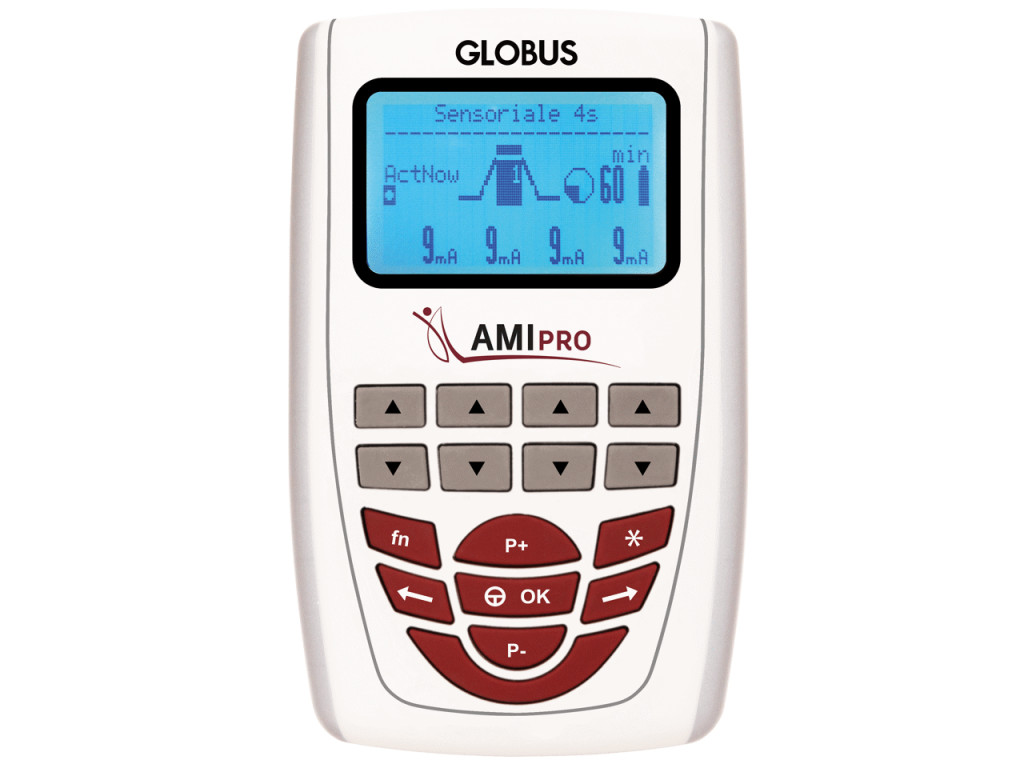
- 1 pc Ami Pro neuromuscular electrostimulator (NMES, 1–4 channels)
- 4 pcs stimulation cables
- 4 pcs butterfly-shaped electrodes (designed for neck anatomy)
- 1 pc 220 V mains adapter
- 1 pc carrying bag
- 1 pc user manual (with clinical protocol descriptions)
In clinical settings, maintenance of butterfly electrodes is critical to prevent cross-infection between patients:
- One patient / dedicated electrode set: per clinical protocol it is recommended to assign a dedicated electrode set to each patient.
- Cleaning after each use: with the prescribed disinfectant (alcohol-based or a specific medical device cleaner, per manufacturer instructions).
- Storage: in a dry, contamination-free environment.
- Replacement timing: when adhesive performance degrades or electrode surface is damaged.
- Spare butterfly electrodes: available separately through the clinical ordering portal.
To fully integrate Ami Pro into a clinical environment the following accessories can be ordered:
- Spare butterfly electrode sets: in 4-piece packs.
- Replacement stimulation cables: in 4-piece sets.
- Replacement mains adapter: for spare clinical power supply.
- Clinical countertop stand: for specialist clinics.
Technical specifications – in detail
| Property | Value | Clinical relevance |
|---|---|---|
| Type | NMES (neuromuscular electrostimulation) | Device specialized for dysphagia rehabilitation |
| Indication | Functional dysphagia rehabilitation | Excluding obstructive causes |
| Channels | 1–4 | Allows bilateral complex protocols |
| Number of programs | 100 (3 Dysphagia 1 + 36 Dysphagia 2 + 5 Dysphagia 3 + 36 Adjustable + 20 Facial Treatment) | Full clinical dysphagia spectrum |
| Action Now function | Yes (Dysphagia 3 + Facial Treatment Action Now) | Biofeedback synchronization with voluntary attempts |
| Electrode type | Butterfly-shaped (4 pcs in package) | Designed for suprahyoid/infrahyoid neck muscles |
| Current intensity | 0–20 mA | Gentle, neck-safe range |
| Frequency | 1–80 Hz | Full NMES protocol range |
| Pulse width | 80–260 μs | Covers clinical dysphagia protocol needs |
| Waveform | Rectangular, biphasic, symmetric, compensated | Even signal quality, no polarization |
| Treatment duration | 30, 45 or 60 minutes (in Adjustable programs) | Complies with clinical protocol standards |
| Display | 2.6" | Compact, practical for clinical settings |
| Power supply | 220 V mains adapter | Optimized for continuous clinical use |
| Dimensions | 100×160×35 mm | Compact, desktop-friendly |
| Weight | 450 g | Transportable in carrying bag |
| Certification | Class IIa medical device; CE (MDD 93/42/CEE-2007/47/CEE) | European conformity, medical device |
| Manufacturer | Globus Corporation (Italy) | Italian medical technology brand |
| Sales | Only to healthcare professionals | Proof of professional status required |
When NOT to use Ami Pro?
The Ami Pro is a Class IIa medical device. Due to electrical stimulation applied to the anterior neck, contraindications must be strictly observed. Screening of the patient regarding the following is the responsibility of the treating professional.
- Pacemaker, implanted defibrillator (ICD) or any implanted electronic device
- Obstructive (mechanical) dysphagia – mechanical causes that require surgery/endoscopic intervention (tumor, structure, foreign body)
- Active or suspected cancer in the treatment area (neck, face)
- Carotid atherosclerosis or carotid stenosis (neck arterial narrowing)
- Epilepsy or other seizure disorders (relative; specialist consultation required)
- Pregnancy (without treating physician’s approval)
- Acute inflammation, infection, fresh surgical scar or ulcerated skin lesion on the neck
- Severe cardiovascular disease (uncontrolled high blood pressure, recent myocardial infarction, severe heart failure)
- Bradycardia (low heart rate), pacemaker-dependent rhythm
- Unconscious or severely non-cooperative patient (especially for Action Now protocols)
- Implanted metallic implant in the neck or facial area (screws, plates, stents)
- Severe psychiatric disorders (acute psychosis, severe cognitive impairment)
- Independent home use by a private individual without healthcare supervision and training
Clinical responsibility: before each treatment the treating professional (physiotherapist, speech therapist, neurorehabilitation therapist, treating physician) is responsible for screening the patient and excluding contraindications. For detailed information see Dr. Zátrok Zsolt’s article on electrotherapy contraindications.
 Clinical usage notes
The Ami Pro is a CE-certified Class IIa medical device (according to MDD 93/42/EEC-2007/47/EC), specifically designed for clinical/institutional use. Not for sale to private individuals. Purchase requires proof of healthcare professional status.
Treating professional responsibilities: patient screening (exclusion of contraindications, clarification of dysphagia etiology, exclusion of mechanical obstruction), appropriate program selection, intensity adjustment, patient monitoring during treatment, and clinical documentation.
Home use: only on the treating physician’s instructions and with fixed-parameter programs set by them. The patient or caregiver may only start trained protocols — Adjustable programs are within professional competence only.
Multidisciplinary approach: NMES is a COMPLEMENT to classic speech therapy exercises and feeding modifications — never a replacement. Comprehensive multidisciplinary dysphagia rehabilitation is the basis of clinical protocols.
Aspiration risk: regular monitoring of dysphagia patients with FEES or VFSS is crucial to prevent aspiration pneumonia. With NMES protocols, modification of liquid feeding (IDDSI standards) is the treating physician’s responsibility.
The device must be used only with original Globus accessories. Documentation of every treatment is mandatory per clinical protocol.
The information on this page is intended for professional guidance and does not replace individual clinical protocols or patient-specific medical assessment. All applications are carried out under the clinical decision-making responsibility of the treating professional.