
 Why does your back hurt – and why does the type matter?
The bad news is that back pain tends to return, and many people drag it along for years with a “it will go away” attitude. This article is your starting point: it helps you identify which type of back pain you have, shows you what you can do at home – and guides you to a detailed guide tailored to your situation.
 Key idea
Most back pain is muscular in origin, and its most effective “medicine” is not lying down but movement: research shows that regular exercise and rebuilding the muscles that support the spine are what reduce pain in the long term. The first step is still to identify the type – because radiating pain, pain accompanied by numbness or sudden-onset pain calls for a different approach from the evening ache caused by sitting at a desk all day.
 Which type of back pain do you have?
Observe the pattern of the pain – where it occurs, when it appears and what accompanies it – then find the detailed guide in the third column of the table:
| What should you look out for? | Likely cause | Detailed guide |
|---|---|---|
| Dull back tension and aching that worsens by evening; associated with desk work and a hunched posture | Muscular back pain, poor posture – the most common form | This article + the tech-back guide → |
| Lower back pain radiating into the leg, with numbness and weakness | Herniated disc, nerve-root compression | Herniated disc – what can you do about it? → |
| Sudden lower back pain that “locks up” with movement – you can barely move | Lumbago (acute low back pain) | Lumbago – what to do in acute pain → |
| Sharp pain running from the buttock down the back of the thigh and calf | Sciatica (sciatic nerve pain) | Symptoms and treatment of sciatica → |
| Asymmetrical shoulders and hips, one-sided, recurring muscle tension | Scoliosis | Scoliosis, or curvature of the spine → |
| Back and shoulder tension returns during demanding, stressful periods | Stress-related muscle tension | Long-term stress and disease → |
| Pain over the age of 60 with osteoporosis; or pain at night or at rest, fever, weight loss, or symptoms after an injury | Suspected vertebral compression fracture, inflammation or another disease | Not for home treatment: medical assessment |
 Good to know
Rarely, back pain can also be caused by an internal organ problem – involving the kidneys, pancreas or heart. In such cases, the pain typically does not depend on movement or body position. If your back pain is just as strong at rest and at night, it deserves medical assessment.
 What can you do at home? Four ways to ease the pain
1. Move – this has the strongest evidence behind it. Scientific reviews agree: with chronic back pain, regular exercise measurably reduces pain and improves everyday functioning – more than rest, physical treatments or education alone.2 The type of exercise is not the decisive factor, but regularity: walking, swimming, cycling, exercise classes – choose something you will keep doing in the long term. Even with acute pain, the aim is gentle movement, not bed rest: prolonged lying down has been shown to slow recovery.
2. Rebuild the muscles that support your spine. Your trunk muscles provide spinal stability – with desk work, they weaken fastest, and this is the main cause of recurring back pain. There are two ways to work specifically on the back muscles: active exercises, taught by a physiotherapist, and, as an adjunct, muscle stimulation – more on this below.
3. Relax with a foam roller. An SMR roller is a simple and inexpensive tool for working through tight, knotted back muscles: you roll over the muscles using your own body weight, which improves local circulation and releases adhesions. Five to ten minutes a day is enough – avoid the bony part of the spinal column and work on the muscles.
4. Heat for tension, cold for fresh pain. With dull back pain caused by muscle tension, warmth, such as a heat pad or warm bath, helps the muscles relax; with fresh, acute pain, cooling is usually more helpful during the first few days. Anti-inflammatory creams may be considered as an adjunct.
Muscle stimulation – when you cannot reach the muscles yourself
If your back muscles are so weak that you cannot perform the exercises properly – or you simply cannot fit more active training into your day – muscle stimulation (EMS) works the muscles that support the spine passively: the 4-channel device treats the entire length of the back with 8 electrodes.
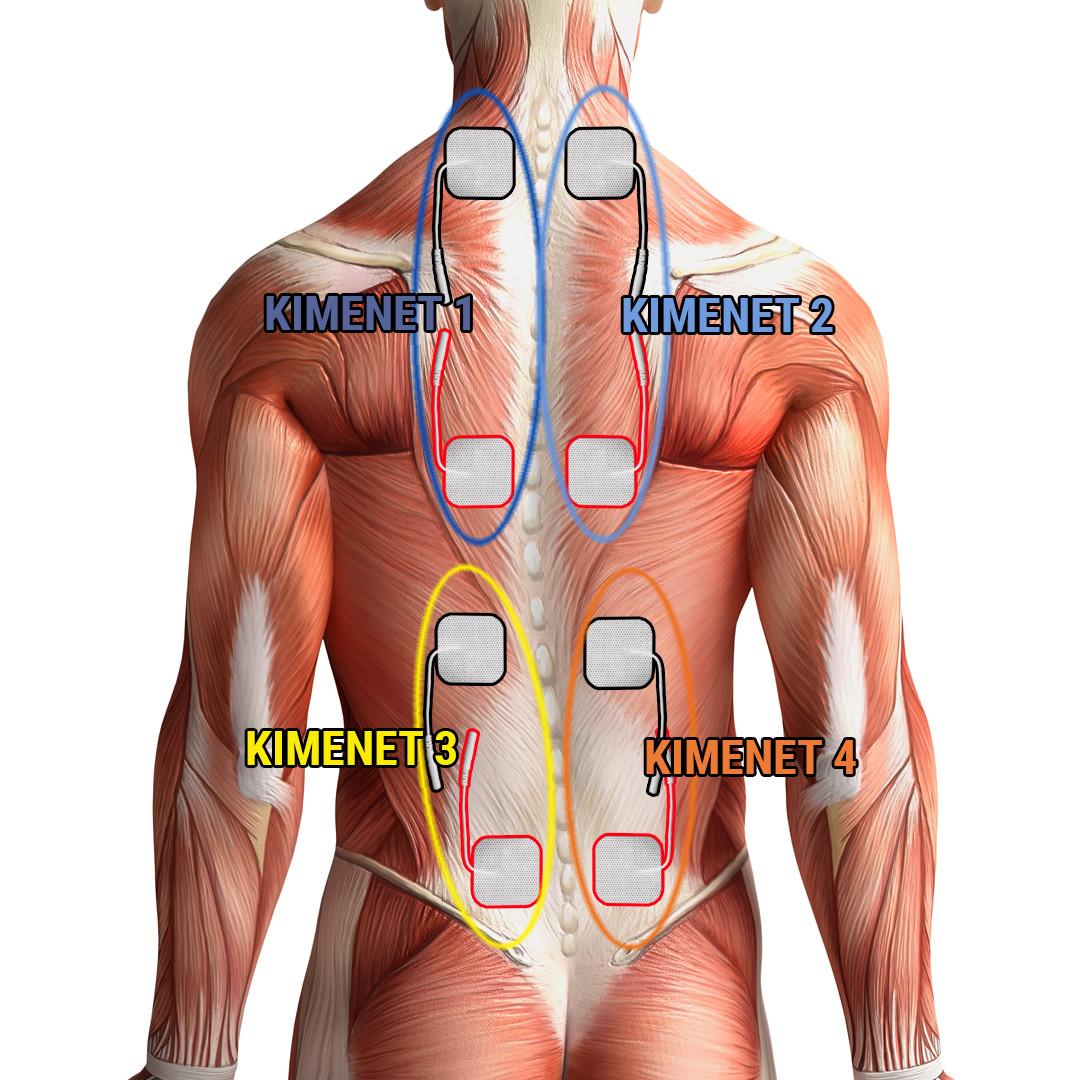
I have written the complete, step-by-step programme – with electrode positions, settings and a 12-week schedule – in a separate article: Back muscle strengthening with a 4-channel muscle stimulator →
Mambo Max Ergonomic foam roller
The simplest tool for daily muscle relaxation: its ergonomic design takes pressure off the bony part of the spine while working through the muscles alongside it. Start with this – it is a small investment that can be added to your daily routine straight away.
You will find a comparison of 4-channel muscle stimulators in the back muscle protocol article, while the full range is available in the muscle stimulator category and among the back pain treatment devices. And the usual honest statement: no device solves anything on its own – regular use and the movement you build around it are what make the difference.
 When should you see a doctor immediately?
If your back pain is accompanied by numbness or weakness in the leg, or loss of bladder or bowel control; if the pain is severe at night or at rest; if it is accompanied by fever or unintentional weight loss; if it started after a fall or accident; or if it recurs after the age of 60 in the presence of osteoporosis – these are signs that require medical assessment and are not suitable for home treatment.
Frequently asked questions
No – this is the most common mistake. Prolonged bed rest weakens the muscles and slows recovery. Even with acute pain, the aim is to stay mobile within the limits of the pain: take short walks and change position carefully. “Taking it easy” means avoiding overloading, not remaining motionless.
In most cases, no. With new back pain and no warning signs, imaging rarely changes what needs to be done – research shows that no single specific structural cause can be identified in the vast majority of cases of back pain. Imaging is needed in cases with red flags, or when radiating symptoms do not improve over several weeks – your doctor will decide.
It may help – roughly as much as any other form of spinal exercise done regularly. According to a scientific review, yoga is better than doing nothing and is broadly equivalent to targeted spinal exercises.3 In other words, it is not the name of the method that matters, but regularity: if yoga is the type of exercise you enjoy and will continue in the long term, it is a good choice – to begin with, work with a qualified instructor so that your technique is sound.
A medium-firm mattress – one that is too soft lets you sink in, while a rock-hard mattress creates pressure points. Your pillow should keep your neck in a neutral position. But do not expect miracles from your mattress: your bed can make the situation worse, but back pain is usually not caused by the mattress. It is caused by what happens during the day – sitting, posture and the condition of your muscles.
As an adjunct for pain relief: TENS may help you get through more painful days without medication, so that pain does not stop you from moving. The lasting solution, however, comes from rebuilding the muscles – so my order of priorities is: movement and back muscle work as the foundation, with electrotherapy alongside it. I have written about the methods in the TENS guide.
 What does the research say?
“Is it really this common, or am I just unlucky?”
You are not alone – not by a long way. According to the most comprehensive international analysis of back pain, it is the leading cause of reduced work capacity worldwide, and no single specific structural cause can be identified in the vast majority of cases. Recurrence is common – but the risk of persistent back pain that affects everyday life is raised most by lack of exercise, excess weight, smoking and long-term stress. In other words, these are all factors that can be changed.1
“What has been shown to reduce back pain?”
Movement. According to a scientific analysis summarising almost 250 studies, regular exercise substantially reduced chronic back pain, with a clinically meaningful effect, compared with no treatment or usual care – and it also performed better than education alone and physical treatments used on their own. There was no clear winner among the forms of exercise: regularity is what matters.2
“Is yoga better than ordinary spinal exercise?”
No – but it is not worse either. According to a scientific review of yoga, it produces a small improvement in back pain and physical function compared with doing nothing, but there is no meaningful difference compared with traditional spinal exercises. The choice therefore comes down to preference, availability and cost – whichever you choose, the key is long-term regularity.3
 Summary – Quick overview
Scientific sources
- Hartvigsen J, Hancock MJ, Kongsted A, et al. (2018). What low back pain is and why we need to pay attention. The Lancet, 391(10137), 2356–2367. DOI: 10.1016/S0140-6736(18)30480-X
- Hayden JA, Ellis J, Ogilvie R, Malmivaara A, van Tulder MW (2021). Exercise therapy for chronic low back pain. Cochrane Database of Systematic Reviews, 9(9), CD009790. DOI: 10.1002/14651858.CD009790.pub2
- Wieland LS, Skoetz N, Pilkington K, et al. (2022). Yoga for chronic non-specific low back pain. Cochrane Database of Systematic Reviews, 11(11), CD010671. DOI: 10.1002/14651858.CD010671.pub3