

Benefits of cold therapy
"Put ice on it!" You've probably been given that advice or have suggested it to someone as a universal remedy. It's not without reason: the beneficial effects of cold therapy are not merely a myth; it truly can reduce pain and at the same time activate the healing process. Cold therapy – when to use it? Cold therapy should be the first treatment and started as soon as possible after fresh muscle and joint injuries […]

"Put ice on it!" You've probably been given that advice or have suggested it to someone as a universal remedy. It's not without reason: the beneficial effects of cold therapy are not merely a myth; it truly can reduce pain and at the same time activate the healing process.
Cold therapy – when to use it?
Cold therapy should be started first and as soon as possible after fresh muscle and joint injuries. Its main effects are:
- it slows the transmission of pain signals, functioning as an immediate "local anesthetic",
- it reduces the production of substances that generate and maintain pain,
- it reduces inflammation, which in many cases is the root of the pain,
- it narrows the diameter of blood vessels, thereby reducing hidden interstitial bleeding,
- after cooling, blood circulation in the treated area speeds up, which enhances the delivery of healing-supporting substances to the injury site,
- the increased circulation removes toxins and metabolites that play a role in sustaining inflammation and pain.
Cold therapy is recommended in the following cases
- fresh muscle injuries (muscle tear, strain, ligament tear, dislocation, sprain);
- acute joint problems, bruising;
- acute inflammation (tendon and tendon sheath inflammation / tenosynovitis);
- injuries with a risk of hematoma formation.
The pain relief effect of cooling or cold therapy can last from half an hour up to 2–3 hours. It is only effective if you rapidly and significantly lower the skin surface temperature (to at least 15°C within 10–15 minutes).
You can apply it up to three to five times a day, but only during the first few (2–3) days after the injury. Do NOT use cold therapy continuously (for weeks).
Risks of cold therapy
There can be two main risks.
One is improperly performed treatment, which can even lead to frostbite injuries. This can happen if you place ice directly on the skin and leave it there for a long time. Recently I received the following photos. The young man fell asleep with an ice pack on his knee; he woke up an hour later with a frostbite injury on his knee.
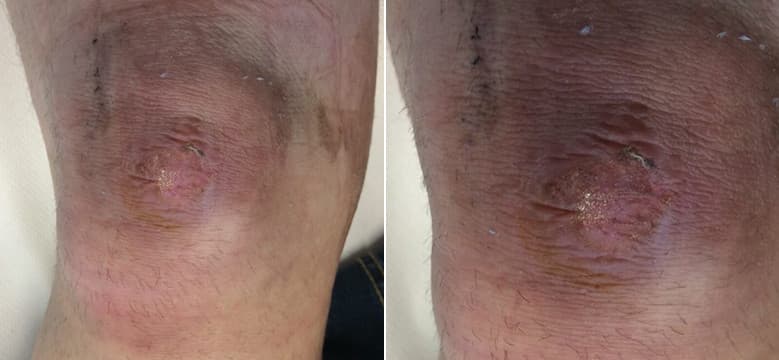
You can avoid such frostbite injuries by placing a piece of cloth (e.g., a towel) between the ice and the skin, and by limiting the cooling time to no more than 15–20 minutes.
The other problem is "overcooling," that is, applying cooling for days or even weeks after the injury. This causes the blood vessels to constrict, blood circulation to slow down and, with it, the healing processes to go into "idle." This way your injury heals poorly. After two to three days switch to a pain relief method that also promotes healing (for example, softlaser).

