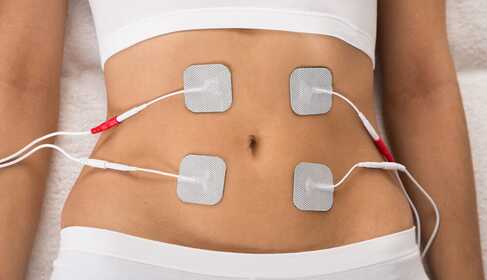

 What does “body shaping” with a muscle stimulator mean?
I discuss the foundations of the method in detail in the articles EMS – electrical muscle stimulation and The theoretical foundations of muscle stimulation. If weight loss is what interests you specifically: Can you lose weight with a muscle stimulator?
 Key point
EMS body shaping improves muscle firmness and muscle mass, not body fat. According to the latest comprehensive research reviews, muscle stimulation alone does not meaningfully reduce body fat, but it does measurably increase muscle mass. If you also want to reduce your body-fat percentage, you need exercise and an organised diet alongside stimulation – research consistently points to this. Body shaping is therefore part of a comprehensive lifestyle programme, in which EMS is a tool for toning.1,2
 What is a body-shaping EMS programme actually good for?
Based on research findings and everyday experience, there are five areas in which body-shaping muscle stimulation provides meaningful value. Click on the one that interests you.
Muscles have a basic level of firmness even at rest – this is what we call muscle tone. It gives the body a “firm” or, conversely, “relaxed” appearance. Regular muscle stimulation may improve this basic firmness.
The most noticeable change is experienced by people who previously did little exercise. With beginner (Toning) programmes, many people already feel after 2–3 weeks of regular use that their muscles feel “more supportive” – this is a subjective sensation, but it has a real basis.
This is where the scientific evidence is strongest. According to the latest comprehensive analysis, a regular muscle-stimulation programme lasting several months measurably increases muscle mass – including in people who are not athletes.1
Another study found that the development of muscle strength may be similar to that achieved with conventional weight training. This is mainly relevant to people who rarely have time to go to the gym because of other commitments.4
Why does this matter for body shape? Because more muscle burns more energy even at rest. This does not cause weight loss by itself, but it may support improved body composition – provided that your diet is also organised.
There is a condition that becomes increasingly common after middle age: muscle mass decreases while body fat increases. Its medical name is sarcopenic obesity. The scales may barely move, yet physical fitness and body shape noticeably deteriorate.
For this situation, research consistently recommends a combined approach: muscle stimulation + adequate protein intake + a lifestyle programme. Together, these may reduce body-fat percentage and waist circumference, while increasing muscle mass and improving everyday mobility.2,3
The division of labour is clear: muscle stimulation acts on the muscles, while organising the diet provides the extra support needed to reduce body fat. Neither replaces the other.
This is one of the real special features of muscle stimulation. With conventional training, it is almost impossible to focus on one lagging muscle group – the body always involves other muscles in the movement as well.
With electrodes, however, precisely the muscle beneath them is working. A lagging scapular retractor or hip extensor can therefore be treated separately.
Typical situations where this helps include recovery after childbirth, toning after major weight loss, or a muscle that is difficult to target during movement.
Very low-frequency stimulation causes mild, wave-like muscle contractions. These work like an internal pump: they may help blood and lymph flow, which may support recovery.
Beauty-care programmes designed to reduce swelling and support lymphatic circulation are based on this effect. It is important to know that the scientific evidence here is weaker than for increasing muscle mass – these are complementary programmes, not stand-alone treatment methods.
What body-shaping programmes can you find in the devices?
The body-shaping programmes in Globus devices can be divided into three groups. It matters which one you start with – the breakdown below will help you find your way around.
Foundation programmes – start with these
- Toning: a beginner, low-intensity programme. If you have never used a muscle stimulator before, use this during the first 2–3 weeks. It prepares the muscles for stronger stimulation.
- Jogging: provides stimulation to the leg muscles that resembles running. It may support basic endurance by improving circulation.
- Anaerobic training: a longer, more intensive programme that helps the muscles adapt to sustained exertion.
Body-shaping programmes – the second step
- Shaping: medium-strength stimulation, adjusted to emphasise muscle contours after 2–3 weeks of foundation training.
- Activation: for maintaining existing muscle mass. It is useful if you have muscle mass but less frequently used muscle fibres have become thinner.
- Mass building: alternating strong contractions and short rest periods – mainly for people who already train regularly.
- Definition: fine-tuning existing muscle tone without reducing muscle mass.
- Aerobic training: develops the muscle’s ability to use oxygen. Useful for athletes when combined with cardio training.
- Cramp prevention: supports muscle circulation and relaxation, and may therefore help reduce the frequency of cramps.
Complementary beauty-care programmes
- Swelling reduction: low-frequency stimulation to support fluid and lymphatic circulation. Used as a complementary measure for swollen limbs or fluid retention.
- Local metabolic activation: supports blood flow in the treated area. It does not reduce body fat on its own – it only makes sense as part of a lifestyle programme.
- Toning massage: gentle impulses to support circulation beneath the skin.
- Postpartum programmes: for gradually rebuilding the abdominal wall and pelvic floor muscles, typically from the third month after childbirth, in consultation with a gynaecologist.
- Facial programmes: very gentle impulses to support facial circulation. Regular use over several months is needed for lasting results.
- Skin-tone programmes: used as a complementary measure after rapid weight loss or postpartum skin laxity.
 Before you choose
Not every device contains the full programme list! Before buying, always check the specific programmes included in the device to make sure it really has what you need.
How should you use it to achieve a real result?
In research, measurable changes were achieved by people who followed the framework below. If you use it less often or for shorter periods, you will probably be disappointed.
| What? | How much? |
|---|---|
| Length of one treatment | 20–40 minutes per muscle group (shorter during the first weeks) |
| Weekly frequency | at least 3 sessions, ideally 4–5 |
| For how long? | at least 6–12 weeks of regular use for a meaningful result |
| Protein intake | 1.0–1.2 g per kilogram of body weight per day for the average adult (1.2–1.6 g for athletes) |
| Alongside exercise | 1–2 cardio sessions per week for cardiovascular health – EMS does not replace this |
 My advice
Research consistently shows that body composition improves when muscle stimulation is combined with exercise and an organised diet.3 If you choose only one of the three, organising your diet will bring the most noticeable change in the mirror – muscle stimulation adds firmness.
What muscle stimulation cannot replace: cardiovascular endurance, movement coordination and strengthening the muscle–bone connection. These require real movement. EMS is a tool for fine-tuning and targeted muscle strengthening – a complement, not a replacement.
 Which device is suitable for body shaping?
For body shaping, three factors matter most: it should contain programmes for several body areas, be easy to operate, and have safe, factory-set protocols. From the Medimarket range:
| Device | Who is it for? | What is it ideal for? |
|---|---|---|
| Myolito | Beginners and home use | General improvement of muscle tone and a first introduction to muscle stimulation |
| Globus Activa 700 | Upper category, with a beauty-care focus | Wide range of body-shaping programmes: shaping, definition, facial and postpartum programmes |
| Globus Elite 150 | Mid-range, for home and sport | If you want to combine body shaping with fitness training |
The full range is available in the muscle stimulator category. A separate selection for athletes: sports stimulators.
 When should you not use body-shaping muscle stimulation?
Most people tolerate body-shaping EMS well, but there are situations in which it is not recommended or may only be used under medical supervision. The full list can be found in the article on contraindications to electrotherapy.
- Implanted electronic device – it must not be used with a pacemaker, implanted defibrillator (ICD) or another active implant.
- Pregnancy – particularly on the lower abdomen and lower back; only after consultation with a gynaecologist.
- The first months after childbirth – stimulation of the abdominal area can generally begin from the third month after childbirth, with gynaecological approval.
- Active or undiagnosed tumour in the treated area – prior oncology consultation is required.
- Deep-vein thrombosis or vascular inflammation – it is prohibited if there is a recent blood clot in the treated area.
- Epilepsy – requires individual medical assessment.
- Fever or infectious condition – not recommended until recovery.
- Skin inflammation or wound in the treatment area – intact skin is required beneath the electrode.
- The front of the neck – electrodes must not be placed near the carotid artery.
- Recent injury during the bruising period – wait until the swelling and bleeding have settled.
 Important information
A home muscle stimulator complements medical treatment and exercise therapy; it does not replace them. If you have a chronic illness, take medication or are in the postpartum period, consult your doctor before starting use.
Frequently asked questions
Not on its own – the latest comprehensive analysis clearly shows this. Muscle stimulation increases muscle mass, which indirectly means somewhat higher energy expenditure at rest, but reducing body fat requires energy balance, sufficient protein and exercise. Read more: Can you lose weight with a muscle stimulator?1
Many people notice a feeling of being “firmer” after 2–3 weeks of regular use – this is subjective, but real. Measurable muscle growth, however, requires at least 6–12 weeks, with 3–5 treatments per week. Age, starting muscle mass and diet also affect how quickly a person progresses.
Generally from the third month after childbirth, and only with a gynaecologist’s approval. Special postpartum programmes aim to gradually rebuild the abdominal wall and pelvic floor muscles. After a caesarean section, a longer wait (3–4 months) and surgical and gynaecological consultation are required. There are also probe-based devices specifically for the pelvic floor muscles – be sure to ask your gynaecologist about using them.
No. Muscle stimulation can genuinely rival weight training in the development of muscle strength. But cardiovascular fitness, balance, movement coordination and the muscle–bone connection can only be developed through real movement. Full fitness requires both – plus an organised diet.4
Facial programmes may support circulation beneath the skin through very gentle stimulation. I need to be honest here: the scientific evidence in this area is limited. If you try it, expect 3–5 sessions per week and several months before any visible change, and on its own, without a skincare routine, it will not achieve much. It is a complementary tool, not a stand-alone skin-toning method.
Yes – perhaps even more so then. The combined increase in muscle loss and body fat becomes increasingly common after 50, and research has shown the best results precisely in this group, when muscle stimulation and appropriate nutrition are used together. It is worth asking a physiotherapist or geriatrician for advice when designing the protocol.2,3
 Summary – what is worth taking away
Related articles
- EMS – electrical muscle stimulation: the complete guide →
- Can you lose weight with a muscle stimulator? →
- G-Pulse – beauty care with muscle stimulation →
- The theoretical foundations of muscle stimulation →
- Muscle stimulation for athletes →
- EMS in rehabilitation – regaining muscle strength →
- Contraindications to electrotherapy →
Sources
- Kemmler W, Shojaa M, Steele J, Berger J, Fröhlich M, Schoene D, von Stengel S, Kleinöder H, Kohl M (2021). Efficacy of Whole-Body Electromyostimulation (WB-EMS) on Body Composition and Muscle Strength in Non-athletic Adults. A Systematic Review and Meta-Analysis. Front Physiol. 2021 Feb 26;12:640657. PubMed: 33716787
- Yang JM, Luo Y, Zhang JH, Liu QQ, Zhu Q, Ye H, Niu YL, Huang H, Xie HY, Long Y, Wang MY (2022). Effects of WB-EMS and protein supplementation on body composition, physical function, metabolism and inflammatory biomarkers in middle-aged and elderly patients with sarcopenic obesity: A meta-analysis of randomized controlled trials. Exp Gerontol. 2022;166:111886. PubMed: 35798137
- Xu S, Tu S, Hao X, Chen X, Pan D, Liao W, Wu R, Yang L, Xia H, Wang S, Sun G (2025). Exercise, Nutrition, and Neuromuscular Electrical Stimulation for Sarcopenic Obesity: A Systematic Review and Meta-Analysis of Management in Middle-Aged and Older Adults. Nutrients. 2025 Apr 29;17(9):1504. PubMed: 40362811
- Qin Y, Chen H, Liu X, Wu J, Zhang Y (2022). Effects of whole-body electromyostimulation training on upper limb muscles strength and body composition in moderately trained males: A randomized controlled study. Front Public Health. 2022;10:982062. PubMed: 36159315
- Beier M, Schoene D, Kohl M, von Stengel S, Uder M, Kemmler W (2024). Non-Athletic Cohorts Enrolled in Longitudinal Whole-Body Electromyostimulation Trials—An Evidence Map. Sensors (Basel). 2024 Feb 2;24(3):972. PubMed: 38339689