
The answer depends on several factors: the type of surgery, the phase of tissue regeneration, the underlying diagnosis and the rehabilitation protocol set by the treating physician. In this article we review the main considerations and show how recommendations differ for certain surgeries (knee/hip replacement, abdominal operations, post-oncologic surgery).
 Key idea
Muscle stimulation (EMS, NMES) in postoperative rehabilitation is a complementary method that should be used only with the authorization and protocol of the treating physician or a physiotherapist/sports physiotherapist. Timing, electrode placement and intensity vary by surgery type; initiating stimulation at home without medical approval should be avoided.
When is it beneficial and when risky?
Postoperative muscle stimulation has a dual effect: studies show it can help reduce muscle atrophy and speed strength recovery, but if mistimed or improperly parameterized it can impede wound closure.
- Reduction of muscle atrophy during the postoperative inactive period (especially relevant after orthopedic surgery)
- Earlier strength recovery – RCTs show NMES-augmented rehab can restore quadriceps strength faster after knee replacement compared to conventional physiotherapy
- Support for blood circulation in the treated muscle, which may aid nutrient and oxygen delivery
- Support for patient mobilization: easier bedside transfer, improved muscle tone alongside active physiotherapy
- Thrombosis prevention via mechanical venous pumping (documented in hip replacement rehabilitation)
- Impaired wound closure – if an electrode is placed directly on or near a fresh suture, skin healing may be disrupted
- Tissue tension from muscle contractions – overly strong stimulation can place mechanical stress on sutures
- Mobilization of an existing deep vein thrombosis – stimulation is not recommended if DVT is present after surgery
- Skin irritation under the electrode – postoperative skin may be more sensitive
- Interference with implanted devices – extra caution is needed near metal components of hip/knee prostheses
 Surgery types and specific considerations
The accordion below covers the most common surgical scenarios: when muscle stimulation may be considered, expected timing and recommended electrode positioning.
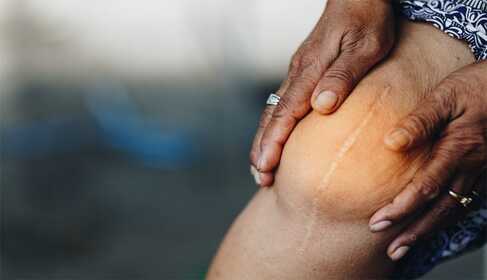
After orthopedic surgeries (total knee arthroplasty, hip replacement, ACL reconstruction) NMES is a well-documented adjunct. The 2012 Stevens-Lapsley RCT showed that starting high-intensity NMES after knee arthroplasty significantly supports quadriceps strength recovery compared to standard physiotherapy.
Timing: per the treating physician's judgment, generally 2–7 days after surgery with gradually increased intensity. Electrodes should NOT be placed over the fresh surgical wound but on the muscle belly of the quadriceps (mid-thigh). Details: quadriceps strengthening with a muscle stimulator.
Metal parts of a prosthesis can slightly alter the stimulating current – this is not a contraindication, but electrode placement and intensity should be agreed with the physician or physiotherapist.
After anterior cruciate ligament reconstruction, meniscal surgery or shoulder reconstruction, NMES can be part of the rehabilitation plan. Protocols depend on the surgery and techniques used and are set by the sports physiotherapist or orthopedic surgeon.
General principle: the stimulated muscle should not directly tension sutures or fixation devices. After ACL reconstruction, quadriceps stimulation is typically safe in partial knee flexion (flexion reduces graft tension).
After abdominal wall or laparoscopic/open abdominal surgery, abdominal muscle stimulation should be applied at a safe distance from the surgical wound. Full suture healing usually takes 4–6 weeks; until then abdominal EMS is not recommended.
Post-hernia abdominal strengthening follows the principle of gradual loading: combined with active physiotherapy and only started at the time authorized by the surgeon. Avoid placing electrodes over sutures permanently.
After discectomy, decompression or spinal fusion, muscle stimulation should be started under the supervision of a neurologist, neurosurgeon or the surgical team. Electrodes must not be placed in the immediate area of the surgical site (lumbar, cervical region), but stimulation of limb muscles (quadriceps, gluteus) to recover muscle strength can be considered.
Details: muscle stimulation and physiotherapy in disc herniation rehabilitation.
After oncologic surgery, muscle stimulation may be used only with the oncologist's permission and only in regions distant from the operated area. See details in the article cancer and electrotherapy.
Special situation: after breast surgery with postoperative lymphedema (if not metastatic disease), low-intensity EMS on the arm may be considered with lymphologist approval combined with compression therapy.
After cardiac surgery, coronary bypass, valve replacement or pacemaker/ICD implantation, home muscle stimulation is generally to be avoided. The cardiologist may permit treatment only on an individual basis and in a controlled environment for limb muscles. Details: electrotherapy and implants.
After plastic surgeries (liposuction, abdominoplasty, breast augmentation) muscle stimulation should be started only after sutures have fully healed (usually 6–8 weeks) and with the plastic surgeon's permission. Early stimulation is avoided because of the tensile forces on sutures and the increased sensitivity of freshly irritated skin.
 When to start? – Timing recommendations
The table below is a general guide that applies to average cases. Exact timing should always be determined by the treating physician or the rehabilitation team.
| Surgery type | EMS/NMES start | Goal | Start authorized by |
|---|---|---|---|
| Knee replacement (TKA) | 2–7 days (clinical) | Quadriceps strength | Orthopedic / physiotherapist |
| Hip replacement (THA) | 2–7 days (clinical) | Gluteus + quadriceps | Orthopedic / physiotherapist |
| ACL reconstruction | 1–2 weeks | Against quadriceps atrophy | Sports physician / physiotherapist |
| Abdominal/hernia surgery | 4–6 weeks | Abdominal muscle strength (outside suture area) | Surgeon |
| Spinal surgery | 4–8 weeks, individualized | Limb muscle strength | Neurosurgeon / neurologist |
| Oncologic surgery | Individual assessment | Muscle strength in distant regions | Oncologist |
| Cardiac surgery, pacemaker | Generally no | – | Cardiologist |
| Plastic surgery | 6–8 weeks | Muscle tone | Plastic surgeon |
 When to postpone treatment?
- Wound leakage, open wound, signs of infection at the surgical site
- Acute fever or suspected infection
- Suspected new deep vein thrombosis (severe, unilateral limb pain, swelling)
- Postoperative period not authorized by the treating physician
- Severe pain during stimulation
 Which devices are suitable for postoperative rehab?
For postoperative rehabilitation, choose a device that offers a low-intensity start, well-regulated programs and NMES functionality. Home-focused rehab devices are usually available in the entry-to-mid range.
Myolito (home EMS entry)
2-channel device with FES function, specifically designed for home muscle stimulation. Suitable for quadriceps, gluteus and abdominal strengthening with gradually increasing intensity.
Rehalito (rehab-focused)
2-channel TENS+EMS device with rehabilitation programs. Can be used within protocols set by the treating physician for orthopedic and sports rehab indications.
Globus Genesy 600 (PRO multifunctional)
Professional device for clinical settings with a wide range of programs: NMES, microcurrent, IF combinations. Highly recommended for rehabilitation centers.
Principle: always start treatment according to a protocol set by the treating physician or physiotherapist/sports physiotherapist, and follow the contraindications listed in the user manual.
 Postoperative contraindications
- Acute wound leakage, open or infected surgical wound
- Acute deep vein thrombosis (DVT) – details in the contraindications article
- Implanted active electronic device (pacemaker, ICD, DBS, SCS) – mandatory physician consultation
- Pregnancy (abdominal, lower abdominal, lumbar region treatments are prohibited)
- Active malignant disease in the treated area
- Postoperative period not authorized by the treating physician
- Persistent, severe pain during treatment – stop immediately
Frequently asked questions
"Immediate start" is never recommended as a self-initiated home measure. In clinical practice (e.g., after knee replacement) NMES is started 2–7 days after surgery under hospital physiotherapist supervision. Home initiation is allowed only after the treating physician or physiotherapist has authorized it in writing or during consultation — typically 1–6 weeks post-op depending on the surgery type.
Never place electrodes over a fresh suture or its immediate area. For quadriceps stimulation, place electrodes mid-thigh and outside the 5–10 cm zone above the patella. The physiotherapist will show the exact electrode positions during the first treatment; it is useful to remember or photograph these for home use.
Duration is individual: it depends on surgery type, age group, preoperative muscle strength and rehab activity. Typically 3–6 months after knee arthroplasty to return to preoperative levels with intensive rehabilitation. NMES can support strength gains but does not replace active physiotherapy.
If persistent, severe or sharp pain occurs: stop treatment, turn off the device and remove the electrodes. Report symptoms to your treating physician or physiotherapist — electrode placement, intensity or program may need adjustment. New unexplained symptoms (especially swelling and warmth suggesting DVT) require urgent medical evaluation.
Yes — this combination is the most effective: active physiotherapy develops coordination and functional muscle activation, while NMES supports muscle strength and hypertrophy. They complement each other. Follow the rehab team's plan; for example, a 15–20 minute NMES session on the target muscle after a physiotherapy block can be beneficial.
 Summary
A guide on when and under what conditions muscle stimulation (EMS, NMES) can be used in rehabilitation after various surgery types (orthopedic, abdominal, spinal, oncologic, plastic, cardiac).
Users in postoperative rehabilitation, caregivers, and physiotherapy and sports physiotherapy professionals.
Muscle stimulation is a complementary part of postoperative rehabilitation. Timing, electrode position and intensity must always be determined by the treating physician / physiotherapist. Apply protocols together with active physiotherapy.
Read about general electrotherapy contraindications, the article on regaining lost muscle strength, or surgery-specific indications (disc herniation rehab, quadriceps strengthening).
Scientific references
- Stevens-Lapsley JE, et al. Relationship between intensity of quadriceps muscle neuromuscular electrical stimulation and strength recovery after total knee arthroplasty – Physical Therapy, 2012. PubMed: 22652985
- Kittelson AJ, Stackhouse SK, Stevens-Lapsley JE. Neuromuscular electrical stimulation after total joint arthroplasty: a critical review of recent controlled studies – European Journal of Physical and Rehabilitation Medicine, 2013. PubMed: 24285026
- Imoto AM, et al. Is neuromuscular electrical stimulation effective for improving pain, function and activities of daily living of knee osteoarthritis patients? – Sao Paulo Medical Journal, 2013. PubMed: 23657509