Effects of Training Cessation on the State of Your Muscles
If you exercise, you know how much tiring work it takes to build muscle and to increase strength and endurance. You also know how quickly a few weeks without training can worsen these. Two to three weeks off and half a year of work can be lost. Gyms, pools and sports halls close. For now you can still run or cycle outdoors, but based on the news from Italy you may only be able to do that for a few more weeks. After that you will be confined between four walls and can only train at home. In such a situation it is worth considering acquiring a sports muscle stimulation device. It will be useful for maintaining muscle condition.
Effects of training interruption on your musculature
By training interruption I mean that the usual intensity of muscle work is persistently limited.
A drop in training load and intensity triggers a number of processes in your body. Muscles accustomed to high loads perceive that your at-home workouts no longer require the previous level of strength. Catabolic processes start and the "surplus" is broken down. In 2–3 weeks what you built with half a year of preparation can be gone.
Circulation, respiration and metabolism adapt similarly! If your body senses that the demands placed on it have decreased, it will not maintain a state of "super-high readiness" either.
Why do muscles "shrink"?
Doing a few push-ups or sit-ups in your apartment protects you from becoming completely inactive. If you know the physiology of muscle function, you also know that bodyweight-only training cannot prevent the loss of muscle mass gained in the gym. Read the section about muscle fibers and the Hennemann principle in this article.
Briefly: your individual muscle fibers do not all participate simultaneously in a contraction; their recruitment depends on the load.
With low-weight training only type I fibers work. Type IIa fibers are recruited when the movement requires about 50% of your maximal force. Type IIb fibers only engage when about 75% of your maximum force is needed.
To illustrate: suppose you can perform an exercise with maximal effort using 100 kg. If you train with 30–40 kg for repetitions, you are training your type I fibers. If you use 60–70 kg, type IIa fibers are also involved; with 80–90 kg, type IIb fibers participate as well.
Because type I fibers are thin and increase little in mass, you can eventually perform hundreds of repetitions with a 30 kg load, but your muscle mass will not change! What improves is endurance.
If you squat using only your bodyweight or strengthen your shoulders by lifting encyclopedias, it is almost certain that only your type I fibers are activated. After a while you can repeat the movement hundreds or thousands of times, but you remain scrawny.
Type IIb and IIa fibers lose their capabilities the fastest, because maintaining them requires working with heavy loads. For example, only if your wife and children sit on your back during push-ups...
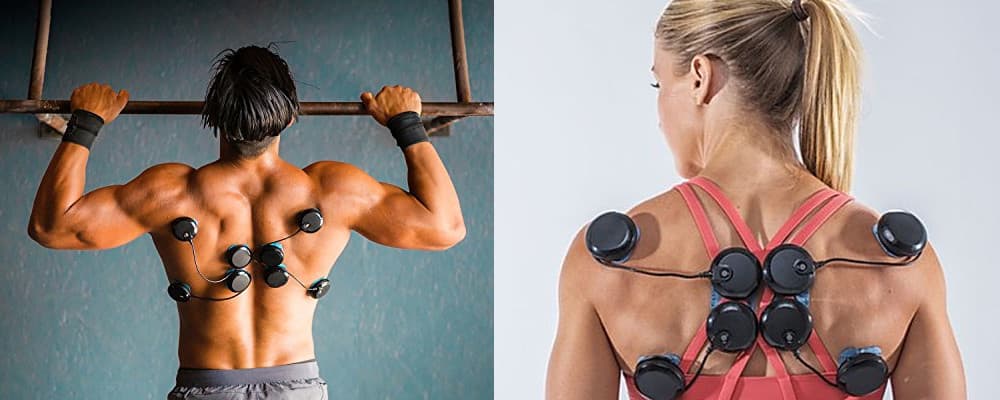
Why is muscle stimulation useful?
The recruitment order described above is regulated by your brain. You cannot naturally bypass it. No matter how much you try to "tense" your IIb fibers, their activation depends not on willpower but on load. In other words, you need very heavy weights for training.
The advantage of a muscle stimulation device is that it allows you to circumvent this brain regulation!
With the proper setting of the impulses you can focus on a specific muscle fiber type. In other words, with programs for maximal strength or hypertrophy you can train the IIa and IIb fibers as well! This way strength and muscle mass can be preserved over time.
Sports muscle stimulation devices with programs that compensate for training interruption start at around HUF 65,000. For HUF 150,000 you can get an excellent device. And of course the sky's the limit…
What are the limitations?
The limitation is that a sports muscle stimulation device can only be used on a limited area at a time (you cannot treat all your muscles simultaneously). It does not affect circulation and respiration. However, it does affect muscle metabolism.
Consequently, it is worth concentrating the treatment on the large muscle groups (thigh muscles, trunk/core muscles, shoulders and arms).
For a muscle it makes no difference whether it contracts in response to impulses from the brain or from the stimulator. In both cases the contraction occurs in exactly the same way.
It follows that stimulation training only "works" if the stimulation is applied daily for an appropriate duration. Thirty minutes per week is worth as much as thirty minutes of conventional training per week.
I do not recommend the device to those who have no time for stimulation. If, however, you sit in an office all day or a virus confines you to your home, you will have time for several hours of daily stimulation.