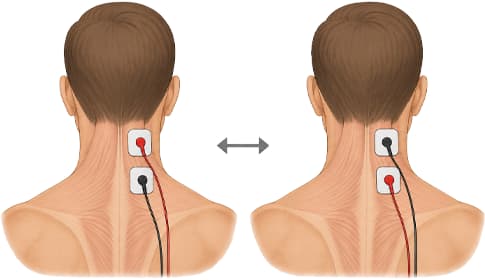

The good news: most TENS and traditional EMS devices use compensated biphasic current, so reversing polarity does not affect the treatment in these cases. The polarity question becomes important for iontophoresis, microcurrent (MENS), selective stimulation and for transcranial direct current stimulation (tDCS).
 Key point
Users of TENS and classic EMS devices can place the two pads on either lead without concern – polarity does not affect the treatment. For iontophoresis, however, the polarity of the drug-containing pad must be set exactly according to the instructions: this determines whether the drug is driven into the skin. Microcurrent protocols that are polarity-sensitive (e.g. wound stimulation) also require precise settings.
 What is polarity and why does it matter?
Electric current flows from the anode (positive, +) toward the cathode (negative, –). In human tissues this movement is accompanied by ion migration: positive ions (e.g. sodium, potassium) move toward the cathode, while negative ions (e.g. chloride) move toward the anode. This migration is unidirectional and sustained only when the current is direct (DC) – in those cases paying attention to polarity is important.
We can distinguish two main groups of effects depending on the pole:
| Pole | Subcutaneous reaction | Physiological effect |
|---|---|---|
| Anode (+, positive) | Acidic reaction (HCl formation possible) | Local increase in circulation, reduced sensory nerve activity (analgesic effect) |
| Cathode (–, negative) | Alkaline reaction (NaOH formation possible) | Increased cell excitability, muscle activation, lowered nerve excitation threshold |
 Risk of skin burns with DC
Long, high‑intensity DC treatments can produce an alkaline environment under the cathode that may cause skin burns. This phenomenon is also observed during hospital galvanic treatments. Manufacturers of home iontophoresis devices regulate current intensity and treatment duration to account for this risk – follow the user manual.
 Polarity‑sensitive and polarity‑independent methods
The waveform used by different electrotherapy methods is the decisive factor regarding polarity.
- Iontophoresis – the charge of the drug (e.g. sodium fluoride, acetic acid, NSAID ions) determines which pole the drug pad must be placed on
- Microcurrent (MENS) – when using polarity protocols (e.g. wound stimulation, sports recovery)
- Selective stimulation for denervated muscle treatment – triangular pulses with exact polarity
- tDCS (transcranial direct-current stimulation) – used in research and clinical environments
- Galvanic therapy in clinical settings (bath techniques)
- TENS – compensated biphasic square waveform
- EMS / NMES classic protocols – two‑phase symmetric current
- Interferential (IF) – interference of two alternating currents
- Kotz (Russian) stimulation – modulated 2500 Hz carrier
- WB‑EMS – whole‑body biphasic stimulation
- Vagus stimulation (tVNS) – pulsed biphasic current
For these methods you can freely place the two pads on the channel in any orientation – reversing polarity does not noticeably affect the treatment.
Polarity by method – details
Iontophoresis uses direct current to deliver a drug through the skin to the target tissue. The drug's charge (positive or negative ion) determines which electrode the drug‑containing pad must be placed on:
- Positively charged drugs (e.g. lidocaine, hydrocortisone) → anode (+) – positive ions are pushed from the positive pole toward the cathode, entering the skin.
- Negatively charged drugs (e.g. acetic acid, NSAID anions) → cathode (–) – negative ions are driven from the negative pole toward the anode.
- For hyperhidrosis (tap water iontophoresis) polarity direction may be alternated between treatments so the skin responds evenly.
The exact polarity and treatment duration for any drug carrier are specified by the product instructions or the treating physician. Details: acetic‑acid iontophoresis, hyperhidrosis article.
Microcurrent treatments typically operate in one of two modes: either with a polarity‑alternating program (e.g. 5‑second cycles) or with a fixed‑polarity DC mode (e.g. for wound stimulation). The 2014 Kloth study specifically recommends placing the cathodal electrode directly over the wound in the initial phase, then switching to anodal stimulation during the granulation phase.
Home devices generally default to a polarity‑alternating mode – this is safer and more user‑friendly. Special protocols (e.g. wound stim, regenerative programs) require professional supervision.
Treatment of peripheral nerve injury (e.g. peroneal palsy) uses triangular pulses that provide a fixed polarity, slowly rising waveform. These selectively target denervated muscle fibers because they do not elicit contractions via intact nerve fibers. Polarity is protocol‑defined here: place electrodes at the motor point with the polarity specified in the user manual. Details: denervated muscle treatment.
tDCS over the skull is explicitly polarity‑sensitive: anodal stimulation can increase cortical excitability, while cathodal stimulation can reduce it. The 2018 Steigerwald study investigated polarity direction effects in subthalamic neurostimulation for Parkinson's disease. Home use of tDCS is not recommended; it should be performed only in research or under appropriate clinical supervision.
Most TENS and traditional EMS devices deliver a compensated biphasic square wave. This means the current polarity reverses many times per second (typical frequencies 40–150 Hz), preventing a persistent electrochemical imbalance under either pad. Users do not need to worry about the red/black order on the pads – the treatment works identically in both orientations. Details: TENS guide, EMS overview.
 Practical placement rules
For most home users the polarity question can be simplified depending on the treated area and the method used:
| Situation | Role of polarity | What to do? |
|---|---|---|
| TENS – pain relief | Doesn’t matter | Place two pads on either side of the painful area; polarity may be either way |
| EMS – muscle strengthening (classic) | Doesn’t matter | One pad near the muscle origin, the other near the insertion or along the muscle belly |
| Iontophoresis (drug pad) | Critical | The drug pad polarity is determined by the drug’s charge – follow the instructions |
| Iontophoresis (tap‑water for hyperhidrosis) | Alternate per treatment | 10 minutes one direction, then 10 minutes the opposite direction |
| Microcurrent – general | Automatic polarity alternation | The device handles it automatically |
| Microcurrent – wound stim | Protocolized | Learn the protocol from a professional; don’t experiment at home |
| Selective stimulation (denervated) | Fixed protocol | Follow the user manual for the motor point polarity |
 General tips for placement
- Never place the two pads facing each other across the chest – current should not pass through the heart (exception: hospital chest protocols)
- Hydrate the skin under both poles – details in our skin hydration before electrical treatment article
- Choose the correct pad – details in our electrode article
- If the tingling is stronger on one side, that is usually the cathode (–) – this is normal, not a polarity error
- In case of skin irritation, check polarity, pad placement and hydration
Frequently asked questions
Most TENS devices deliver a compensated biphasic current. The red and black leads simply distinguish the two channel ends (or pairs for multi‑channel units), but polarity often reverses during the session. So you don’t need to worry about the order – place the pads on either side of the painful area in whichever orientation is convenient.
Because only from the correct pole will the drug ions migrate into the skin. A positively charged drug is placed under the anode, a negatively charged drug under the cathode. If you place the drug pad on the wrong pole, the medication will not penetrate the skin and the treatment won’t achieve the intended physiological effect. The exact polarity is listed in the drug’s instructions and is always checked in clinical settings.
In DC‑based treatment the slightly alkaline reaction under the cathode and the lowered nerve excitation threshold can produce a sharper stinging sensation. This is normal if mild; however, if it is painful or there is a risk of blistering, reduce intensity or stop the session. With biphasic TENS/EMS this phenomenon does not apply because the polarity alternates.
No, that usually means the device provides biphasic or polarity‑alternating current. This waveform is used by most TENS and traditional EMS devices. Specialized iontophoresis and selective stimulation devices are DC‑based and may offer polarity selection – if your device supports that, it will let you reverse or program the polarity.
Home electrotherapy is generally contraindicated for people with a pacemaker. If a cardiologist has approved limb treatments, polarity is a secondary issue – the main concerns are distance from the implant, bipolar electrode placement, and supervision. Details: electrotherapy and implants.
 Summary
A guide explaining when the polarity of the two electrodes matters across electrotherapy methods (TENS, EMS, microcurrent, iontophoresis, selective stimulation, tDCS) and when it is not relevant.
Users of home electrotherapy devices, physiotherapists, sports physiotherapists and professionals performing iontophoresis.
Polarity does not matter for TENS and classic EMS. Polarity is critical for iontophoresis, microcurrent wound stimulation, selective stimulation and tDCS. Always follow the user manual and the instructions of your treating physician or physiotherapist.
Read about skin hydration before treatment and electrode selection, or consult our pillar articles on polarity‑sensitive methods (iontophoresis, microcurrent, denervated muscle).
Scientific references
- Manola L, Holsheimer J, Veltink P, Buitenweg JR. Anodal vs cathodal stimulation of motor cortex: a modeling study – Clinical Neurophysiology, 2007. PubMed: 17150409
- Kloth LC. Electrical Stimulation Technologies for Wound Healing – Advances in Wound Care, 2014. PubMed: 24761348
- Steigerwald F, Kirsch AD, Kühn AA, Volkmann J, et al. Anodic versus cathodic neurostimulation of the subthalamic nucleus – Parkinsonism & Related Disorders, 2018. PubMed: 29784559