
Endurance-building stimulation from the couch? Tips for time‑pressed amateur athletes
Preparing for a running race or a longer triathlon distance? Then endurance development is your top priority. You need to devote many hours to your preparation. If, however, you have little time to train… well, it's worth getting a little help. Of course, this only applies if you have spare time, for example when you do office work.

In today's fast‑paced world many people struggle to find enough time for sport and endurance training alongside work, study and family life. If you are an enthusiastic amateur athlete — regularly entering running races, cycling or taking on triathlon challenges — you know that sustained performance requires investing long hours.
The secret of endurance sports lies in the slow but persistent type I muscle fibers, which require long time investment to develop.
When your schedule is tight and you can only fit in 1–2 hour workouts 4–5 times a week, your performance can easily fall short of expectations. That can be frustrating: you do everything, but your body does not receive the necessary stimulus to improve.
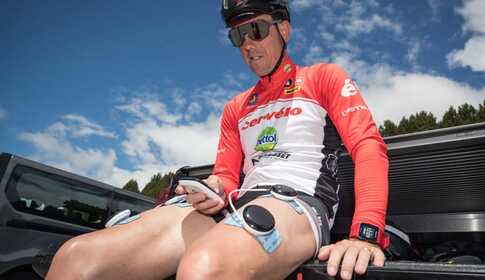
Good news: muscle stimulation (also called electrical muscle stimulation or EMS) is a biohacker tool you can use to supplement your training, allowing you to improve in less time than usual, even passively or as a complement to your regular sessions!
This technology is a smart option that can "gain extra training time" on the muscle groups most important to your sport (for example the leg muscles or the muscles responsible for core stability) without further burdening your schedule.
What is muscle stimulation and why is it useful?
Muscle stimulation works by the device sending small electrical impulses to the muscles, producing muscle contractions very similar to those commanded by your own nervous system.
This technology has long been used in rehabilitation and physiotherapy, for example to assist recovery after muscle injuries or to prevent muscle atrophy.
For amateur athletes, one of the biggest advantages is that it can recruit muscle fibers in a targeted and intense way. When you run or cycle, your nervous system selects which fibers to activate according to the conditions. With muscle stimulation you can work in a controlled, deep way, even without stressing your joints.
Two "friends" of endurance: EMS/NMES and Kotz stimulation
Among muscle stimulation methods, two types are worth special attention for anyone looking to develop endurance and muscle strength while short on time.
EMS and NMES - general muscle strengthening and endurance development
EMS (Electrical Muscle Stimulation) and NMES (Neuromuscular Electrical Stimulation) essentially describe the same phenomenon: nerve‑muscle stimulation.
This method primarily develops the muscles' contraction ability and strength. With appropriate programs, muscular endurance can also be significantly improved.
How does it work?
The impulses emitted by the electrodes reach the muscle or the motor nerves directly, resulting in intense muscle contractions.
How does it help when time is limited?
During a short 20–30 minute EMS session, several thousand muscle contractions occur. This intensity allows you to target specific muscle groups, such as the legs, while you rest or do other light activities. A time‑poor runner can strengthen, for example, the thigh muscles while sitting in the office chair or in the evening while watching TV, thereby increasing the training time of the treated muscles.
Kotz stimulation: Deep strengthening
Kotz stimulation is a special form of muscle stimulation developed by the Russian sports physician Yakov Kotz, which is why the method is also called Russian stimulation.
It typically uses a special medium‑frequency current modulated by another frequency. This can elicit very deep and powerful muscle contractions.
What does it do?
This technique focuses on increasing the muscles' maximal strength and performance capacity. It is especially effective at improving strength‑endurance, which is essential for long‑distance sporting performance.
How does it help when time is limited?
Kotz stimulation allows muscles to work under near‑maximal load without subjecting the musculoskeletal system (bones, joints, ligaments) to the same high mechanical stress. This means you can gain significant strength and endurance in less time while reducing the risk of overload injuries. It is ideal if you want an intense but joint‑friendly supplement alongside one or two regular weekly workouts.
How can it be integrated into everyday life?
The great thing about muscle stimulation devices is their suitability for home use. You do not need to go to the gym or arrange a separate appointment.
Recovery: Use low‑frequency stimulation after workouts to speed up recovery and reduce muscle soreness (DOMS).
Strengthening: Incorporate short 20–30 minute "extra strengthening" blocks into your day (while watching TV, reading) to target the main mover muscles (thigh, calf, core).
Warm‑up: Low‑intensity stimulation can effectively prepare the muscles for load, helping to prevent injuries.
Muscle stimulation does not replace basic training — nothing can substitute the joy of running and cycling or their cardiovascular benefits — but it is an excellent supplement during difficult, time‑constrained periods. It helps you spend the limited available time with maximum efficiency.

