Who is it recommended for?
Stress incontinence results from weakness of the pelvic floor sphincter muscles. The evoStim P programs at 35–50 Hz specifically train these muscles, while pressure biofeedback shows whether you are engaging the correct muscle group. This is the most common form of incontinence — and one that often responds well to muscle training.
Caused by bladder overactivity: a sudden, uncontrollable urge to void. The evoStim P programs at 10–20 Hz aim to calm the bladder muscle, reducing involuntary contractions. Biofeedback also helps teach relaxation techniques.
If stress and urge incontinence occur together, the evoStim P mixed program treats the problem in two phases: first bladder calming (10–20 Hz), then muscle training (35–50 Hz). The device automatically handles the phase transition.
With weakness of the anal sphincter, using the evoStim P with an anal probe provides targeted training of the sphincter muscles. Pressure biofeedback is particularly valuable here: you can see whether the anal sphincter actually responds to stimulation.
Childbirth can damage or overstretch the pelvic floor muscles. The evoStim P can help targeted muscle restoration — pressure biofeedback objectively shows the degree of improvement. Treatment may begin after the 6–8 week postpartum medical check.
Combined effect of pressure biofeedback and ETS
The conventional stimulator works "blindly": it delivers pulses but doesn’t measure whether the treatment actually reaches the target muscles. In contrast, the evoStim P pressure sensor quantifies every contraction — so you immediately know if the probe is badly positioned or if the patient is using the abdominal rather than pelvic floor muscles.
The ETS (electrically triggered stimulation) function further increases effectiveness: the device senses voluntary muscle contraction and "assists" it with stimulation pulses. This combined training produces a more focused muscle contraction than either method alone — which can lead to faster improvement.
Frequently asked questions
No. You will feel a slight tingling and a definite muscle contraction. If you experience pain, reduce the intensity. The treatment should never be painful — if it is, check the probe position.
No. Use of electrical stimulation devices is prohibited during pregnancy. Start treatment after the 6–8 week postpartum medical check.
Both are biofeedback stimulators but work on different measurement principles. The evoStim P uses pressure-biofeedback (measuring the pressure exerted by the muscle), while the evoStim E uses EMG-biofeedback (measuring the muscle’s electrical activity). Pressure biofeedback has the advantage of providing more objective, position-independent measurements.
Yes. Men can use the evoStim P with an anal probe — particularly for post-prostatectomy incontinence. Pressure biofeedback also supports training of the anal sphincter.
With biofeedback-combined electrostimulation, initial improvements can be noticed after 2–4 weeks of regular use. The intensive treatment phase is 8–12 weeks, followed by maintenance treatment (1–2 times weekly) to preserve results.
It depends on the type of incontinence. For stress incontinence choose the muscle training program (35–50 Hz), for urgency choose the bladder-calming program (10–20 Hz), and for mixed forms choose the combined program. If unsure, consult your treating physician.
How to use the evoStim P?
1
Select the program
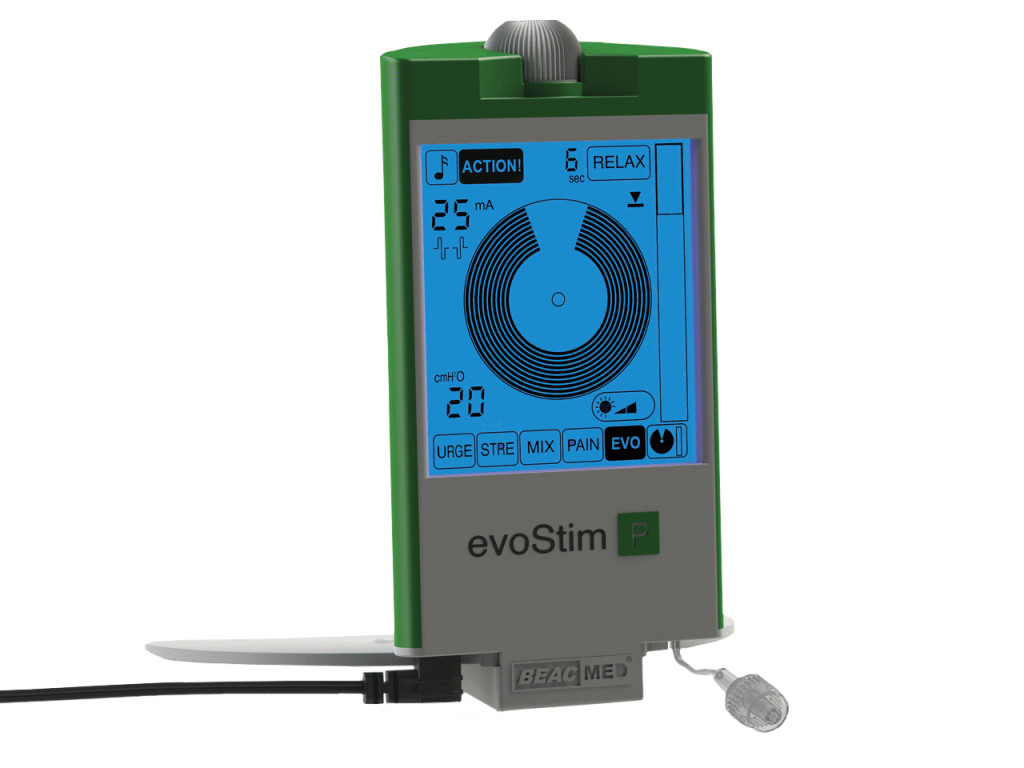
On the touchscreen, choose the program group that matches your incontinence type (stress, urge, mixed, pain or relaxation). Any of the 9 programs can be assigned to the 5 quick-select buttons.
2
Insert the probe
Moisten the pressure-sensing probe with water or gel lubricant, then insert it. The probe transmits stimulation pulses and measures the pressure of muscle contractions simultaneously.
3
Set the intensity
Slowly increase intensity with the rotary knob until you feel a definite but comfortable muscle contraction. Typically 10–30 mA is the suitable range. The treatment should never be painful.
4
Train using biofeedback
The screen shows the pressure trace in real time. In ETS mode the device detects your voluntary contraction and assists it. Contract your muscles on cue — the stimulator’s effect combines with your effort.
5
Track your progress
At the end of a session the device stores measurement data. You can compare results week to week — visible improvement motivates continuation. Daily 20–30 minutes for at least 8–12 weeks is recommended.
Package contents
The evoStim P includes the following accessories:
- 1 pc evoStim P device (with touchscreen and rotary knob)
- 1 pc pressure-sensing vaginal probe
- 1 pc stimulation cable
- 3 pcs 1.5V AAA alkaline batteries (LR03)
- 1 pc user manual
- 1 pc storage pouch
Probes are for personal hygienic use. If multiple people use the device, each should have their own probe. Spare probes and accessories are available on our category page.
Technical specifications
| Channels | 1× stimulation + 1× pressure biofeedback |
| Waveform | Biphasic symmetric, selectable alternating |
| Stimulation output | 1–99 mA (1 mA steps, at 1 kΩ load) |
| Frequency | 1–150 Hz (28 steps) |
| Pulse width | 50–400 µs (10 µs steps) |
| Session duration | 5–90 minutes (5-minute steps) |
| Biofeedback scale | 2–200 cmH₂O (17 levels) |
| Program groups | 5 (stress, urgency, mixed, pain, relaxation) |
| Programs/group | 9 predefined + customizable |
| Intellistim | Yes – frequency fine-tuning during use |
| User interface | Touchscreen + rotary knob |
| Power supply | 3× 1.5V AAA alkaline batteries (LR03), ~20 hours runtime |
| Certification | CE medical device (MDR) |
 When NOT to use the device?
- Cardiac pacemaker or implanted defibrillator
- Pregnancy
- Active malignant disease in the treatment area
- Untreated epilepsy
- Acute inflammation or infection in the pelvis
- Within 3 months postpartum
Unsure? Consult your treating physician before use!
 Important information
The evoStim P is a CE-marked medical device (MDR classification) designed as an adjunct to medical treatment. A medical examination is required before starting treatment to determine the type of incontinence, as different types require different treatment protocols.
Electrical stimulation can be an effective complement to pelvic floor muscle training. The Cochrane review of 2022 found high-level evidence supporting pelvic floor muscle training (PFMT) for incontinence treatment.1
Information on this page is for guidance only. Home therapeutic devices are intended to complement, not replace, medical treatment. Consult your physician if you have symptoms.
Scientific background
High-level clinical evidence supports the effectiveness of pelvic floor muscle training augmented with electrical stimulation:
- Todhunter-Brown A, Hazelton C, Campbell P, et al. (2022). Conservative interventions for treating urinary incontinence in women: an Overview of Cochrane systematic reviews. Cochrane Database Syst Rev. 9(9):CD012337. PubMed
- Ghaderi F, Mohammadi Oskouei A, et al. (2023). Effects of pelvic floor muscle exercise on stress urinary incontinence. Int Urogynecol J. 34(5):1137-1147. PubMed
 Incontinence treatment – complete guide →
 Treatment in practice – step by step →
 Urinary incontinence and its treatment →
 Fecal incontinence and its treatment →
 Pelvic floor exercise guide →
 evoStim E – EMG-biofeedback alternative →
 All incontinence devices →