
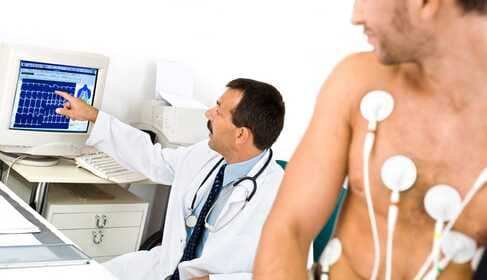
Exercise ECG test
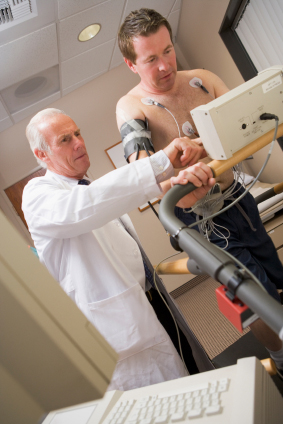
The exercise ECG test examines the condition of your heart. On a bicycle or treadmill ergometer you are subjected to gradually increasing workload (that is, you are expected to walk/run faster or pedal faster) while your heart's electrical activity and your blood pressure are recorded. Diagnostic conclusions are drawn after analyzing the data. During a resting ECG examination the heart's resting [...]

The exercise ECG test examines the condition of your heart. On a bicycle or treadmill ergometer you are subjected to gradually increasing workload (that is, you are expected to walk/run faster or pedal faster) while your heart's electrical activity and your blood pressure are recorded. Diagnostic conclusions are drawn after analyzing the data.
During a resting ECG examination the heart's resting electrical activity is examined on a 10-second recording. Many abnormalities can be detected at rest, but in many cases symptoms do not appear this way. The exercise ECG provides a test that corresponds to everyday situations, since symptoms most frequently occur with physical exertion, such as during work.
Response to exercise
When your body faces exertion—for example, when you climb stairs, rush for a bus, chop wood, or do any sports activity—the energy and oxygen demand of your muscles increases. To ensure the muscles get what they need, your heart pumps faster and more forcefully.
Under normal circumstances, the heart and circulation easily "meet" the higher demand.
However, in heart disease the heart may not be able to meet increased performance demands. Signs indicating the heart muscle's lack of oxygen appear on the ECG recording. The test detects problems related to blood flow to the heart.
Activity usually involves walking (or running) on a treadmill or cycling on a stationary bicycle. During the examination, healthcare staff monitor your heart rhythm, blood pressure, and breathing.
When is an exercise ECG test necessary?
An exercise test is advisable if:
- There is a suspicion of coronary artery disease and you need confirmation: the coronary arteries directly supply your heart with blood and oxygen. Coronary artery disease develops when these arteries are damaged or diseased. For example, cholesterol deposits and inflammation in the heart arteries usually lead to coronary artery disease.
- To detect heart rhythm disorders: a heart rhythm disorder is called an arrhythmia, which can cause the heart to beat too fast or too slow.
- To determine the direction of treatment for heart diseases: if you have already been diagnosed with a heart condition, the exercise test can help determine whether the treatment is effective. Test results also help decide which treatment is best for you.
- To check circulatory status before surgery: the exercise test helps show whether surgery, such as valve replacement or heart transplantation, can be performed safely.
If the exercise test does not reveal the cause of symptoms, further imaging tests may be recommended. Such tests include exercise echocardiography (ultrasound) or cardiac MRI.
Risks
The exercise ECG test is generally safe; complications are rare. Possible side effects of the exercise test include:
- Low blood pressure: blood pressure may drop during or immediately after exertion. The drop can cause dizziness or fainting. The problem usually resolves once the exertion stops.
- Irregular heart rhythms, called arrhythmias: rhythm disturbances that occur during the exercise test usually disappear after the exertion stops.
- Heart attack (myocardial infarction): although very rare, it is possible that the exercise test could trigger a heart attack.
Because the test is performed in a dedicated laboratory, trained staff and life-saving equipment are always available. Adverse signs can be detected in time and the exercise can be stopped.
For decades I have been present as a physician at multiple exercise ECGs every day, and during that time there has not been a single fatal outcome. In other words, there is no need to be afraid of the exercise ECG test.

