
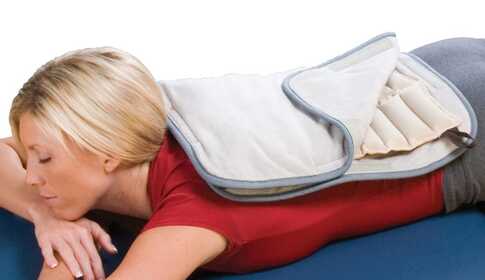
Beneficial effects of heat therapy
Joint pain is unpleasant on its own, but the reflexive contraction and stiffening of the muscles surrounding the joint can further increase your symptoms. For such problems that become chronic, the simplest and also the most affordable treatment is heat therapy. Let’s see how you should apply it to achieve the proper effect.

Heat therapy is a treatment used to relieve pain and muscle stiffness. Heat therapy is generally used to reduce persistent or chronic pain. Do not use it for a fresh (1–3 day) injury, especially a muscle injury (tear, strain, bruise), as it increases the risk of bleeding.
Heat therapy can be wet, e.g., bath treatments, mud packs, or a hot water bottle, which are mostly performed in clinical settings. It can also be dry (e.g., a heating pad, blanket). The latter are the easiest to use at home.
How does heat therapy work?
Heat causes the blood vessels in the treated area to open and dilate, resulting in increased blood flow. The increased circulation stimulates the healing processes. Warming also relaxes stiff muscles and makes them more elastic.
You can use heat therapy alone or together with other treatments. For example, warming muscles and tendons before a massage or physiotherapy makes movement easier and reduces pain.
What does heating the skin surface cause?
- your pain decreases
- your muscles relax, muscle stiffness eases — this further reduces pain
- blood flow increases in the treated area
- the increased flow accelerates the healing processes
- the increased flow promotes the removal of toxins and waste products (pain-causing substances)
- it prepares the muscles and joints for physiotherapy and massage
Heating devices intended for home use
In hospitals and clinics, moist heat (e.g., a hot water bottle) is commonly used. The main reason is that moist heat is more convenient to apply in institutional settings. It is also easier to disinfect than dry heating elements.
For personal use at home, prefer dry heating elements. Today most such devices contain carbon fibers and so-called FIR (far infrared) emitters. FIR rays penetrate deeply into the body (even 5–8 cm) and produce the heating effect where it is most needed. Many manufacturers produce blankets with heating elements or devices shaped to fit the joint being treated. Most allow the heating temperature to be adjusted in several stages, generally in the 45–60 °C range. Temperatures above this may cause injury.
Devices are equipped with thermal protection, meaning the device will automatically switch off in case of overheating.
How often can heat therapy be applied?
Never place a heating pad or heat pack directly on the skin; have a thin layer of clothing or a towel between it and your skin.
The general recommendation is that a heat therapy session should last between 15 and 30 minutes. After that, the beneficial effects remain for 2–4 hours, at which point the treatment can be repeated. Heat therapy can be repeated. Taking into account the time for warming and subsequent cooling, 1–2, at most 3 treatments fit into a day.
If you are also receiving physiotherapy (therapeutic ultrasound, softlaser, magnetic therapy, muscle stimulation, etc.), it is advisable to do a heat warm-up before those treatments. This reduces the discomfort associated with the treatments (muscle and tendon tension, pain) and also enhances their effectiveness.

