
 Rebuilding thigh muscle strength: why is this the key to knee rehabilitation?
The problem is that this muscle deteriorates incredibly quickly. After a knee injury, surgery or prolonged pain, it is not only reduced use that causes wasting: a swollen, painful joint reflexively “switches off” the thigh muscle (this is called arthrogenic muscle inhibition) — even if you want to tense it, the nervous system puts the brakes on. This starts a vicious circle: weak thigh muscle → less controlled knee movement → overloaded cartilage → more pain → even less use → an even weaker muscle. This article explains how to break this cycle with a muscle stimulator (EMS/NMES): when it is appropriate, where to place the electrodes, which programme and intensity are needed, and what clinical studies say about it.
 Key point
Muscle stimulation in rebuilding thigh muscle strength is not a replacement for exercise, but a bridge to it: it is most useful when exercises performed with your own strength are not yet possible — after surgery, because of pain or arthrogenic inhibition — because the electrical impulse bypasses the inhibiting reflex and works the muscle that your conscious effort cannot yet reach. Research indicates that muscle stimulation ADDED to standard physiotherapy measurably speeds up the return of strength in the early weeks after surgery — under two conditions: the intensity must produce a strong, visible muscle contraction, and the treatment must last long enough. A mild setting that merely “tickles” does not build muscle.
 How does it work — and when is it needed?
Click the tabs:
Two mechanisms work at the same time. The first is simple inactivity: an unused muscle measurably loses strength and bulk as early as the first week — in a plaster cast or during bed rest, this happens remarkably quickly. The second is more insidious: arthrogenic muscle inhibition. Receptors in an injured, swollen, painful knee joint reflexively inhibit activation of the thigh muscle at spinal cord level — no matter how strongly your brain gives the command, some of the muscle fibres simply do not switch on. This is why, after knee surgery, many people “cannot find” their thigh muscle for weeks. It is also why the “I’ll exercise when it stops hurting” strategy is not enough: while the inhibition persists, voluntary exercise reaches only part of the muscle. Read more about the consequences of deterioration: The consequences of inactivity →
EMS (electrical muscle stimulation, medically known as NMES) stimulates the nerves supplying the muscle directly through electrodes placed on the skin and triggers a contraction — independently of your will and of arthrogenic inhibition. In this situation, it does three things that nothing else can: it works the muscle even when voluntary exercise is not possible because of pain or inhibition; it reaches the high-threshold fibres that waste quickly; and it “re-teaches” the nerve–muscle connection — you also consciously tense the muscle during treatment, so your brain reconnects the command with the contraction. Read about the physics of the method and the difference from TENS: EMS – electrical muscle stimulation → and TENS, EMS, MENS – what is the difference? →
Typical situations include the early stage after knee surgery (joint replacement, cruciate ligament reconstruction or meniscus surgery), alongside physiotherapy1,2; muscle wasting after plaster immobilisation or reduced weight-bearing; knee osteoarthritis, when pain makes exercise difficult — here, stronger thigh muscles are themselves part of the treatment; general muscle loss after a long illness or bed rest, particularly in older people; and in athletes, to bridge the period away from sport because of an injury. The framework is the same in every case: stimulation is part of a rehabilitation plan, not a stand-alone miracle method — after surgery, agree the timing with your doctor and physiotherapist. Related guides: Using muscle stimulation after surgery → · Joint replacement surgery and rehabilitation → · Cruciate ligament rehabilitation →
 Electrode placement and body position
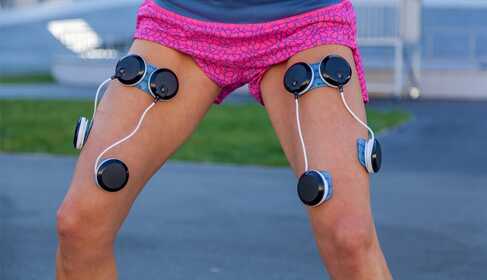
The thigh muscle has four heads; for home treatment, we work on the two easily accessible front heads (the vastus lateralis and vastus medialis, together with the rectus femoris). The rules are:
| Rule | Why? |
|---|---|
| Two electrodes per muscle: one on the upper third and one on the lower third of the muscle — the two poles of the same cable (channel) must always be placed on THE SAME muscle | The current flows between the two poles; if the pair is placed on two different muscles, neither will work properly |
| Self-adhesive electrodes of at least 5×5 cm; with a 4-channel device, both legs can be treated at the same time (8 electrodes) | A larger surface is more comfortable and produces deeper muscle work; treating both legs together saves time, while the unaffected side also remains in training |
| Apply to clean, grease-free, dry skin — without cream or oil | Good electrode adhesion and even conduction of current depend on this |
| Sitting, with the knee slightly bent (about 20-60 degrees) and the leg supported | A strong contraction with the knee extended may place uncomfortable stress on the joint; with the knee bent, the muscle works safely |
| During the contraction, consciously tense the muscle yourself or resist it (press your foot against the floor or a fixed support) | Voluntary tensing combined with stimulation is more effective than either alone — and it also rebuilds the nerve–muscle connection |

The 12-week rebuilding plan
| Stage | Programmes | Frequency | Goal |
|---|---|---|---|
| Week 1: familiarisation | Muscle relaxation programme (about 20 minutes) + endurance-strength programme (about 25 minutes) | Relaxation daily, strengthening 3 times a week | Getting the skin, muscle and nervous system used to the treatment; finding the right intensity |
| Weeks 2–3: foundation | Endurance strength (20-30 minutes) + maximum-strength programme (20-30 minutes) | Endurance daily, maximum strength twice a week | Rebuilding muscle mass and tolerance to fatigue |
| Weeks 4–12: building | Endurance strength (30 minutes) + maximum strength (30 minutes) | Endurance daily, maximum strength 3 times a week | Strength and stability — alongside progressively increasing personal exercise |
Intensity is the key to the whole treatment: increase it until you get a clearly visible, powerful but painless contraction — you can continue increasing it from week to week as the muscle becomes accustomed to the treatment. The lesson from the studies is clear: stimulation performed for a short time and at low intensity has little effect2 — it is better to use fewer programmes, but at a proper intensity. The other half of the plan is your gradually rebuilding exercise: squat variations, lunges, stairs and cycling — stimulation supports these at first, then gradually gives way to them: Building up rehabilitation exercise load →
Which device is suitable for rebuilding thigh muscle strength?
For this task, choose a 4-channel muscle stimulator (suitable for treating both legs simultaneously) with rehabilitation and strengthening programmes and electrodes of a suitable size. Four typical levels from the range are:
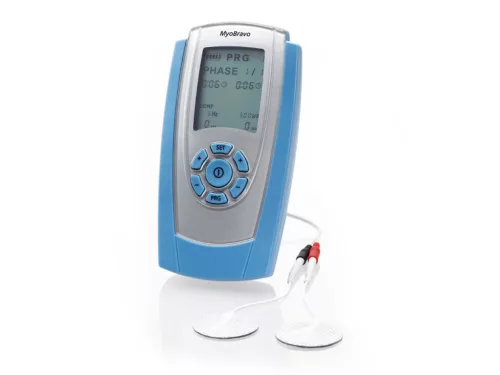
MyoBravo
A two-channel muscle stimulator with a rehabilitation focus — for anyone treating one leg, who wants a simple treatment and would primarily use it for rebuilding strength after surgery or injury. The smallest entry-level option for this task.
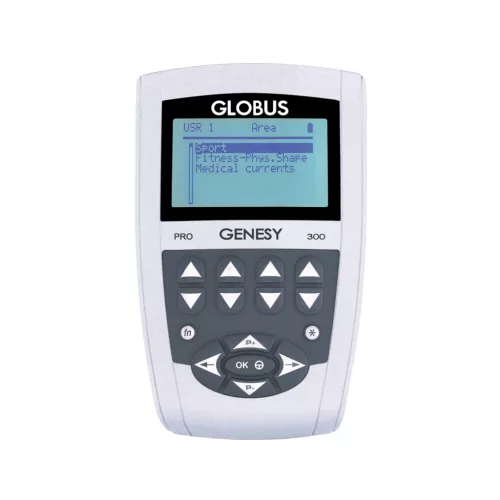
Genesy 300 Pro
A four-channel Globus device with EMS, TENS and microcurrent programmes: both thighs can be treated at the same time, and the same device can also be used to relieve knee pain with TENS. A sensible choice for most home rehabilitation.

Premium 400
The sibling of the Genesy 300 Pro, with an expanded sports and strengthening programme package — for anyone who also wants to use it for training goals (strength, endurance and recovery) after rehabilitation. Athletes can also choose sports-specific programmes (Runner, Cycling, Triathlon Pro).
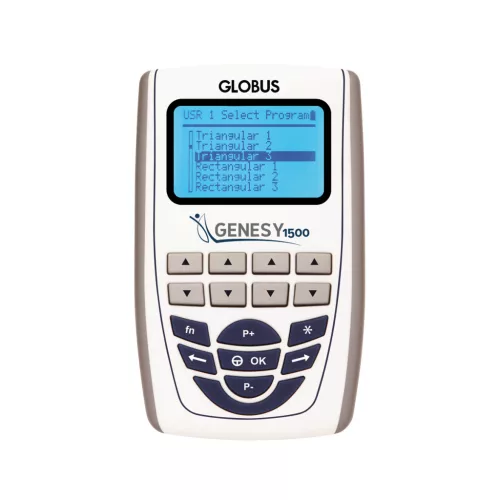
Genesy 1500
A professional device with a wide programme selection for physiotherapists, clinics and demanding home users — with ample capacity even for near-denervation conditions and complex rehabilitation protocols.
The full range — from the entry-level Elite 150 through the Activa 700 to professional devices — is available on the category page: Muscle stimulators →. If you are unsure which to choose, I have written separately about the differences between budget and professional devices: Comparing budget and professional muscle stimulators →
 When should you not use a muscle stimulator on your thigh?
- Pacemaker, implanted defibrillator or other active electrical implant – electrical stimulation is prohibited because it may interfere with the device’s operation.
- Recent or suspected deep vein thrombosis – muscle stimulation of the leg is prohibited in this situation: the muscle pump could dislodge the clot. After surgery and prolonged bed rest — when the risk of thrombosis is greatest — you should therefore agree the start of treatment with your doctor. Thrombosis →
- Pregnancy – electrotherapy on the trunk and lower limb during pregnancy requires medical approval.
- Epilepsy – only with approval from your treating doctor.
- Cancer in the treatment area – stimulation must not be performed over a known or suspected tumour.
- Skin injury, infection or a fresh wound at the electrode site – avoid the area until it has healed; after surgery, never place the electrodes on the scar or directly around it.
- Metal implant in the treatment area (e.g. knee replacement) – this is not an absolute prohibition: thigh muscle stimulation alongside a joint replacement has also been used in studies2, but do not place the electrodes directly over the implant, and agree its use with the surgeon after surgery.
- Acute, hot and swollen, unexplained knee – diagnosis first (inflammation? infection? gout?), rehabilitation afterwards: Knee pain guide →
 What does the research say? Based on readers’ questions
“Does it really speed recovery after cruciate ligament surgery?”
The best data come from this situation. According to an analysis reviewing 11 randomised studies, six of which were included in a meta-analysis, muscle stimulation added to standard physiotherapy in the early period after cruciate ligament surgery (4–12 weeks) produced a statistically and clinically significant additional improvement in thigh muscle strength compared with physiotherapy alone, and physical function also improved more.1 This is exactly the period when voluntary exercise works least effectively because of arthrogenic inhibition — in other words, EMS helps most where the traditional method is weakest. The longer-term difference evens out in the studies as personal exercise takes over the main role — but the strength gained in the early weeks determines the pace of the entire rehabilitation.
“And after knee replacement?”
The picture is favourable there too — with one important lesson. A systematic review of NMES studies after joint replacement found that rehabilitation supplemented with stimulation produced stronger thigh muscles, particularly in the early period after surgery, than standard physiotherapy alone. The authors also emphasise that the result depends on intensity and duration — short, low-intensity treatments have little effect.2 It is worth knowing that an early (2010) Cochrane review did not yet find sufficient evidence3 — the higher-quality studies using a greater treatment dose that have appeared since then have shifted the picture in a favourable direction. There are two messages for you: the method can work, but only when done properly — with a strong contraction, sufficient treatment time and consistent use over several weeks.
“Wouldn’t it be simpler just to exercise?”
Yes — as soon as you can. Exercise is the foundation of knee rehabilitation, and in osteoarthritis its effect is comparable with that of medicines4; in the long term, EMS cannot outperform or replace proper voluntary exercise. The value of stimulation lies in the transitional period: when pain, swelling, inhibition or immobilisation means that exercise is not possible or is only possible to a limited extent, EMS still works the muscle — so you will not have to rebuild from zero later. The right formula is therefore not “exercise OR stimulation”, but staging: at first, stimulation + as much exercise as you can manage, then gradually more personal exercise, with the device eventually serving only as an addition. For someone who can walk and is pain-free, the primary “muscle stimulator” is squatting and climbing stairs.
Frequently asked questions
It should not hurt — but you should feel it. At the correct intensity, you feel strong tingling followed by a firm, visible muscle contraction that is unusual but not painful; mild muscle soreness after the first treatments is normal and even a good sign. If you feel sharp, stinging or burning pain, the electrode is not adhering properly or the intensity has increased too quickly — reduce it, check the electrode and increase it more slowly. Always sit comfortably with your leg supported during treatment.
Your surgeon and physiotherapist should make this decision — in studies, stimulation typically begins in the first days or weeks after surgery as part of the rehabilitation protocol, because this is when it provides the greatest additional benefit. What you can do is ask at your first follow-up appointment whether it can be included in your programme, and bring the details of your device with you. Always keep the electrodes away from the area around the wound, and clarify the thrombosis question (see the contraindications). Read more: Using muscle stimulation after surgery →
The neural effect — “finding” the muscle again and being able to tense it more easily — can often be felt after 1-2 weeks. According to studies, measurable strength gains require 4–6 weeks of regular treatment at a good intensity, while visible increases in muscle bulk take 8–12 weeks. This is why the plan lasts 12 weeks, and why it is not worth judging it after 2 weeks. You can measure progress simply: measure thigh circumference with a tape measure (always at the same point and in the same position), count how many times you can stand up from a chair in 30 seconds, and note fatigue after climbing stairs.
Often, yes — active knee stability is provided precisely by strong, fast-reacting thigh muscles, and the feeling that the knee is “giving way” is often caused not by a ligament injury but by muscle weakness and a slowed muscle response. But the order is important: a doctor should first clarify the cause of the instability (ligament? meniscus? kneecap?), because when there is a true ligament tear, strengthening is necessary but is not always sufficient on its own. After diagnosis, however, a muscle programme is the backbone of treatment in every case — using the protocol described in this article.
The honest answer is: do not expect it to. EMS uses a fraction of the calories burned during a walk, and “spot fat reduction” does not exist — stimulation builds and preserves muscle; it does not break down fat. Weight loss is decided in the kitchen: Weight loss – the simple recipe for success → — you can get a realistic picture of body shaping here: Can you lose weight with a muscle stimulator? →
 Summary – Quick overview
Sources
- Hauger AV, Reiman MP, Bjordal JM, Sheets C, Ledbetter L, Goode AP. Neuromuscular electrical stimulation is effective in strengthening the quadriceps muscle after anterior cruciate ligament surgery. Knee Surg Sports Traumatol Arthrosc. 2018;26(2):399-410. DOI: 10.1007/s00167-017-4669-5
- Labanca L, Bonsanto F, Raffa D, Orlandi Magli A, Benedetti MG. Does adding neuromuscular electrical stimulation to rehabilitation following total knee arthroplasty lead to a better quadriceps muscle strength recovery? A systematic review. Int J Rehabil Res. 2022;45(2):118-125. DOI: 10.1097/MRR.0000000000000525
- Monaghan B, Caulfield B, O'Mathúna DP. Surface neuromuscular electrical stimulation for quadriceps strengthening pre and post total knee replacement. Cochrane Database Syst Rev. 2010;(1):CD007177. DOI: 10.1002/14651858.CD007177.pub2
- Fransen M, McConnell S, Harmer AR, Van der Esch M, Simic M, Bennell KL. Exercise for osteoarthritis of the knee. Cochrane Database Syst Rev. 2015;1:CD004376. DOI: 10.1002/14651858.CD004376.pub3