Pedicurist, Podiatrist and Special Foot Care — Whom Should You Turn To?
For foot-related complaints it's worth consulting a professional. Few people probably know exactly how a pedicurist, podiatrist or special foot care professional can help. These occupations are related. To help clarify, I asked Anna Németh, master special foot care practitioner, lecturer and instructor, for her input. Dr. Zsolt Zátrok (ZZs): What are the roles of the pedicurist, the podiatrist and the special foot care professional? Anna Németh (AN): All three professions deal with foot problems, but their training and competencies differ.

For foot-related complaints it's worth consulting a professional. Few people probably know exactly how a pedicurist, podiatrist or special foot care professional can help. These occupations are related. To help clarify, I asked Anna Németh, master special foot care practitioner, lecturer and instructor, for her input.
Dr. Zsolt Zátrok (ZZs): What are the roles of the pedicurist, the podiatrist and the special foot care professional?
Anna Németh (AN): All three professions address foot problems, but their training and competencies differ. While a pedicurist can help with simpler issues, a podiatrist and a special foot care professional can provide increasingly complex treatments. All three serve the patient's benefit, but in slightly different ways.
Every foot care treatment begins with an assessment. The specialist evaluates which conditions they can treat and which ones exceed their competence. They can determine when to refer the client to a medical specialist.
ZZs: Let's go through them one by one. What is the pedicurist's role and how far can they go?
AN: The pedicurist or foot care specialist's tasks range from aesthetic procedures to medical treatments. Aesthetic tasks include nail trimming, polishing and filing. Medical pedicure (medipedicure) includes removal of calluses/corns, treatment of inflamed or ingrown nails, etc.
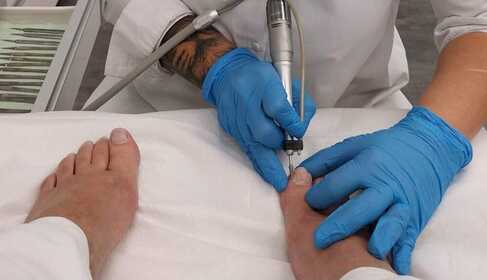
They use manual instruments and also specialized machines for treatments.
ZZs: Who is a podiatrist and what do they do?
AN: A podiatrist is a healthcare professional specializing in the diagnosis and treatment of disorders of the lower limbs and feet.
Their knowledge and tasks are diverse. They include assessment and correction of the static and functional condition of the lower limb, recognition of dermatological, angiological, diabetological and orthopedic processes, and correction of lower limb deformities.
They treat skin wounds, calluses, fissures, thickened, discolored and ingrown nails, and remove corns. They manage fungal infections.
Many of their tasks today relate to diabetes-associated foot changes (diabetic foot).
ZZs: Does the special foot care professional provide the highest level of care?
AN: Yes. The special foot care professional has the highest level of foot care knowledge. They handle problematic feet that exceed the podiatrist's competence.
The special foot care professional collaborates with the patient's treating clinic and hospital physicians to support and relieve them.
They perform post-treatment care that complements or follows medical care—activities that greatly aid healing. They measure pressure points and use diagnostic tools such as tuning forks, tip-therm and monofilament. They make custom offloading devices (orthoses).
ZZs: As a special foot care professional, what tasks occupy you the most?
AN: We examine the entire foot up to the knee. Our tasks include recognizing, treating and relieving pain from skin and nail issues as well as orthopedic conditions, and offloading the affected areas.
Most problems are caused by the nails. For example, ingrown or injured nails, or nail problems caused by internal diseases (thyroid disease, diabetes, circulatory insufficiency, psoriasis). Then there are nails infected with fungi or bacteria.
We must be able to recognize these and apply the most appropriate procedures!
Many skin diseases affecting the foot are infectious in origin: viral, bacterial or fungal.
Skin changes due to medications and various treatments (for example chemotherapy) are common, such as acute dermatitis, eczema and hyperkeratosis. Corns (clavus) and fissures are painful and act as entry points (which can lead to infection).
Autoimmune or metabolic disorders can also play a role in structural skin changes, and in many cases psychological factors may be involved.
It is important to distinguish skin types to decide which technique to use (manual or machine).
Signs of diabetes can be noticeable to us even when the client is unaware or if suspicion arises. Initially the skin is dry and fragile. Later there is callus formation, a white "floury" skin, and superficial ulcers on the sole and toes. Maintaining, treating and improving these, and when necessary applying dressings, are our tasks. The special foot care professional is trained to recognize and manage these. Early detection, treatment and advice for the diabetic foot are crucial to avoid limb loss!
Introduction

Anna Németh
Master special foot care practitioner, lecturer, instructor
My motto:
"A bridge connects the doctor and the foot care professional. The doctor is not a foot care specialist, and the foot care specialist is not a doctor! Together many problems can be solved and limbs saved!"
Owner of "recann", the first Hungarian nail regulation and correction method
ZZs: In your introduction you mentioned you developed a special method, the recann system. What should people know about it?
AN: Foot care is very important because we walk on our feet all day. Problems must be recognized and prevented in time.
Prevention is the most important thing. Many clients think their foot problem is trivial and will heal on its own. As a result they often arrive late. With timely treatment, a large portion of problems can be reversed. Early treatment can avoid nail removal and even toe amputation.
In over 28 years I have encountered many cases. I felt a great lack of an appropriate technique to treat ingrown, deformed and pincer nails. An ingrown toenail can be very painful. Simply cutting out the ingrown nail does not solve the problem.
Something else is needed. I tried various foreign corrective systems, but one was cumbersome, another lengthy, a third expensive, and a fourth painful.
To fill this gap I developed the first Hungarian nail regulation and correction method.
It is painless, does not interfere with regrowth, cost-effective, fast and gives immediate results. And (I say this for the ladies) it can be polished.
The name of my method is recann. I coined it from rec = reconstruction and ann = Anna.
Since then I have used it with great success, together with hundreds of colleagues. Great results in a short time. In this area there is no longer a gap!