

 What is piriformis syndrome — and why is it confused with sciatica?
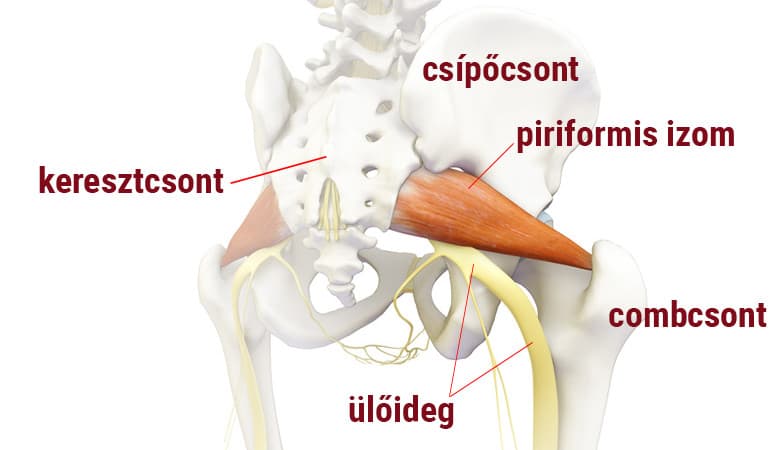
The piriformis is a flat, band-shaped muscle under the gluteal muscles, at hip level. It plays a key role in walking: it stabilises the hip joint, turns the thigh outwards and lifts it to the side, and helps shift body weight from one leg to the other. Directly beneath it — more rarely through it — runs the body’s thickest and longest nerve, the sciatic nerve, which leaves the spine and runs through the buttock and thigh all the way to the foot.
If the piriformis muscle tightens, cramps, or thickens, it can press on the sciatic nerve running beneath it — and that causes exactly the same radiating pain as if the entrapment were in the spine. That is why misdiagnosis is so common.
 Key point
In piriformis syndrome, treatment is not about tablets and not about surgery, but about loosening the muscle and then strengthening it — and that means regular work at home for weeks or months: stretching, exercise, and the physiotherapy that supports it. The doctor’s job is the diagnosis (which is not simple here) — the work of recovery is yours.
 Which one is mine? — quick guide
If the pain starts in your lower back and radiates from there into the leg, suspect a spine-related problem: read my articles on sciatica and disc herniation. But if the pain centres deep in the buttock, gets worse when sitting, and deep pressure on the gluteal muscle brings it on — stay with this article. The final word comes from the specialist.
 How does it develop?
The starting point is injury to the muscle or long-term overload: a blow, a fall onto the gluteal muscle, or the tiny injuries caused by thousands of repeated movements in runners and cyclists. The inflamed muscle contracts reflexively, becomes stiff — and if the sciatic nerve runs “in the wrong place”, too close, the muscle presses on it. A vicious circle starts: because of the pain, the muscle tightens even more, and the tightness presses the nerve even more.
Two extremes meet in the same diagnosis: people who sit a lot (office work, drivers — sitting keeps the muscle under constant pressure) and people who train a lot (runners, cyclists, in whom repeated loading wears the muscle down). A sudden increase in training volume, one-sided loading, and a previous injury to the gluteal muscle also make it more likely.
Because there is no instrument-based test that shows it clearly: X-ray, ultrasound and MRI usually do not show any change — they are mainly used to rule out spine-related causes. The diagnosis is made by an experienced examiner from the pattern of symptoms and special movement tests: movements that tighten the piriformis and trigger the familiar pain.
Symptoms of piriformis syndrome
The most typical complaints are:
- Pain deep in the gluteal muscles — from tingling and numbness to severe, distressing pain
- Radiation along the sciatic nerve into the back of the thigh and the lower leg — which is why it can be mistaken for sciatica
- Symptoms that worsen when sitting, walking, climbing stairs, or running — many people “can’t sit still” because of the pain
- Pressure sensitivity: strong pressure directed deep into the gluteal muscle triggers the familiar pain
- In severe, prolonged cases, the muscle can shorten so much that the affected leg turns slightly outward
 When should you see a doctor immediately?
If your leg becomes weak, if the numbness also extends to the perineal area (towards the genital organs), if urinary or bowel control problems appear, or if the pain started suddenly after an injury — these are not piriformis symptoms, but they may be warning signs of a spine-related emergency that need urgent medical assessment.
Home treatment — loosen, then strengthen
The basis of medical treatment is the conservative route: reducing load, anti-inflammatory medicine, physiotherapy — injection (steroid, botulinum toxin) only if that is not enough, and surgery only very rarely.2 Once the diagnosis is clear, most of the work happens at home, and the goal is twofold: first loosen the cramping muscle, then strengthen it, so the symptoms do not return.
Step 1: reduce the load — but do not stop completely
If you keep creating the trigger again and again, you are working against recovery. Temporarily reduce training and prolonged sitting (stand up for a few minutes every hour) — but do not become inactive: walking and swimming help.
Step 2: cooling for acute pain
Place an ice pack wrapped in a towel on the painful area for 10-15 minutes, then let it warm up again (about 1 hour), and repeat 3-4 times a day. Cooling reduces inflammation, and warming up again boosts circulation. Do not use this method for more than two or three days.
Step 3: loosening — stretching, ultrasound, deep massage
 The daily stretching and exercise programme
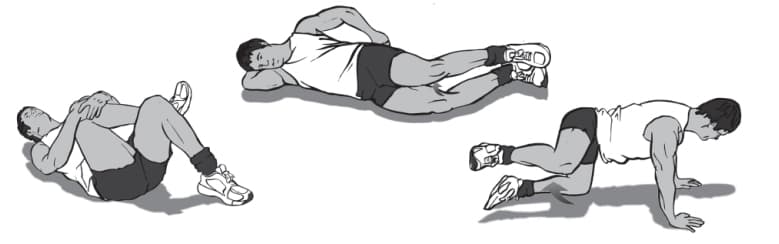
Piriformis stretch: lie on your back, pull up one knee, and cross the other leg over it. Hold the raised knee, and slowly pull it towards the opposite shoulder. Hold for a few seconds, repeat 20 times on both sides, and gradually increase the holding time.
Strengthening in side-lying: with your knees bent up (at a 60 degree angle), lift the top knee so that your ankles stay together throughout — hold, lower it, 10 repetitions on each side.
Strengthening on all fours: lift one knee out to the side, hold it for a few seconds, lower it again — 10 repetitions on each side, increasing the hold by 1 second every day.
Loosening the deep muscle can also be supported by devices.
Therapeutic ultrasound (1 MHz, because that penetrates deep enough) warms the tissue and may help the stiff muscle relax: 1 treatment a day, at medium intensity, for 10 minutes, always with ultrasound gel — for up to 12 days, then take a 3-4 month break in that area.
The vibration massage gun, with a small head, reaches the deep piriformis in a pinpoint way: 1-2 minutes per area is more than enough — anyone who has tried it knows why.
Step 4: strengthening — exercise or muscle stimulator
With exercises, the muscle can be rebuilt over months. If you do not have the patience or time for a long exercise programme — let’s be honest, that applies to most of us — an electrical muscle stimulator is useful: with a combination of pain-relieving, muscle-relaxing and muscle-strengthening programmes, the first noticeable improvement usually comes after 2-3 weeks. For a full resolution, however, even with stretching and a stimulator, expect 2-3 months — this is not a quick fix, but consistent work.
Home devices — where to start?
You do not need everything at once. The nature of your symptoms decides: if the stiff, cramping muscle is the main problem, start with loosening devices; if the aim is to replace the long exercise programme, start with electrotherapy.
Premium 400 electrotherapy device A practical starting point, because it has all three functions needed for treatment in one device: TENS for pain, microcurrent to support regeneration of inflamed tissues (2-3×20 minutes a day), EMS to relax and strengthen the muscle again. With one machine, you can carry out the whole programme.
Genesy 300 Pro electrotherapy device An alternative to the Premium 400. You do not need both.
SonicRelief therapeutic ultrasound device 1 MHz ultrasound for home use to loosen the deep muscle, together with contact gel. An additional step in the loosening phase — follow the 12-day rule above.
4 Vibe massage gun With the pinpoint massage head, the piriformis deep in the gluteal muscles can also be reached: it speeds up circulation and relieves muscle tension. At most 1-2 minutes per area — no more is needed, and it is not pleasant either.
 Before you start home treatment
- No diagnosis yet – pain that feels like sciatic nerve pain may also be caused by a disc herniation or another spine disease; specialist assessment first, then a home programme.
- Leg weakness, numbness in the perineal area, urinary/bowel control problems – urgent medical care is needed, do not treat at home.
- Cardiac pacemaker – electrotherapy devices (TENS, EMS, microcurrent) cannot be used.
- Pregnancy – consult your doctor before using device-based treatments.
- Thrombosis, inflamed varicose vein in the affected limb – massage and device treatment are forbidden until medically clarified.
- Skin injury, infection in the treated area – do not treat until it has healed.
 What does the research say?
“How can you tell that the piriformis really is the culprit?”
According to the research summary, the most telling signs are a combination of four findings: pain in the buttock, tenderness deep in the buttock, symptoms that worsen when sitting, and pain that can be triggered by movements that tighten the piriformis muscle. If this pattern fits you, it is worth seeking an examiner with specific experience of piriformis syndrome.1
“How often is the diagnosis missed?”
More often than you would think. According to the literature, piriformis syndrome is regularly confused with spine-related nerve entrapment and other lower back disorders, because the symptoms overlap greatly — estimates suggest that this syndrome is actually responsible for a small but not negligible share of chronic lower back and buttock pain. Correct recognition is key, because its treatment is different from that of spine disorders.2,3
“What is the official order of treatment?”
Professional reviews are consistent: first comes conservative treatment — stretching, physiotherapy, anti-inflammatory measures — and for most patients that is enough. Injection treatments (steroid, botulinum toxin) are only for cases that do not improve, and surgery is exceptional, a last resort. In other words, the home programme described in the article is not a “fallback”, but the officially recommended first-line approach.2
Frequently asked questions
The word “sciatica” means pain along the sciatic nerve — but the cause can be two different things: in the spine (for example a disc herniation) or deep in the buttock (piriformis). Piriformis-related pain is centred in the buttock, gets worse when sitting, and forward bending of the lower back typically does not provoke it — spine-related pain behaves the other way round. Exact differentiation is the specialist’s job.
With consistent home treatment, the first noticeable improvement usually comes after 2-3 weeks, and full settling should be expected in 2-3 months. The most common mistake is stopping the programme too early at the first sign of improvement — then the symptoms are very likely to return.
Continuous sitting is one of the main maintaining factors. If you do desk work: stand up for a few minutes every hour, avoid hard chairs and a thick wallet in the back pocket (it really matters — it puts one-sided pressure on the muscle), and if you can, alternate between sitting and standing work.
Moderately, yes — total stopping is not the goal. Reduce running and cycling (the typical triggers) while the symptoms are acute, and replace them with swimming and walking. The return should be gradual, and stretching should become a lasting part of your training routine — that gives the most protection against relapse.
Very rarely. According to professional recommendations, the vast majority of patients improve with conservative treatment — stretching, exercise, physiotherapy, and injections if needed. Surgery is only considered if long, consistently followed treatment has still not brought results.
 Summary – Quick overview
Sources
- Hopayian K, Song F, Riera R, Sambandan S (2010). The clinical features of the piriformis syndrome: a systematic review. European Spine Journal. PubMed: 20596735
- Probst D, Stout A, Hunt D (2019). Piriformis Syndrome: A Narrative Review of the Anatomy, Diagnosis, and Treatment. PM&R. PubMed: 31102324
- Boyajian-O'Neill LA, McClain RL, Coleman MK, Thomas PP (2008). Diagnosis and management of piriformis syndrome: an osteopathic approach. Journal of the American Osteopathic Association. PubMed: 19011229