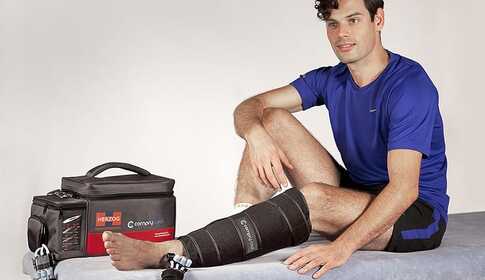

 What is cold compression therapy?
Cold compression therapy — which combines cryotherapy and compression therapy — offers benefits enjoyed by both athletes and patients. It can be used for:
- everyday sports activity — to support muscle recovery after the strain of training and competition (see the pillar article: compression therapy for athletes);
- acute muscle and joint injuries — to relieve pain and swelling and to support the healing process (for symptomatic differential diagnosis see the leg swelling triage article, sport section);
- post-operative rehabilitation (e.g. knee ligament or shoulder surgery) and to accelerate muscle recovery.
Cold compression can positively influence pain, swelling and edema; it can support muscle regeneration and blood flow. Studies indicate that combining cold therapy with compression therapy is more effective than using either alone.
 Key point
Cold compression is a modern implementation of the RICE principle (Rest-Ice-Compression-Elevation): cooling + intermittent pressure in a single device. It is a primary choice during the first 48–72 hours after an acute injury; in sport regeneration it can be combined with "warm" pneumatic compression (IPC). Therapeutic temperature 5–10 °C, 20 minutes per session. Pillar: compression therapy for athletes; parallel IPC modality: pneumatic compression and muscle regeneration.
 How does the cold compression (ice massage) machine work?
The ice massage machine combines the functions and advantages of cryotherapy and a compression device:
- The compressor inflates the cuff to the desired pressure, holds it for a set time, releases the pressure, then inflates again.
- Intermittent pressure has been proven to be more effective than static pressure because it more favorably supports circulation, helping to reduce swelling.
- During compression, a pump circulates icy water from a reservoir into the treatment cuff and slowly recirculates it.
Compression by itself is effective in reducing swelling and edema: the active, intermittent squeeze pushes the swelling from the injured area toward healthy tissue and it is removed via the lymphatic system. This type of compression supports blood flow, delivering more oxygen to the injured area, which can accelerate healing.
Cold therapy can positively affect pain and swelling, making recovery faster and more comfortable.
Ice massage and muscle recovery
High-intensity training causes microtrauma in muscles that does not necessarily limit function, but it is important to know that the body responds to muscle fiber injury with an inflammatory defensive and self-healing reaction. This normally lasts 2–3 days. Only after this period does true healing begin.
Cooling helps reduce this inflammation, while the circulation-supporting effect immediately triggers healing processes. This increased circulation has further beneficial effects: it helps clear lactic acid from the muscles, which causes fatigue and stiffness.
That is why cooling is used in many sports: track and field athletes, cyclists, triathletes, combat sports athletes, and also after team ball game training sessions. The details of the regeneration routine are discussed in depth in the pneumatic compression and muscle regeneration cluster article — the two modalities complement each other.
 Basic parameters of the ice massage treatment
Medical recommendations suggest a continuous 20-minute cryotherapy session on a given area, followed by a "rest" period at room temperature. The therapeutic temperature is between 5–10 °C — meaning the assumption "colder is better" is not true! Below 5 °C the risk of freezing injury contraindicates use.
When cold, when "warm" compression?
| Situation | Choice |
|---|---|
| First 48–72 hours after an acute injury (sprain, strain, joint trauma) | Cold compression (inflammatory phase) |
| 1–2 weeks after surgery (ACL, shoulder surgery, etc.) | Cold compression + medical protocol |
| Acute muscle contusion of traumatic origin (e.g. after prolonged contact) | Cold compression in the first 24–48 hours |
| DOMS (delayed onset muscle soreness) after training | IPC ("warm" pneumatic compression) |
| Between-competition regeneration (multiple matches) | Combination of IPC + cold compression |
| Chronic venous disease, lymphatic congestion | IPC (cold contraindicated) |
The two modalities do not exclude each other — athletes often use them one after the other. After an acute injury, cold compression is preferred for the first 48–72 hours, then switching to IPC can support further regeneration.
 Before you start — contraindications
- Raynaud's syndrome or other cold sensitivity
- Reduced peripheral circulation (severe arterial stenosis, critical ischemia)
- Open wound in the treatment area without physician approval
- Reduced or absent skin sensation (neuropathy, sensory loss)
- Cryoglobulinemia, cold agglutinin disease
- Acute deep vein thrombosis
 Risk of freezing!
Therapeutic temperatures below 5 °C are not recommended — freezing injuries may develop. Never apply ice directly to the skin; keep a layer of the cuff between the skin and the ice. If numbness, whitening of the skin or sharp pain occurs, stop the treatment immediately.
 Cold-compression devices
Ice massage machine
Cold-compression (ice massage) devices for home and therapist use: intermittent pressure + icy water circulation. Suitable for sport regeneration, acute injuries and post-operative rehab.
Lymphatic massage machine (IPC) – category
After the acute injury phase (after 48–72 hours) IPC can take the lead in the regeneration protocol. The two devices complement each other.
Practical recommendations for athletes: lymphatic massage machine category page – sport section; technical buying guide: Lymphatic massage machine — what it is for, how to choose?.
 Scientific background
Cryotherapy and sport regeneration — meta-analysis (Hohenauer 2015)
Hohenauer and colleagues' 2015 meta-analysis suggests that cold water immersion (CWI) can positively affect perceived recovery parameters, muscle soreness and markers of muscle damage in athletes.1
Cryotherapy after acute injury — Cochrane (Bleakley 2012)
Bleakley and colleagues' Cochrane review indicates that cold therapy may favorably influence pain and swelling in acute muscle and joint injuries within the first 72 hours. The compression combination may strengthen the effect.2
IPC + cold combination at a multisport tournament (Fernández-Lázaro 2020)
The combination of pneumatic compression and cold water immersion favorably supported athletes' physiological and perceived recovery at an international multisport championship.3
Summary
Studies show that pairing active compression with cold therapy increases blood flow, favorably affects swelling, edema and muscle spasm; cold reduces post-injury pain. Cold compression therapy can therefore result in faster healing.
This therapy can be used for minor joint pain and in post-operative rehabilitation (e.g. recovery after ACL surgery). Active athletes can also use cold compression therapy after daily training to support post-exercise muscle recovery. Overworked, stiff, sore muscles fill with blood and oxygen under the influence of cold and compression, swelling and excess fluid (edema) decrease, lactic acid and other metabolites are flushed out — as a result, regeneration can accelerate and you can be ready for the next load sooner.
Deeper guides on sport and compression topics
In addition to cold compression, several home modalities and related condition articles can help plan sport regeneration and post-injury recovery:
Sport regeneration pillar and parallel modality
- Compression therapy for athletes — pillar article on all regeneration modalities
- Pneumatic compression and muscle regeneration (IPC) — parallel modality (DOMS, lactic acid, recovery)
- Muscle stimulator (EMS) devices — support for muscle tone after regeneration
Related venous and symptomatic conditions
- Home treatment of venous disease — athlete-specific varicose veins
- Thrombosis — when your vein clots — pillar article (DVT acute: cold compression contraindicated!)
- Leg swelling triage — sport section — when is it regenerative, when is it medical?
- Leg swelling triage — injury section — RICE principle and acute ankle sprain
Home device categories
Frequently asked questions
In the first 48–72 hours after an acute injury: 2–3 times daily, 20 minutes per session, with 1–2 hours rest between sessions. For sport regeneration, 1×20 minutes after training is sufficient. After 48 hours, consider switching to pneumatic compression (IPC).
Below 5 °C the risk of freezing injury increases — the skin and superficial tissues can be damaged. Clinical research has worked within the 5–10 °C range. The assumption "the colder, the better" is clearly false.
No. Cold compression is a complement to the post-operative rehabilitation protocol; analgesic and anti-inflammatory medications must be taken as prescribed by the surgeon/anesthesiologist. Cold compression may reduce medication needs but does not replace them.
From the day after surgery (or at the time specified by the orthopedist) — always follow the protocol given by the treating physician. In the first weeks, 3–4 treatments per day are typical, with 20-minute sessions. The exact protocol is defined by the surgeon and physiotherapist.
 Summary
Sources
- Hohenauer E et al. (2015). The Effect of Post-Exercise Cryotherapy on Recovery Characteristics: A Systematic Review and Meta-Analysis. PLoS One. PubMed: 26361787
- Bleakley CM et al. (2012). PRICE needs updating, should we call the POLICE? British Journal of Sports Medicine. PubMed: 22075321
- Fernández-Lázaro D et al. (2020). Intermittent Pneumatic Compression and Cold Water Immersion Effects on Physiological and Perceptual Recovery during Multi-Sports International Championship. International Journal of Environmental Research and Public Health. PubMed: 33467261