Relieving menstrual pain: solutions for those "difficult days"
“Difficult days”, “that time of the month” – even common expressions hint that menstruation can often be quite unpleasant. Every woman experiences this time differently. Some aren’t bothered by these few days at all. Some suffer mild discomfort, and some are tormented by almost unbearable pain, which can lead to missed days from work or school…

“Difficult days”, “that time of the month” – even common expressions hint that menstruation can often be quite unpleasant. Every woman experiences this time differently. Some aren’t bothered by these few days at all. Some suffer mild discomfort, and some are tormented by almost unbearable pain, which can lead to missed days from work or school. Fortunately, in most cases menstrual pain is harmless. Let’s look at what you can do at home to prevent and relieve it.
Characteristics of menstrual pain
Menstrual pain (medically called dysmenorrhea) means cramps, lower pelvic pain and weakness during menstruation. It primarily occurs in teenage girls and women who have not given birth.
Fortunately, the causes and consequences are usually not serious (unless another disease underlies the discomfort).
The most common symptom is crampy lower abdominal pain (which can radiate to the lower back, buttocks, and lower limbs), and it may be accompanied by general malaise, listlessness, fatigue, headache, frequent urge to urinate, diarrhea and nausea/vomiting.
Dysmenorrhea can be classified by severity as
- mild (mild pain lasting a few hours),
- moderate (moderate pain lasting longer than a day),
- and severe (severe pain lasting longer than a day).
It’s important to find out whether a disease is causing the menstrual pain!
Types of menstrual pain:
- Primary dysmenorrhea occurs without any disease or structural abnormality. The pain simply appears with ovulation and is caused by prostaglandins released during menstruation, which cause uterine contractions, reduce uterine blood flow, and increase the sensitivity of pain receptors in the uterus.
- Secondary dysmenorrhea is caused by an underlying pathological condition or disease. Symptoms are generally more severe. The most common causes include
- pelvic inflammatory disease (PID),
- endometriosis (when endometrial cells appear not only in the uterus but also outside it),
- and fibroids (common but benign tumors).
With menstrual complaints it is therefore worth consulting a doctor to rule out secondary causes. If any are found, those must be treated. If there is no underlying disease, you can relieve your symptoms with self-care.
Relieving menstrual pain
Doctors generally recommend antispasmodic medications to reduce symptoms. Keep in mind that medications—especially with regular use—can have unwanted side effects, so it’s advisable to take as little as possible and prefer drug-free methods when you can.
- For milder complaints, heat can be beneficial in easing uterine cramps. Place a warmed towel, hot water bottle or a deep-heat therapeutic belt on your abdomen or lower back.
- Relax and unwind. A soothing massage often works wonders.
- Many complaints can arise from psychological causes. If you view menstruation as a “curse of being female,” that attitude alone can trigger symptoms. Treating menstruation and femininity with acceptance helps reduce and eliminate pain. If you think your symptoms may relate to your feelings about being a woman, consult a psychologist and ask for help.
- As the critical period approaches, pay attention to your diet. Drink plenty of fluids, eat fiber-rich foods, and reduce meat consumption. Chamomile or ginger herbal teas act as natural muscle relaxants and relieve cramps.
- The TENS device can be used for almost any form of pain, including menstrual complaints. The success rate is at least 70–80%, meaning that patients report a reduction in pain at that rate. The method is drug-free and can be repeated as often as necessary without the risk of side effects. Home use is simple and safe!
For example, the Dolito TENS device is suitable for treatment. The modulated TENS program is expected to deliver the best results.
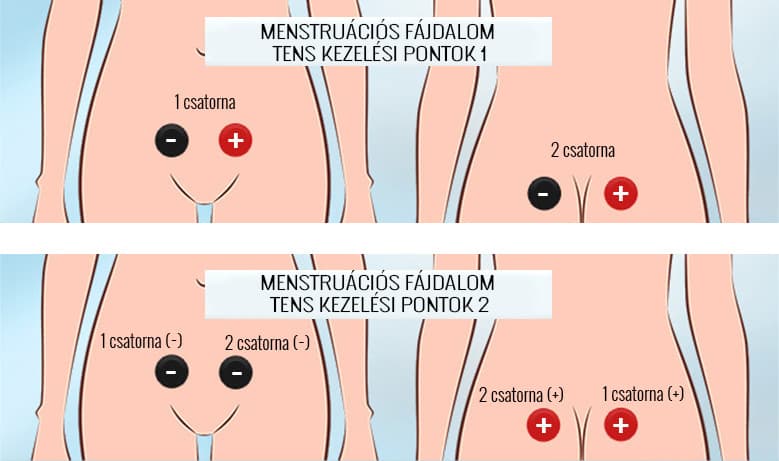
I made a diagram showing where to place the electrodes.
- Attach the two ends of the cable for the first channel to the electrodes on your lower abdomen, and connect the other channel’s cables to the ones above your sacrum at the back.
- One end of the first channel’s cable goes to the front right of your lower abdomen, the other end to the right side of your sacrum at the back. The other channel should connect the left side in the same way.
Try both placement methods and later use whichever proves more effective. For such treatment you can use, for example, the Dolito TENS device.