Respiratory muscle training – MadMax in the gym
Respiratory muscle training is a technique aimed both at exercising the muscles involved in breathing and at improving the performance of the respiratory system, ultimately boosting endurance and recovery capacity. Typically, breathing exercises are recommended for people with respiratory diseases such as asthma, COPD, bronchitis and emphysema. Athletes have also discovered its benefits and use it in everyday training — studies have confirmed the advantages of respiratory muscle training in athletes.
Respiratory muscle training is a technique aimed both at exercising the muscles involved in breathing and at improving the performance of the respiratory system, ultimately boosting endurance and recovery capacity.
Typically, breathing exercises are recommended for patients with respiratory disorders such as asthma, COPD, bronchitis and emphysema. Athletes have also discovered its advantages and apply it during regular training – and studies have validated these benefits: they have demonstrated the positive effects of respiratory muscle training in athletes.
Goals of respiratory muscle training
- Improving breathing efficiency
- Optimizing oxygen uptake and transport
- Improving carbon dioxide tolerance
- Improving the blood's ability to release oxygen
- Enhancing overall physical endurance, especially under load
Benefits of respiratory muscle training
Training the respiratory muscles brings many benefits that can be useful for everyone, particularly in endurance sports. In addition, many people with respiratory illnesses can enjoy these advantages.
Effect on the whole musculature
RMT (Respiratory Muscle Training) causes several changes in the body. It does not only stimulate the respiratory system but also provokes responses throughout the whole body. Its main benefit appears in the continuous metabolic "improvement" – as a result of respiratory muscle training, carbon dioxide tolerance and oxygen uptake improve, and thus oxygen delivery. Better cellular oxygenation leads to aerobic energy production, i.e. delayed and reduced lactate production, which directly results in more efficient and longer-lasting muscle performance. Another advantage is that improved oxygen kinetics also reduce heart rate.
Structural and functional adaptation
Respiratory muscles, like skeletal muscles, respond to training. They adapt both functionally and structurally.
- Structural adaptation – muscle fiber type shifts (type IIa fibers move toward type I, i.e. increased endurance) and endurance-related muscular strength increases.
- Functional adaptation – marked improvements are seen in carbon dioxide tolerance, expiratory values, peak inspiratory flow, flow rate, strength, power, maximal inspiratory performance and respiratory endurance.
Performance improvement
Study data clearly show that training with a mask (also called a training mask) improves endurance performance and recovery.
How does the training mask help respiratory muscle training?
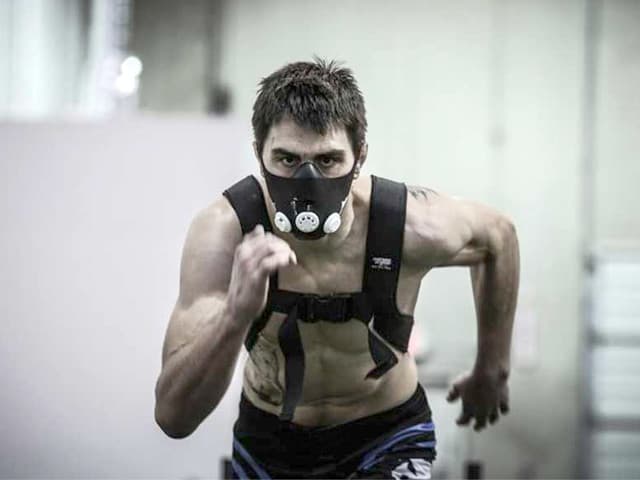 The use of a training mask during workouts initially feels suffocating — "you'll think you're going to die" — but when used smartly and progressively it is an excellent tool to improve your endurance performance and recovery capacity. The mask covers the nose and mouth opening and allows inhalation only through an adjustable resistance valve. The higher the valve resistance, the more you must focus on your breaths and on voluntary control of the respiratory muscles.
However, the mask's most important feature is the dead space — the volume that retains part of the exhaled air and which you re-inhale on the next breath. The oxygen concentration of the air inhaled through the mask decreases only slightly, but the carbon dioxide concentration increases substantially. This raises the body's overall carbon dioxide level, which, through the Bohr effect, improves cellular oxygen delivery. (Bohr effect: the higher the carbon dioxide level, the more readily hemoglobin releases the oxygen it carries to the cells.) Repeatedly inducing elevated carbon dioxide levels during training causes your body to "get used" to it, and this adaptation ensures greater efficiency and performance during competitions when you take the mask off.
Strengthening the respiratory muscles
Although not its primary effect, the training mask also strengthens the intercostal muscles and the diaphragm. The mask creates resistance against which you must breathe. This forces the muscles and the cardiovascular system to work harder and thus adapt.
Conditioning booster
Breathing efficiency is very important in endurance sports. The training mask helps effectively improve your performance, primarily by increasing your endurance, stamina, and recovery. With breathing training you can achieve better results. Of course, your goal may simply be to become fitter in everyday life. For people with airway diseases it can also help prevent symptoms.
Boosting mental and physical energy
Using a training mask helps you concentrate on your breathing, since the mask increases resistance and thus makes breathing more effortful. It is also notable that regular use of the mask can improve your tolerance for breath-holding under stress — in extreme competition scenarios, this ability to "endure" can become an advantage.
Meditative breathing exercises aimed at harmonizing body and mind have been known in Eastern cultures for millennia. Proper breathing is essential in daily life and in almost every sport. By focusing on your breath you can reach a higher level of performance in sport as well. Overall, the training mask can have excellent effects not only on your sports performance but on your general health, too.
Conditions for using a training mask
Before trying a training mask determine your personal breath-hold control time. This is the duration that elapses in a normal, resting state between a usual exhalation and the appearance of breathlessness while you do not take a breath. In other words, from a normal exhalation (not after a deep inhalation) measure how long you can hold your breath.
If you do not reach 15 seconds, then DO NOT use a training mask, because the mask will raise your body's carbon dioxide level so much that it can be "very unpleasant" (fainting, diarrhea, heart rhythm disturbances, headache, sleep disorders, etc. can occur). With small control pause values (<15 s), a training mask is definitely not the right tool to improve breathing and endurance – first get in shape with conventional training and cardio.
A training mask can be used safely if your control pause value exceeds 20 seconds, and preferably 25 seconds. Even then you should not start with closed valves! Remove the choke membranes from the mask and begin using only the dead space. After a few weeks, if your control pause exceeds 30 seconds, you can set the restriction to the baseline. With a control pause above 45 seconds it is enough to start increasing the restriction.