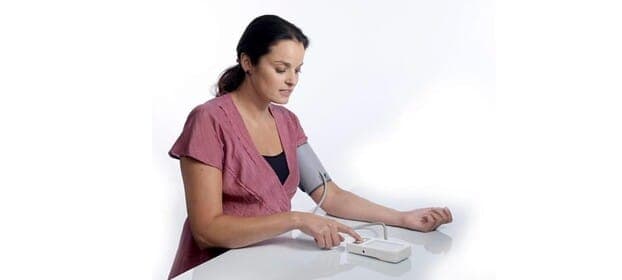

 Blood pressure measurement: simple — until you get it wrong
Most people think measuring blood pressure is child's play: put on the cuff, press the button, and that's it. Usually, it really is that simple — but without knowing a few basic rules, the device can easily show a reading 10-20 mmHg different from the actual value. That's no small matter: a wrong reading can lead to a wrong decision — unnecessary medication, or, conversely, poorly managed high blood pressure, the consequences of which (heart attack, stroke, kidney damage) cannot be corrected with another measurement.
Four things determine the accuracy of a home reading: the type of device, the cuff size, your position during measurement, and what you do before and during the measurement. In this article, I'll go through these four factors — briefly and practically, so you can put them into practice from your next measurement.
 Key point
A blood pressure monitor is only as accurate as the conditions in which you measure. An upper-arm monitor, a cuff that fits your arm, your arm held at heart level, five minutes of rest, a still hand and silence during the measurement — these five conditions give you and your doctor a reading you can rely on. And always measure in the same way: on the same arm, with the same device, in the same position, because only comparable readings show how your blood pressure is changing.
 The four factors that determine what the device shows
| Factor | Typical mistake | The rule |
|---|---|---|
| Device type | Choosing a wrist monitor because it's more convenient | Use an upper-arm monitor; use a wrist monitor only if measurement on the upper arm isn't possible |
| Cuff size | A cuff that's too large for a slim arm or too small for a larger arm | The cuff should wrap around the arm about one and a half times; your arm circumference must fall within the range marked on the cuff |
| Position | Arm hanging down, legs crossed, sitting without back support | Sit with your back against the chair, feet flat on the floor, cuff at heart level and arm supported |
| Before and during measurement | Measuring without resting after coffee, smoking or climbing stairs; talking or moving during measurement | Sit quietly for five minutes beforehand; keep your hand still and stay quiet until the cuff has fully deflated |
 Choosing a device: upper arm or wrist?
Upper-arm monitors are more accurate, and their readings are the ones accepted in medical practice. Wrist monitors give different readings from upper-arm monitors because the artery in the wrist is smaller and measurement is much more sensitive to hand position. That's why doctors generally don't accept wrist-monitor readings, except in special cases: when for some reason the upper arm can't be used (a very large arm, recent surgery, lymphoedema or severe pain). You can read a detailed comparison of the two types in this article.
How do you know if your device is reliable?
Home monitors detect vibrations (oscillations) in the artery walls and use them to calculate the two readings. A good-quality, clinically validated device does this reliably — but only if the measurement is taken correctly. Here's a simple check: take your monitor to your next medical appointment and take readings with both your device and the doctor's monitor, one after the other on the same arm. If the readings are within 5-10 mmHg of each other, you can feel confident about the readings from your home monitor.
Cuff size: the detail most often got wrong
The right cuff wraps around the upper arm (or wrist) about one and a half times. It won't fit properly and will give an inaccurate result if it's too short — with the ends barely overlapping by 1-2 centimetres — or too long, so that it wraps around twice. A cuff that's too small gives a higher reading than the actual value; one that's too large gives a lower reading. Most cuffs show the arm-circumference range (for example, 22–32 cm or 22–42 cm): use a tape measure to measure the circumference of your upper arm halfway between the shoulder and elbow, and check that it falls within the range. If it doesn't, you can order a different cuff size for your device from the manufacturer.
When putting on the cuff, pay attention to three things. Put it on bare skin or, at most, over a thin shirt sleeve — a rolled-up, tight jumper sleeve constricts the arm and distorts the measurement. Position its lower edge 2-3 centimetres above the elbow crease so it doesn't restrict bending your arm. The arrow or line marking the artery should point along the inside of your arm, towards the elbow crease: that's where the artery runs, and the device monitors its pulse.
Position during measurement: heart level is key
The most important physical rule for blood pressure measurement is that the cuff must be at the same level as your heart. If your arm hangs lower, the monitor gives a higher reading than the actual value; if it's higher, the reading is lower — by roughly 7-8 mmHg for every 10 cm difference. So it matters whether your arm is in your lap, on the table or held in the air.

| Upper-arm measurement (left-hand diagrams) | Wrist measurement (right-hand diagrams) |
|---|---|
| Sit on a chair, lean against the backrest, keep your feet flat on the floor and don't cross your legs. | Sit on a chair in the same way: back against the backrest, feet flat on the floor, legs uncrossed. |
| Fasten the cuff around your upper arm so it's at the same level as your heart. | Fasten the cuff so that the device sits on the palm side of your wrist. |
| Rest your forearm on the table in front of you, palm facing up, and support it — keep your arm muscles relaxed. | Raise the device to heart level (in front of your chest) and use your other hand to support the elbow of the arm being measured. |
| Wait until the cuff has fully deflated before moving. | Keep your wrist still and straight; don't bend it. Wait until the cuff has fully deflated. |
During measurement: two things you mustn't do, but almost everyone does
First: don't move your hand or drum your fingers until the cuff has fully deflated — even clenching your fist or reaching for your phone can interfere with the reading. Second: don't talk. Home monitors detect vibrations in the artery walls, and speech (or laughter, or reacting to the television) can mask these subtle vibrations. It can also raise your blood pressure. Sit quietly and relax during the measurement, and look at the monitor's display.
 Before, during and after measurement — a short protocol
Getting into the right position isn't enough if what you do in the minutes before the measurement affects the reading. Blood pressure is a live reading: coffee, a cigarette, a flight of stairs, a full bladder or an upsetting phone call can raise it by 10-20 mmHg. That's why there's a short but essential routine to follow when measuring.
| When | What to do |
|---|---|
| 30 minutes before measurement | Don't drink coffee or energy drinks, smoke or exercise. Empty your bladder. |
| 5 minutes before measurement | Sit where you'll take the measurement and remain quiet and relaxed — no phone, television or conversation. Put the cuff on now. |
| During measurement | Keep your hand still, stay quiet, relax your muscles and keep the cuff at heart level. |
| After measurement | Wait 1 minute and take another reading. Write down both readings (or their average), your pulse and the time — the monitor's memory isn't a substitute for a log. |
| Morning and evening | Measure in the morning before taking your medication and having breakfast, and in the evening before bed. Before a medical appointment, take readings every day for a week: your doctor can learn the most from this 7-day average. |
 Tips for comparable blood pressure readings
- Always measure on the same arm. The first time, measure both arms two or three times in succession. If the difference between the arms is consistently greater than 10 mmHg, tell your doctor and use the arm that gives the higher reading from then on.
- Always measure in the same position. If you can't sit, you can measure lying down, but always do so in the same position, with your arm supported on a pillow at heart level — only readings taken in the same position can be compared.
- Always use the same device. Don't switch between blood pressure monitors or try to “check” the result with another device: two monitors can differ by 5-10 mmHg without either being faulty.
- Don't expect a wrist monitor and an upper-arm monitor to show the same reading. The two measurement sites differ physiologically. If you don't know this, you may lose confidence in your monitor — and, in a worse case, in your treatment too.
- One high reading isn't a verdict. If the reading surprises you, don't take five readings in a row, getting more anxious each time. Rest for 5 minutes, measure again and look at the average over several days. Your doctor will never base a diagnosis or a change in treatment on a single reading.
 My advice
People regularly come to the clinic looking frightened because of a reading “over 200”. Often, it turns out they took it after climbing stairs, standing at the kitchen counter, holding their phone in one hand. After sitting quietly for five minutes and measuring properly at the table, the same person may get a reading of 140. Most home “blood pressure scares” start not in the arteries, but with the measurement. So I recommend two things to everyone: take your monitor to your appointment and compare it with the clinic's monitor. Keep a log — the trend in properly taken morning and evening readings tells you more about your blood pressure than any single reading at the clinic.
When isn't taking another reading enough?
The aim of measuring correctly is to make sure your readings can reliably help with managing high blood pressure and keeping it under control — and ultimately preventing heart attack and stroke. But in two situations, taking another reading isn't the answer. If your properly taken home readings stay above 135/85 mmHg for several days, or remain consistently above your usual level despite your prescribed medication, make an appointment with your doctor and take your log with you. If you get a reading above 180/120 mmHg and also have chest pain, a severe headache, vision problems, confusion, difficulty speaking or weakness on one side, don't take another reading — call an ambulance immediately (112).