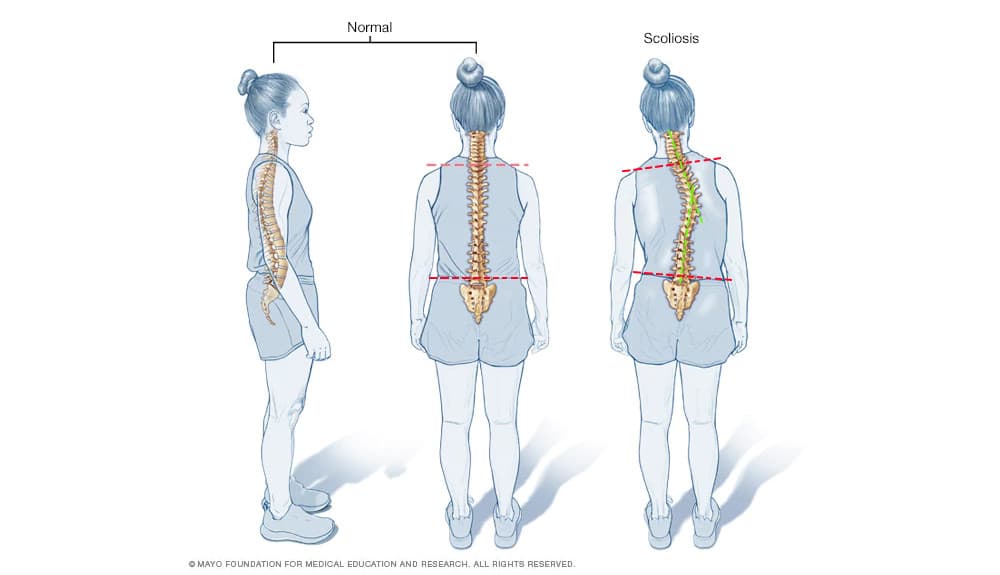
 What is scoliosis?
The most common form is adolescent, so-called idiopathic scoliosis, which typically develops or worsens during the growth spurt, between the ages of 10 and 16 – more often in girls, with a greater tendency to progress. In adulthood, curvature can also develop on the basis of degenerative changes in the spine, but the priority is different: not stopping the curve, but keeping pain and mobility under control.
 Key point
With scoliosis – as with torticollis in infancy – time is what matters: during childhood and adolescence, while the bones are growing, progression can often be stopped with a brace and targeted exercises; once growth is complete, this window closes. That is why the most important thing parents can do is arrange regular checks – curvature detected early can be managed well, while curvature detected late is much harder to treat.
 How can you recognise it? Checking at home
Scoliosis can be deceptive: it does not hurt and develops slowly – children almost never complain about it themselves. Once or twice a year, while bathing or getting dressed, check your child’s back using the following points:
| What should you check? | What should you look for? |
|---|---|
| Shoulders | Are they at the same height; is one shoulder blade more prominent? |
| Waist and hips | Is the “indentation” on both sides of the waist the same; is one hip tilted; do clothes always sit unevenly? |
| Forward-bending test | Ask the child to bend forward with straight knees and arms hanging loosely – viewed from behind, are both sides of the back at the same height, or is there a “hump” or raised rib area on one side? |
| Signs visible in clothing | One trouser leg always seems longer; the skirt twists; one shoulder strap is more worn |
The forward-bending test provides the most information: because the vertebrae rotate, the ribs on one side rise when the child bends forward. If you notice any of these signs, ask for an orthopaedic specialist examination – the diagnosis is confirmed by a physical examination and X-ray, which also allows the doctor to measure the degree of curvature, known as the Cobb angle. This number determines what needs to be done.
 The two main forms – two different stories
In the vast majority of cases, the exact cause is unknown (this is what the word “idiopathic” means) – there is an inherited predisposition, and it often runs in families. The critical period is the growth spurt: while the bones are growing, the curve can worsen, so this is when it must be monitored and treated most closely. Once growth is complete, smaller curves typically stabilise – larger ones can still worsen slowly in adulthood, so the aim is to keep the curvature as small as possible until growth ends.
In adulthood, it appears in two ways: either the curvature from adolescence continues, or new curvature develops on the basis of degenerative changes in the spine – uneven wear of the discs and facet joints – typically after the age of 50. The main issue here is no longer “stopping” the curve, but managing its consequences: one-sided muscle tension, recurring back pain and restricted movement. The foundation of treatment is keeping the trunk muscles strong and controlling pain – I wrote about this in detail in the back pain guide.
This is important to clarify because it causes many parents to blame themselves: a heavy schoolbag, poor sitting posture and hunching over a phone do NOT cause structural scoliosis – they can cause poor posture (I wrote about this in the tech-back article), but not true rotation of the vertebrae. Distinguishing between the two is a specialist’s job: poor posture straightens voluntarily and when lying down, while structural curvature does not. So bad habits do not cause scoliosis – but they can worsen the symptoms of existing curvature.
 How can it be treated? The steps – honestly
Treatment is determined by the degree of curvature, age and the time remaining for growth – the decision always belongs to an orthopaedic specialist. The steps in the international professional guideline are:1
1. Observation. With a mild curve, the approach is regular specialist monitoring – typically every six to twelve months – so that any worsening is detected in time. This is not “doing nothing”, but active monitoring.
2. Spine-specific exercises. Scoliosis exercises are not general back-muscle training, but a specialised method tailored to the individual pattern of the curve, such as the Schroth method. They are taught by a physiotherapist trained in scoliosis and must be performed at home every day. To be honest about the evidence: exercises are useful for improving posture, muscle balance and quality of life, but the scientific evidence for permanently reducing the degree of curvature is weak3 – so perform the exercises ALONGSIDE the brace and check-ups, never instead of them.
3. Brace. In a growing child with a moderate curve, a brace is the most effective tool – and the evidence here is strong: in the large international study, the curve was kept below the surgical threshold in three quarters of adolescents who wore a brace, compared with fewer than half of those who were only observed – and the more hours the brace was worn, the better the result.2 A brace does not straighten an existing curve – it stops progression while the bones are growing. Wearing it is uncomfortable and emotionally demanding for a teenager – but it is the tool that prevents the most operations.
4. Surgery. For severe, progressive curves, spinal fusion surgery (spondylodesis) may be considered – this is decided by specialised spinal surgery centres and concerns only a small proportion of patients.
Additional methods – keeping them in perspective. General movement and sport are not only allowed alongside scoliosis, but specifically recommended – anything from swimming to yoga that the child enjoys.1 As an additional method, muscle stimulation (EMS) may help regulate the tone of tight, asymmetrically loaded muscles and ease adult pain – but let’s say this plainly: it does not straighten the curve, and it cannot replace the brace or exercises. I wrote about the method in the article on using muscle stimulation in disease management, and about general back-muscle training in the 12-week back-muscle programme.
 My advice to parents
I ask you to do two things. First: perform the forward-bending test on your child at least once a year – it takes 30 seconds and is the most important screening check you can do at home. Second: if a brace has been prescribed, your most difficult task is to make sure it is worn for the prescribed number of hours each day. The studies send a clear message: the result depends on the hours the brace is actually worn; a brace kept in the cupboard treats nothing. Find your child a peer-support community, and treat the brace as a shared project, not as a punishment.
 When should you see a doctor promptly?
If your child’s curvature is visibly worsening over a period of months; if scoliosis is accompanied by pain – painful scoliosis in a child always requires a search for another underlying condition; if numbness, weakness or difficulty walking develops; or if breathing problems occur. These are not signs of usual idiopathic scoliosis – they require investigation.
Frequently asked questions
Not by itself – in fact, growth is precisely the period when it can worsen. “They’ll grow out of it” is the most dangerous attitude to take with scoliosis, because it wastes the years when treatment is most effective. The good news is that when detected and treated in time, most children reach adulthood with a good quality of life and avoid surgery.
Yes – the international guideline specifically recommends general sporting activity alongside treatment. Movement builds muscle strength, fitness and self-confidence. There is no generally “forbidden sport”; the treating orthopaedic specialist and physiotherapist can advise on the individual situation, including competitive sport and extreme exertion.
No. Structural scoliosis is not caused by a schoolbag, sitting posture or phone use – the cause of the most common form is unknown, with an inherited predisposition. This does not mean that a heavy bag is a good thing – it can cause poor posture and muscle complaints – but you do not need to blame yourself or your child for scoliosis.
Typically until bone growth is complete – the doctor monitors this with X-rays. The daily wearing time, often 16–20 hours, is prescribed by the doctor, and studies show that the result is closely linked to it: the more consistently the brace is worn, the greater the chance of avoiding surgery. Weaning off the brace is also done gradually under medical supervision.
Once growth is complete, the curvature can no longer be meaningfully reduced with conservative methods – be wary of anyone who promises this. What can very much be achieved is keeping symptoms under control and slowing degenerative progression through strong trunk muscles, regular movement and pain relief when needed. In adulthood, this is the realistic and worthwhile goal.
No – and anyone advertising it this way is misleading you. EMS may help relax tight muscles, exercise weakened muscles and ease adult pain as an additional method. The foundation of scoliosis treatment in childhood is the brace + spine-specific exercises + monitoring; in adulthood, it is movement and maintaining muscle strength.
 What does the research say?
“Does bracing really work, or are we simply putting the child through unnecessary suffering?”
It works – this is the strongest evidence in scoliosis treatment. In the large international study, the curve was kept below the surgical threshold in 72–75% of growing adolescents who wore a brace, compared with 42–48% of the observation-only group – the study was even stopped early because the benefit of bracing became clear. And the key message for everyday life is this: the result improved in proportion to the number of hours the brace was actually worn.2
“What does the international professional community say about non-surgical treatment?”
The international guideline for conservative scoliosis treatment summarises the recommendations in 68 statements, and the strongest recommendations concern bracing. The guideline also recommends spine-specific exercises to support the prevention of progression, and general sport as a specifically recommended additional measure – in other words, a child with scoliosis does not need restraint, but well-directed activity.1
“Can specialised exercises straighten the curve?”
You deserve an honest answer: according to the latest scientific review, the evidence that spine-specific exercises alone permanently reduce the degree of curvature is of very low certainty – it is based on few studies of mixed quality.3 This does not make exercises worthless: they have an important role in improving posture, muscle balance, breathing and quality of life. But they must be kept in perspective: alongside bracing and regular monitoring, not instead of them.
 Summary – Quick overview
Read more
Scientific sources
- Negrini S, Donzelli S, Aulisa AG, et al. (2018). 2016 SOSORT guidelines: orthopaedic and rehabilitation treatment of idiopathic scoliosis during growth. Scoliosis and Spinal Disorders, 13, 3. DOI: 10.1186/s13013-017-0145-8
- Weinstein SL, Dolan LA, Wright JG, Dobbs MB (2013). Effects of bracing in adolescents with idiopathic scoliosis. New England Journal of Medicine, 369(16), 1512–1521. DOI: 10.1056/NEJMoa1307337
- Oba H, Watanabe K, Asada T, et al. (2024). Effects of Physiotherapeutic Scoliosis-Specific Exercise for Adolescent Idiopathic Scoliosis Cobb Angle: A Systematic Review. Spine Surgery and Related Research, 9(2), 120–129. DOI: 10.22603/ssrr.2024-0191