
 Low-level laser for spinal pain and herniated discs
Let’s start with the most important point, because everything else follows from it: low-level laser therapy does not “push a bulging disc back into place”. What it can genuinely do – and what research supports – is reduce inflammation and swelling around the nerve root, which is often the main source of pain, and provide pain relief. This is significant in spinal problems: for lower back pain, the American College of Physicians (ACP) guideline lists low-level laser therapy among the non-drug treatment options for chronic lower back pain1, while a 2024 international consensus involving 22 experts also includes it among the recommended physiotherapy methods for acute lower back pain.2
The aim of this article is to show where laser therapy fits into the treatment of spinal problems: when it makes sense, which protocol to use, and what you should never rely on it to do. You can find the complete treatment strategy for a herniated disc – from diagnosis through exercise to the question of surgery – in the comprehensive guide Herniated disc: what can you do about it?; this article expands on its laser therapy chapter.
 Key point
With a herniated disc, it is not the “hernia” itself that hurts, but the compressed and inflamed nerve root. This is why light may help: it reduces inflammation and swelling – while a substantial part of the bulge may also shrink on its own over time. The role of laser therapy is to make this period more manageable and allow you to start exercising – because long-term protection for the spine comes not from light, but from strong core muscles.
 What does the research say about each spinal problem?
| Problem | What does the research show? | The role of laser therapy |
|---|---|---|
| Acute lower back pain (“locked back”) | The 2024 international expert consensus recommends low-level laser therapy among the physiotherapy methods used in the acute phase, alongside manual therapy2 | To get through the painful days – as a drug-free adjunct, alongside early, gentle movement |
| Chronic, non-specific lower back pain | Meta-analysis of 7 placebo-controlled studies: an average of 13.6 mm greater pain reduction than placebo on the 100 mm scale – but the review did not confirm improved function3 | There is good evidence for pain relief – movement programmes improve function, so using both together makes sense |
| Lumbar disc herniation, sciatica | Double-blind randomised study (110 patients): after 18 sessions, laser treatment added to physiotherapy produced better results for pain, function and range of movement than exercise alone4 | As an adjunct to physiotherapy – not instead of it; also treating along the path of radiating pain |
| Cervical disc herniation | Small Japanese study (26 people): treatment with an 830 nm laser twice a week for 4 weeks produced a significant reduction in pain – the authors also highlighted the importance of postural correction5 | Promising, but based on weaker evidence – for neck problems, it makes sense together with postural improvement |
A further point: chronic lower back pain is one of the more mixed areas in laser research – the pain-relieving effect is supported, but the meta-analysis did not confirm improvements in function or range of movement.3 That is why we stress in all our spinal articles: laser therapy is symptomatic treatment. The underlying treatment is exercise and rebuilding the muscles that support the spine. You can find the evidence map in the scientific review of low-level laser therapy.
 What happens in your spine – and what does light do there?
A bulging disc is often silent in itself – MRI scans regularly find herniated discs even in people without symptoms. Two things cause the pain: mechanical pressure from the bulging material on the nerve root and – at least as importantly – the inflammatory reaction that develops around it. The body treats material released from inside the disc as “foreign”, and the inflammation causes swelling, which further narrows an already tight space.
This leads to the good news: symptoms may ease even while the herniated disc is still there. When inflammation and swelling decrease, pressure on the nerve root is relieved – and a substantial part of the bulge may shrink on its own over several months. Conservative, non-surgical treatment is built precisely around buying this time.
Red and infrared light stimulates energy production in cells and influences the process above in three ways. One: it reduces inflammatory signalling around the nerve root – this is the main effect. Two: it stimulates local circulation and lymphatic drainage, which helps reduce swelling. Three: it dampens the transmission of pain signals along the affected nerve fibres – which is why temporary relief may be felt after treatment even before the inflammation has meaningfully decreased.
What it cannot do, however, is remove the bulging material, “regenerate” the disc or create stability in the spine. Anyone who promises this is promising more than the research supports.
It is a fair question, because the spine is a deep structure. Infrared light around 800 nm reaches several centimetres into tissue at a meaningful dose – the exact depth depends on body shape and the region being treated. In the neck and in people with a slimmer build, the light may reach close to the nerve root; with deeper structures in the lumbar region, part of the effect is indirect, acting at the level of the muscles, connective tissues and pain-conducting nerve endings closer to the surface.
And do you need an expensive, high-powered laser for this? Not necessarily, according to research: a meta-analysis comparing high-intensity laser therapy (HILT) and conventional low-level laser therapy (LLLT) in musculoskeletal problems – including lower back pain – found no meaningful difference between them in pain or function.6 Higher power primarily shortens treatment time; it does not increase the effect.
 Home treatment protocol – based on dose
When treating the spine, you do not illuminate a single point. You treat the affected section and the path of the pain. The guiding principle here is also dose: a defined amount of energy per point. The time needed depends on the power of your device, so always start with the table for your own device.
| Question | Recommendation |
|---|---|
| Where should you direct the light? | To both sides of the affected vertebral section, over the muscles alongside the spinal column (2–3 points on each side), plus 2–3 points along the path of radiating pain in sciatica (buttock, back of the thigh) |
| What dose? | 4–7 J per point, moving towards the upper end of the range because the target is deep – treatment time is determined by the power of the device |
| How often? | Daily in the acute phase; every other day as symptoms ease |
| For how long? | 1–2 weeks for acute lower back pain; a 4–6-week course is realistic for radiating symptoms caused by a herniated disc – the clinical study achieved results after 18 treatments4 |
| When can improvement be expected? | Pain relief is often noticeable after a few treatments; meaningful, lasting improvement takes 10–14 days – if nothing changes within 3 weeks, ask for medical review |
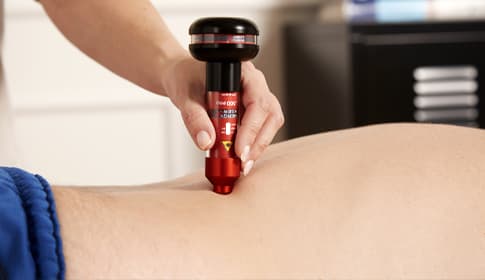
Treatment is most effective with the treatment head placed on the skin and pressed gently against it. If symptoms temporarily become more intense at the beginning of the course, you can read about the background in our article “Why does pain increase after treatment?” – a reaction that settles within 24–72 hours is not an alarm sign.
 My advice
Always combine laser therapy with movement – this is not a polite suggestion, but the central message of the research. The ACP guideline names an exercise programme as a first-line treatment1, while in the clinical study of disc herniation, laser therapy added benefit alongside physiotherapy, not on its own.4 The practical order is: laser therapy for pain relief → gentle exercises that day or the next → a gradually developing core-strengthening programme. We also have two detailed guides for this: muscle stimulation and physiotherapy in herniated-disc rehabilitation and strengthening the back muscles with a muscle stimulator.
Which device is suitable for spinal treatment?
For the spine, you need a device that works in the infrared range and delivers a known dose. Because the area to be treated is relatively large, a larger treatment head or higher power is an advantage:
B-Cure Laser Pro
A Class 1 laser device with a particularly large 4.5 cm² treatment surface. The muscle bands alongside the spine can be treated comfortably, strip by strip, without protective glasses. Compensate for the lower power with a longer treatment time per point.
Personal-Laser L400
A 400 mW, 808 nm diode laser, with a wavelength suitable for reaching deeper tissues and a short treatment time per point. With radiating sciatic pain, it allows the points along the pain pathway to be treated quickly.
Energy-Laser L500 Pro
A 500 mW professional home-use device with built-in programmes. The device controls the dose for the spinal protocol, making treatment convenient and predictable during longer courses involving multiple points.
You can find the full range in the low-level laser device category – before buying, also check the scam-avoidance checklist.
 When should you NOT treat your spine at home?
- Loss of bladder or bowel control, saddle numbness – a new symptom involving numbness in the perineal area may indicate cauda equina syndrome: seek medical attention immediately; this is a surgical emergency
- Rapidly worsening muscle weakness in the leg – weakness when lifting the foot, stumbling: urgent neurosurgical and neurological assessment, NOT home treatment
- Unexplained spinal pain before investigation – especially when accompanied by fever, night pain or weight loss; diagnosis first, treatment afterwards
- Cancer or a suspected tumour in the area being treated – treatment only with the approval of your treating doctor
- Pregnancy – treatment of the lower back during pregnancy only after medical consultation
- Taking medicines that cause photosensitivity – discuss this with your doctor first
 Red flags override everything
Most spinal problems are benign and can be treated conservatively – but the first two points on the list above are exceptions. In those cases, days lost to home treatment can cause permanent nerve damage. If in doubt, the rule is simple: doctor first, laser afterwards. You can find the complete safety list in the low-level laser contraindications article.
Frequently asked questions
No – and it is important to say this clearly. Laser therapy treats the inflammation and pain around the herniated disc; it does not remove the bulge. The good news is that this is often not necessary for symptoms to disappear, because the bulge may shrink on its own over time, and inflammation is usually the main cause of symptoms. Laser therapy makes the months needed for this more manageable – lasting improvement comes from building up the core muscles.
Both. The source is at the spine, so you should definitely treat both sides of the affected lumbar section. In clinical practice, treating the path of the radiating pain is also common: the 2–3 most painful points on the buttock and the back of the thigh. In the study that confirmed an additional benefit from laser therapy alongside physiotherapy, the entire affected region was also treated, in a course of 18 sessions.4
The logic is tempting – a deeper target, higher power – but research does not confirm it. A review of comparative studies of high-intensity and conventional low-level laser therapy in musculoskeletal problems found no difference in pain relief or function.6 Higher power mainly saves time. For home use, the decisive factors are a known, documented dose and a safe laser class – not the wattage.
Yes, they complement each other well because they act in different ways: laser therapy reduces inflammation in the tissue, TENS dampens the transmission of pain signals, and EMS helps rebuild weakened core muscles alongside exercise. A practical order within one day is: laser therapy → exercise or EMS → TENS at the end of the day if needed. You can find the details in the muscle stimulation and physiotherapy article.
Give the method 2–3 weeks of regular daily treatment at the prescribed dose. Clinical studies also achieved results with courses lasting several weeks.3 If you feel no change in any direction during this time, do not continue unchanged indefinitely. First, ask a doctor or physiotherapist to review the dose and treatment points, and if symptoms worsen – especially if numbness or weakness develops – request a follow-up examination.
 What the research says – answers to readers’ questions
“Do medical guidelines really recommend laser therapy for lower back pain, or is it just marketing?”
They do. The American College of Physicians (ACP) guideline for lower back pain lists low-level laser therapy among the first-line, drug-free treatment options for chronic lower back pain, alongside exercise, yoga and cognitive therapy.1 A 2024 international Delphi consensus, reached with the agreement of 22 experts, included low-level laser therapy among the recommended physiotherapy methods for acute lower back pain, alongside manual therapy.2 The guidelines also indicate the quality of the evidence: this is support at the level of a “recommended option”, not miracle treatment status.
“With a herniated disc, what can I realistically expect from laser therapy alongside physiotherapy?”
A double-blind randomised study involving 110 patients provides an answer: in lower back pain radiating into the leg due to a disc problem, half of the patients received physiotherapy alone and half received physiotherapy AND laser treatment, over 18 sessions. The group receiving laser as an adjunct achieved measurably better results in pain, functional status and spinal range of movement.4 The lesson works both ways: laser therapy provided a real additional benefit – but the study tested it on the basis of physiotherapy, not instead of it.
“Is there any evidence for the herniated disc in my neck as well?”
There is, but it is more limited. A Japanese research group treated 26 patients with chronic neck pain caused by cervical disc herniation using an 830 nm laser twice a week for four weeks. Pain decreased significantly, but the range of neck movement did not change. The authors specifically highlighted that, to achieve lasting results, patients also had to learn to avoid postures that put strain on the neck.5 It was a small study without a control group – a promising signal, but not conclusive evidence.
Summary
What is this article about? A practical and scientific guide to using low-level laser therapy for spinal pain and herniated discs: what research shows, which dose to use and where to treat, and when home treatment is not allowed.
Who is it for? People with acute or chronic lower back pain, or with a doctor-diagnosed herniated disc or sciatica, who are looking for a drug-free adjunctive treatment alongside physiotherapy.
Main message: Laser therapy treats inflammation and pain around the herniated disc – it does not remove the disc bulge, but this is often not necessary because the bulge may shrink over time. Research supports laser therapy as an adjunct to physiotherapy; lasting protection comes from strong core muscles.
Next step: Ask your doctor to rule out red flags, then start the two-part programme: a dose-based course of laser therapy + a gradually developing exercise programme. You can find the complete herniated-disc strategy in our comprehensive guide.
Read more
- Herniated disc: what can you do about it? A comprehensive guide
- Muscle stimulation and physiotherapy in herniated-disc rehabilitation
- Building up the back muscles with a 4-channel muscle stimulator
- Low-level laser therapy guide: how it works, dose and laser classes
- Low-level laser therapy: what does the science say?
- Low-level laser contraindications: when should you not use it?
- Why can pain increase after treatment?
Scientific sources
- Qaseem A, Wilt TJ, McLean RM, Forciea MA. (2017). Noninvasive treatments for acute, subacute, and chronic low back pain: a clinical practice guideline from the American College of Physicians. Annals of Internal Medicine. DOI: 10.7326/M16-2367
- Wang XQ, Wang YL, Witchalls J, et al. (2024). Physical therapy for acute and sub-acute low back pain: a systematic review and expert consensus. Clinical Rehabilitation. DOI: 10.1177/02692155241229398
- Huang Z, Ma J, Chen J, et al. (2015). The effectiveness of low-level laser therapy for nonspecific chronic low back pain: a systematic review and meta-analysis. Arthritis Research & Therapy. DOI: 10.1186/s13075-015-0882-0
- Ahmed I, Bandpei MAM, Gilani SA, et al. (2022). Effectiveness of low-level laser therapy in patients with discogenic lumbar radiculopathy: a double-blind randomized controlled trial. Journal of Healthcare Engineering. DOI: 10.1155/2022/6437523
- Takahashi H, Okuni I, Ushigome N, et al. (2012). Low level laser therapy for patients with cervical disk hernia. Laser Therapy. DOI: 10.5978/islsm.12-OR-10
- Saleh MS, Shahien M, Mortada H, et al. (2024). High-intensity versus low-level laser in musculoskeletal disorders. Lasers in Medical Science. DOI: 10.1007/s10103-024-04111-1