Soft laser treatment for arthritis – Home arthritis therapy
Joint inflammation, or arthritis, is one of the most common musculoskeletal conditions. If it affects you, you know how agonizing the pain, stiffness and swelling can be. Anti-inflammatory drugs can help, but long-term use may come with side effects. What if there were a side-effect-free method you could use at home to support your recovery? Soft laser therapy – also known as photobiomodulation – may offer exactly that.

What is joint inflammation?
“Arthritis” is an umbrella term that covers more than 100 different conditions. The most common forms are:
- Osteoarthritis (arthrosis): Gradual wear of the joint cartilage, mainly affecting older people
- Rheumatoid arthritis (rheumatism): An autoimmune disease in which the body attacks its own joints
- Gout: Deposition of uric acid crystals in the joints
- Psoriatic arthritis: Joint inflammation associated with psoriasis
Common symptoms are pain, joint stiffness and swelling. These conditions can significantly reduce your quality of life and limit everyday activities.
How can soft laser help in arthritis?
Soft laser therapy (English: Low-Level Laser Therapy, LLLT) is a painless, non-invasive treatment method. The device emits low-energy laser light that penetrates the tissues and acts at the cellular level.
According to scientific research, soft laser can:
- Positively influence inflammatory processes
- Support cellular energy production (ATP synthesis)
- Contribute to improved microcirculation
- Help reduce the sensation of pain
An important advantage is that soft laser treatment is free of side effects, so it can be used long-term. Many patients find that regular use can reduce their need for anti-inflammatory medications.1
What does the science say?
The efficacy of soft laser therapy has been examined in numerous clinical studies for inflammatory joint conditions.
A 2019 meta-analysis that investigated patients with knee osteoarthritis concluded that appropriately dosed soft laser treatment showed more favorable results than placebo for pain reduction.2
Earlier studies suggested that in osteoarthritis patients, soft laser treatment had particularly beneficial effects in acute (recent) inflammatory states.3
Results for rheumatoid arthritis are mixed, but a 2023 meta-analysis found that soft laser treatment may help reduce morning joint stiffness and improve grip strength in RA patients.4
It is important to note that research findings vary, and soft laser is not equally effective for everyone or in every case. The therapy's effectiveness depends on treatment parameters, disease stage and individual factors.
How to treat your joints with soft laser
To succeed with at-home soft laser treatment, follow a few basic rules:
The right wavelength
For joint treatment, choose a device that emits light at a wavelength of 808 nanometers. Note: devices at 650–660 nm are cheaper, but they are not suitable for deeper joints (knee, hip, shoulder, spine) — those are mainly for superficial treatments.
The question of energy
For joint treatment, generally 5–7 Joules of energy are needed per treatment point. Depending on the device's power, the time required to deliver that energy will vary:
| Device | Power | Treatment time (for 5 Joules) |
|---|---|---|
| B-Cure Laser Classic | 3.75 J/treatment | 6 minutes |
| B-Cure Laser Sport | 5 J/treatment | 5 minutes |
| B-Cure Laser Pro | 5 J/treatment | 5 minutes |
| Personal Laser L400 | 400 mW | 12.5 seconds (!) |
Treatment procedure
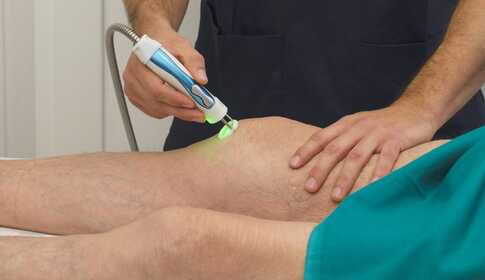
- Place the device directly on the skin – laser light does not penetrate clothing or bandages!
- Keep the device still on the treatment point
- Do not move it until the set time has elapsed
- Then move to the next treatment point
Important: Doubling the treatment time does not increase the effect! Too much energy can halt regenerative processes. Treat each point only for the recommended duration.
Treatment frequency
- Acute (recent) inflammation: 2–3 times daily, even hourly if needed
- Chronic complaints: One treatment per day is sufficient
Beneficial effects take time to develop – improvement usually becomes noticeable after about 10–12 days of regular treatment, and the therapy should be continued thereafter.
Treatment points for joint inflammation
Shoulder arthritis
Treat the area of the shoulder joint and the outer side of the upper arm. Approach from multiple points: front, side and back.
Fingers, rheumatoid arthritis
Treat each affected finger individually, on both sides of the finger. Also treat the fold between the palm and the fingers.
Knee arthritis
Treat the knee from several points:
- Back of the knee (popliteal fossa)
- Right and left sides of the knee
- Area under the kneecap
Before you start treatment
For safe use, it is important to know the contraindications. If any of the following conditions apply to you, consult your treating physician before using soft laser.
When NOT to use it
Do NOT use a soft laser device if:
- You have an implanted pacemaker or other electrical implant – do not use the device near it. A distant joint can be treated, however.
- You are pregnant (avoid abdominal area; consult your doctor for other areas)
- You have an active malignant tumor in the treatment area
- You have active thrombosis
- You are taking a medication that causes photosensitivity
- You have epilepsy
Never treat the eye directly, and avoid the thyroid area!
Detailed information on contraindications: Soft laser therapy contraindications
Possible temporary reactions
During the first treatments you may experience:
- Temporary increase in pain – this may indicate the start of healing processes
- Mild warming sensation in the treated area
These reactions usually subside after 1–2 treatments. If you experience persistent discomfort, consult your doctor.
Which soft laser device should you choose?
For joint complaints I recommend the following devices:
| Device | Wavelength | Advantage |
|---|---|---|
| B-Cure Laser Pro | 808 nm | Compact, easy treatment, longer treatment time |
| Personal Laser L400 | 808 nm | Good price, reliable |
| Energy Laser L500 Pro | 808 nm | Higher power, faster treatment |
| Energy Laser L2000 | 808 nm | Professional power |
The full range of soft laser devices can be found here.
Other applications of soft laser
Soft laser therapy can also support the treatment of many other conditions and complaints. For an overview of all at-home applications, read the Soft laser therapy at home – Treatable conditions article.
If you are not familiar with the basics of soft laser therapy, start with the Comprehensive guide to soft laser therapy.
Summary – Quick overview
What is this article? A comprehensive guide to using soft laser therapy for inflammatory joint complaints (arthritis).
Who is it for? People with osteoarthritis, rheumatoid arthritis, gout or other inflammatory joint diseases who are looking for a side-effect-free complementary therapy.
Main message: Research suggests that soft laser therapy can positively influence inflammatory joint complaints. When the correct wavelength (808 nm) and energy (5–7 J/point) are applied, it may support healing processes.
Key points to know:
- Choose a device with an 808 nm wavelength
- 5–7 Joules of energy per treatment point
- Apply directly on the skin
- For acute inflammation: multiple times daily; for chronic: 1–2x daily
- Meaningful improvement is expected after 10–12 days
Frequently asked questions:
How quickly does soft laser treatment work?
Pain may decrease after the first treatment, but significant improvement usually appears after about 10–12 days of regular treatment.
Can soft laser replace medication?
It does not replace medication, but can complement it. Many patients find that regular use reduces the need for anti-inflammatories — always do this in consultation with your doctor!
Is the treatment painful?
No, soft laser treatment is painless. Most people feel nothing, at most a slight warmth.
Related musculoskeletal articles
- Soft laser for knee pain and knee osteoarthritis – if your knee is affected
- Soft laser for heel pain – heel spur, Achilles tendon problems
- Soft laser for tendon inflammation – tennis elbow, golfer’s elbow, tendon issues
- Soft laser for herniated disc and back pain – neck and lower back complaints
- Treating sports injuries with soft laser – regeneration for athletes
Sources
- Bjordal JM, et al. (2003). A systematic review of low level laser therapy with location-specific doses for pain from chronic joint disorders. Australian Journal of Physiotherapy. PubMed: 12775206
- Stausholm MB, et al. (2019). Efficacy of low-level laser therapy on pain and disability in knee osteoarthritis: systematic review and meta-analysis of randomised placebo-controlled trials. BMJ Open. PubMed: 31662383
- Brosseau L, et al. (2000). Low level laser therapy for osteoarthritis and rheumatoid arthritis: a metaanalysis. Journal of Rheumatology. PubMed: 10955339
- Oliveira P, et al. (2023). Effects of low-level laser therapy in adults with rheumatoid arthritis: A systematic review and meta-analysis of controlled trials. PLOS ONE. PLOS ONE
The information in this article is for guidance only. At-home therapeutic devices are intended to complement medical treatment, not replace specialist care. Consult your physician if you have complaints.