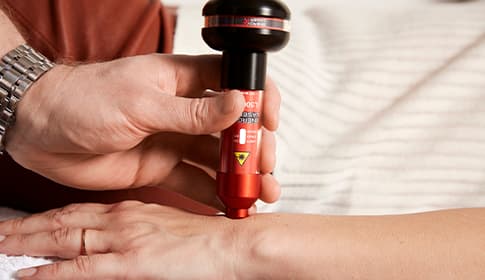
Softlaser for Tendon Inflammation Treatment – Tendinitis Therapy
Tendon inflammation (tendinitis) is one of the most common musculoskeletal complaints – it affects both athletes and people who work at desks. If you have already felt that persistent, pulling pain in your shoulder, elbow, or knee, you know how hard it can be to get rid of it. Softlaser therapy can help support the healing process.
What is tendon inflammation?
Tendons are the fibrous connective tissue structures that attach muscles to bones. Due to overload, repetitive movements or sudden strain, a tendon can become inflamed – this is called tendinitis.
Common forms:
- Shoulder tendon inflammation (rotator cuff tendinitis): Inflammation of the rotator cuff tendons that surround the shoulder
- Tennis elbow (lateral epicondylitis): Inflammation of the tendons on the outer side of the elbow
- Golfer's elbow (medial epicondylitis): Inflammation of the tendons on the inner side of the elbow
- Jumper's knee (patellar tendinitis): Inflammation of the tendon that connects the kneecap to the shinbone
- Achilles tendon inflammation: Inflammation of the tendon between the calf muscles and the heel bone
Symptoms
- Dull, pulling pain in the affected area
- Pain during movement, especially under load
- Stiffness, especially in the morning or after rest
- Mild swelling
- Tenderness to touch
How can softlaser help?
Softlaser therapy (LLLT) can exert beneficial effects on tendinitis through several mechanisms:
- It may favorably influence inflammatory processes
- It can support collagen production, which is the primary building material of tendons
- It may contribute to improved microcirculation
- It can help alleviate pain
A 2022 systematic review and meta-analysis that examined lower extremity tendon disorders and plantar fasciitis concluded that softlaser treatment had a beneficial effect on pain and functional status.1
Common tendinitis locations and their treatment
Shoulder tendon inflammation (rotator cuff)
The rotator cuff is formed by the tendons of four muscles surrounding the shoulder joint. They can become inflamed due to overload, repetitive movements, or age-related wear.
Treatment points:
- Anterior part of the shoulder joint
- Lateral surface of the shoulder
- Posterior part of the shoulder
- Upper outer side of the upper arm (humerus)
Tennis elbow (lateral epicondylitis)
Despite its name, it does not only affect tennis players – anyone who repeatedly uses the wrist extensor muscles (computer work, tool use) can develop it.
Treatment points:
- Outer bony prominence of the elbow
- Upper outer part of the forearm, at the muscle origins
Golfer's elbow (medial epicondylitis)
The "opposite" of tennis elbow – it affects the inner side of the elbow.
Treatment points:
- Inner bony prominence of the elbow
- Upper inner part of the forearm
Jumper's knee (patellar tendinitis)
Common in jumping sports (basketball, volleyball) and in runners. The tendon below the kneecap becomes inflamed.
Treatment points:
- Directly below the kneecap
- Front of the knee along the course of the tendon
Detailed information can be found in the jumper's knee article.
Achilles tendon inflammation
The body's strongest tendon can also become inflamed due to overload or inappropriate footwear.
Treatment points:
- Back of the heel at the tendon insertion
- Middle third of the tendon
- Lower part of the calf muscle
More details in the heel pain softlaser treatment article.
Treatment parameters
| Parameter | Value |
|---|---|
| Wavelength | 808 nm |
| Energy per point | 5-7 Joule |
| Acute inflammation | 2-3x daily |
| Chronic complaints | 1-2x daily |
| Treatment period | Min. 2-3 weeks |
Treatment procedure
- Clean the skin over the treatment area
- Place the device directly on the skin – it does not work through clothing!
- Keep it still for the set duration
- Treat all designated treatment points
- Do not stop the treatment prematurely; continue until symptoms have fully resolved
Important: Do not double the treatment time thinking this will speed recovery! Too much energy can halt regenerative processes.
Before you start treatment
When NOT to use it?
- You have an implanted pacemaker
- There is an active malignant tumor in the treatment area
- There is an active infection in the area
- You are taking medication that causes photosensitivity
Detailed information on contraindications: Softlaser therapy contraindications
When should you see a doctor?
- If you suspect a complete tendon rupture (sudden, severe pain, loss of function)
- If the area is significantly swollen, warm, or red
- If fever accompanies the symptoms
- If symptoms do not improve after weeks
Complementary therapies
Tendinitis treatment usually consists of several elements:
- Rest: Avoid the activity that triggers the pain
- Icing: Can help reduce swelling in the acute stage
- Stretching and strengthening: In the later stages of rehabilitation
- Therapeutic ultrasound: May positively influence tissue healing
- TENS: Can help reduce the sensation of pain
Recommended devices
| Device | Advantage |
|---|---|
| B-Cure Laser Sport Pro | Designed for athletes |
| B-Cure Laser Pro | Simple treatment, longer session time |
| Personal Laser L400 | Budget-friendly |
The full range of softlaser devices can be found here.
Other softlaser applications
Softlaser therapy can support the treatment of many other conditions and complaints. For an overview of all at-home application areas read the Softlaser therapy at home – Treating conditions article.
If you are not yet familiar with the basics of softlaser therapy, start with the Comprehensive guide to softlaser therapy article.
Summary – Quick overview
What is this article? A guide on applying softlaser therapy for tendinitis in various localizations.
Who is it for? People with shoulder, elbow, knee, or Achilles tendon inflammation, athletes, and manual workers.
Main message: Softlaser therapy can positively influence the healing processes of tendinitis. Perform treatment along the painful tendon at multiple points.
Key points to know:
- A device with an 808 nm wavelength is required
- 5-7 Joule energy per treatment point
- Acute cases: multiple times daily; chronic: 1-2x daily
- Continue treatment until full recovery
- Can be combined with other therapies (rest, icing, stretching)
Frequently asked questions:
How long does tendinitis take to heal?
Tendinitis typically heals slowly – it can take 2–6 weeks, and longer in chronic cases. Softlaser can support this process.
Can I do sports during treatment?
Temporarily avoid the activity that triggers the pain, but you do not have to stop general movement completely. Consult a sports physician or physiotherapist.
Related musculoskeletal articles
- Softlaser for heel pain – heel spur, Achilles tendon, plantar fascia
- Softlaser for knee pain and knee osteoarthritis – if your knee is affected
- Softlaser for joint inflammation (arthritis) – inflammatory joint complaints
- Softlaser for herniated disc, back pain – neck and lower back problems
- Treating sports injuries with softlaser – for athletes, faster recovery
Sources
- Naterstad IF, et al. (2022). Efficacy of low-level laser therapy in patients with lower extremity tendinopathy or plantar fasciitis: systematic review and meta-analysis of randomised controlled trials. BMJ Open. PubMed: 36171024
The information in this article is for informational purposes only. At-home therapeutic devices are intended to complement medical treatment and do not replace specialist care. Consult your doctor if you have complaints.