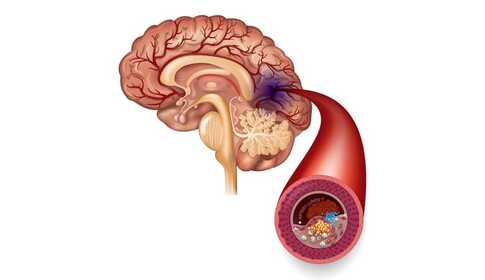
Stroke – not only a brain-affecting "catastrophe"
Stroke (pronounced: strok) is the collective name for diseases that mean a severe disturbance of the brain's blood supply. Older and folk names include: apoplexy, stroke of paralysis, brain softening, cerebral hemorrhage, brain infarction. The symptoms and consequences can be similar in every case. Stroke always denotes a permanent condition, meaning functions are usually not fully restorable. In fortunate and mild cases the symptoms disappear within 24 hours and the loss of function is temporary. In such cases it is not called a stroke but a transient ischemic attack (medical name: TIA).
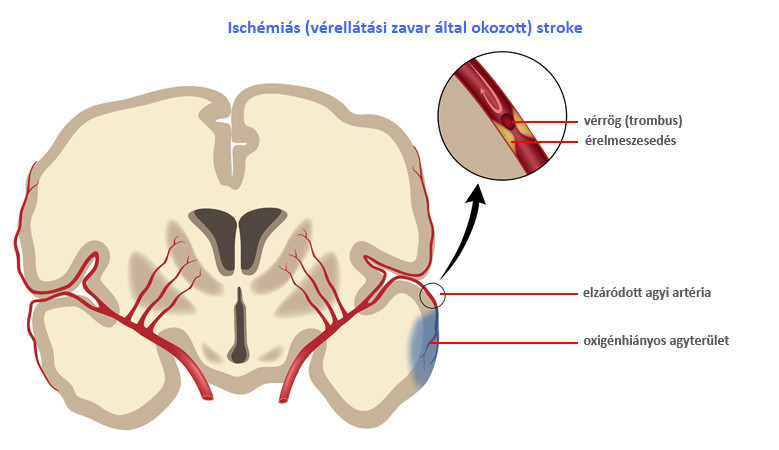
Ischemic stroke
This occurs when the blood supply to an area of the brain suddenly stops, for example due to vasospasm, arterial narrowing or an embolus (blood clot). The brain area deprived of blood does not receive oxygen and the nerve cells stop functioning. If circulation is not restored within minutes, nerve cells (especially those immediately adjacent to the occluded area) die. The functions provided by that brain area (for example speech, balance, movement, thinking, memory, sensation, etc.) are lost.
Ischemic stroke accounts for 70–80% of all cases.
Hemorrhagic stroke
Less common than the ischemic form. It occurs when one of the vessels inside the skull "ruptures". Causes can include a stiff arterial wall due to atherosclerosis, untreated high blood pressure (or a sudden blood pressure spike from missed medication). Here symptoms are not caused by lack of oxygen. A growing "pool of blood" within the brain tissue or in the space between the meninges compresses surrounding areas, causing dysfunction. Because the space inside the skull is limited and the bones do not "expand," the pressure tends to shift toward the skull base's foramen magnum. Increased pressure can press the brainstem against bone; the medulla oblongata contains the breathing center. If its function stops, death can result.
Symptoms of stroke
- Sudden numbness or weakness (especially on one side of the body)
- Confusion
- Difficulty speaking or understanding
- Sudden visual impairment in one or both eyes
- Difficulty moving
- Dizziness, loss of balance or coordination problems
- Sudden, severe headache with no known cause
Although stroke is a disease of the brain, its symptoms and consequences can severely affect the whole body.
- Disorders of cognition and thinking: perception, focusing attention, arithmetic and more complex thinking tasks (e.g. learning, decision-making, planning, problem-solving, self-awareness, etc.) may become difficult or impossible. Memory problems, speech difficulties, emotional challenges, difficulties in daily living (self-care ability) and pain can make everyday life harder.
- Paralysis (loss of voluntary muscle control). Paralysis can affect only the face, or the arm or leg. A common form affects one side of the body (face, arm and leg) — unilateral paralysis is called hemiplegia. The location of the paralysis indicates which side of the brain is affected. If the paralysis affects the left side of the body, the problem is in the right brain hemisphere, and vice versa.
Main risk factors for stroke
High blood pressure, heart disease, diabetes and the damaging effects of smoking on blood vessels are the most important. Increased red blood cell count and atrial fibrillation, a heart rhythm disorder, increase the risk of clot formation.
According to some medical opinions, eighty percent of strokes could be prevented. That is, by reducing risk factors and continuously treating and monitoring underlying conditions, stroke can be avoided or at least the danger significantly reduced.
Treatment
With acute stroke symptoms, IMMEDIATE emergency care must be sought. Time is important — the patient should be taken to hospital as quickly as possible. The first hours truly matter for the outcome of the disease.
Treatment of ischemic stroke involves removing the blockage and restoring blood flow to the brain. There are fewer interventional options for hemorrhagic stroke. If possible, they aim to eliminate the source of bleeding (e.g. an aneurysm).
When the brain's blood supply is interrupted, the most affected nerve cells die within a short time, while in the "border zones" dysfunction predominates. The goal of treatment is to reduce and minimize the area of irreversible damage.
Unfortunately, only a few percent of stroke patients arrive in time at hospitals equipped appropriately. Sadly, whether permanent damage develops often depends on minutes.
In fortunate cases the brain repairs or mitigates the damage caused by the stroke. Neurons that have not died may function again over time. Sometimes another region of the brain takes over some functions of the area damaged by the stroke. Stroke survivors sometimes report unexpected returns of function that cannot be explained.
Treatment outcomes
- About 10% of stroke survivors recover almost completely without symptoms
- 25% have mild impairments that do not or minimally interfere with daily life
- 40% are left with impairments that require external help for certain tasks
- 10% become unable to care for themselves and need long-term care by others
- 15% die shortly after the stroke
Rehabilitation
As soon as intensive care has removed the immediate life threat and the general condition has been stabilized, rehabilitation must begin immediately! Rehabilitation specialists should start treatment even within two days after a stroke. They must teach how to continue rehabilitation after discharge from hospital, what to practice and why.
The aim of rehabilitation is to restore or at least improve functions damaged by stroke so that the survivor remains as independent as possible. The hardest part is motivating the patient, as the unexpected and severe loss of abilities can be shocking and may lead to depression. The patient must want to relearn basic skills taken away by the stroke — for example speech, eating, drinking, dressing and walking — otherwise they become dependent on others.
Much is expected of the family too, because often home modifications are needed to adapt to the changed abilities after stroke. Installing grab bars, ramps, obtaining special dishes, cutlery, a wheelchair, patient lift, etc. may be necessary. Material needs differ for each person and must be implemented according to the individual's condition.
Home medical technology in rehabilitation
Most stroke survivors lose some degree of motor ability. In some, muscles only weaken because nerve impulses do not properly reach the muscle. In others, movement coordination is problematic — for example lifting a spoon to the mouth may be almost impossible. Unused muscles quickly lose strength and mass (muscle atrophy), which must be prevented. After stroke the affected muscles often become spastic (stiff), further hindering movement and coordination.
The rehabilitation ergometers for home use can already be used a few days after stroke.
Damaged nerves need to be "re-taught," which is possible by repeating the execution of movements. Initially the patient may try to raise the paralyzed arm in vain. Because of the damaged nerve‑muscle connection no movement is visible, so the patient does not know what to do or how to perform the movement correctly. Biofeedback devices provide fantastic help for these patients. They can detect the nerve impulse even when the muscle does not contract and send feedback indicating that the correct neural "instruction" has been initiated. For example, a chart on the display or a sound of varying intensity shows whether the movement was performed correctly. A higher value indicates better execution, so the patient knows exactly how they performed the exercise. Repetition with the feedback provided by the device helps restore the nerve‑muscle connection so the movement can again be performed with appropriate strength and coordination. One such biofeedback device is the SineBravo device.
Even more effective are combined biofeedback + muscle stimulator devices. These not only provide feedback but, when they detect a signal sent by the brain to the muscle, they deliver a stimulation impulse to the treated muscle, causing it to contract and helping the desired movement occur. This dual reinforcement speeds up rehabilitation and also helps maintain and improve muscle strength. An example of such a device is the DuoBravo biofeedback+EMS device.
Technology — including medical technology — is developing at an astonishing pace! Today's modern machines provide such useful assistance in treatment that was inconceivable just a few years ago. Previously, paralysis caused by stroke almost always led to permanent disability. Today one need not abandon hope, because technology offers effective support in rehabilitation. It makes a huge difference whether the ability to care for oneself can be restored, or whether a simple activity like eating or drinking will still require assistance!
It is therefore worth acquiring a device and persistently continuing rehabilitation exercises at home.