
 What is vibration training?
A vibration trainer is a vibrating platform: you stand on it (or lean on it), and the machine moves your whole body many times per second with small displacements. The idea did not come from a fitness fad: in the 1960s, it was used in the Soviet space programme to maintain muscle and bone tissue deteriorating in weightlessness. The direct predecessor of today's devices was developed in 1999 by Guus van der Meer for training Dutch speed skaters. From there, the method spread to gyms and homes.
There have been many exaggerated promises around vibration training ever since — “training without training”, “just stand on it and lose weight”. In this article, I show you what is supported by research and what is not. Who it is suitable for, who must avoid it, and how to start safely.
 Key point
A vibration trainer is an exercise device! The vibration triggers a series of reflex muscle contractions, so your muscles keep working continuously. However, simply standing on it and letting it “shake you” is not enough to achieve results! You need to perform exercises on the platform, regularly and consistently. When used properly, it is a time-efficient, joint-friendly form of additional exercise — especially for older people, those with a weaker physique and those who do not enjoy very sweaty workouts.
 How does it work?
With every movement, the vibrating platform pushes your body slightly off balance — sensors in your muscles (muscle spindles) detect this immediately and trigger a contraction by reflex, without conscious control, to stabilise your body. A number of small corrections corresponding to the vibration frequency occur every second: your muscles are forced to work continuously and rapidly. This is called the tonic vibration reflex. That is why you feel that you have been working after just a few minutes — and why the vibration also reaches the deeper stabilising muscles that are difficult to work consciously.
Three properties make it special. It is time-efficient: because of the reflex muscle work, more muscle contractions take place in a shorter time than with conventional exercises. It is joint-friendly: you do not need to jump or lift weights — the load arrives as vibration. And the entry threshold is low: it can also be used by people who find conventional exercise difficult — older people, those with a weaker physique and people undergoing rehabilitation. These groups have been studied the most, and the results are also most convincing here.
It does not make you lose weight by itself: vibration increases muscle activity, but visible weight loss can only be achieved with regular exercises and a suitable diet, typically over 2-3 months. It does not replace a complete exercise programme: walking, cycling or swimming are still needed for cardiovascular endurance. And it is not a treatment: in research it performs well as an additional form of exercise — nobody has studied it as a miracle method on its own, because that is not what it is.
What effects does it have? What research supports
Click on the topic that concerns you — you will find the detailed research background below, in the scientific section.
Bone depends on loading: what you do not load, the body breaks down. Vibration loads the bones with thousands of small, repeated mechanical stimuli, and research suggests that it may have a measurable beneficial effect on femoral neck bone density in postmenopausal women — the area where the most dangerous form of fractures in older age occurs.1 The right perspective is important: vibration can be part of an exercise programme, but it is not a replacement for osteoporosis treatment — medication and the question of vitamin D and calcium are matters for your doctor.
The most consistently confirmed effect of vibration training is increased lower-limb muscle strength — especially in the knee extensor muscles, which play a key role in standing up, climbing stairs and preventing falls.3 The effect is strongest when exercises are performed on the platform (squats, lunges) — the vibration effectively reinforces the muscle work of the exercise.
The continuous small losses of balance and corrections are practically balance training — under safe conditions and with a handrail. A summary of studies in older people suggests that vibration training may improve basic balance abilities and mobility, especially in weaker and more frail older adults.2 This has also been studied in post-stroke rehabilitation and balance disorders — in those cases, always in consultation with a therapist.
Rapid cycles of muscle contraction and relaxation work like a pump: they may stimulate peripheral blood circulation and lymphatic flow — which is valuable in itself alongside a sedentary lifestyle. Many people report that their legs feel warmer and lighter after use. The circulatory effect is temporary: regular use maintains it.
The vibration platform is an excellent surface for stretching: the vibration relaxes the muscles, so static stretching on the platform (calves, backs of the thighs, hip flexors) may be deeper and more comfortable than on the floor. Two or three stretching positions on the platform after exercise are a natural part of cooling down — you will find the specific exercises illustrated below, in the programme description. I have also written a separate article about the importance of warming up and stretching: The role and importance of warming up →
Let's be precise here. Vibration may support weight loss (active muscle work, increased metabolism), but it does not solve the problem: without a calorie deficit and regular exercise, there will be no visible result. For cellulite, massage-like positions may stimulate local circulation — cellulite is a more complex issue, which I have covered in a separate article: Cellulite: what can really be done? → For recovery (post-exercise muscle relaxation and a slight reduction in muscle soreness), gentle vibration in massage mode has a place.
How do you start? The gradual programme
The golden rule of vibration training is the same as for every form of exercise: progress gradually. This is how to build a safe start:
| Stage | Dosage | What should you watch for? |
|---|---|---|
| Weeks 1-2 (familiarisation) | 1 minute per position, half a minute's rest between positions, 8-10 minutes in total, 3 times a week | Knees slightly bent in every standing position — straight knees transmit the vibration towards the spine |
| Weeks 3-6 (building up) | 1-2 minutes per position, 10-15 minutes in total, 3-4 times a week | Increase by no more than 1 minute every 1-2 days — especially if you are a beginner, overweight or undergoing rehabilitation |
| From week 7 (regular routine) | Up to 3 minutes per position, 20-25 minutes in total, 3-4 times a week | The first noticeable change (firmer muscles) after 15-20 sessions; a visible result after 2-3 months is realistic |
| Maintenance | 2-3 times a week | The effects are maintained by regular use — they gradually disappear during months without exercise |
Basic exercises on the platform include standing with slightly bent knees, static and dynamic squats, lunges (one foot on the platform), calf raises, supported positions for the arms and torso (for example, a plank with your arms supported on the platform), seated stretching positions and massage positions (resting the thigh or calf on the platform at a gentle setting). Always start your workout with a warm-up and finish with stretching.

Warning! Trainers without a handrail are not suitable for active exercise. Standing on them without a firm handrail is dangerous, especially for older people, inexperienced users and those who also have balance problems.
Stretching exercises on the platform — cooling down
When you stretch, you train yourself to release the muscles from their tense, contracted state — after exercise, this prevents muscle stiffness and supports recovery. Stretching on a vibrating platform may feel more relaxed and comfortable than stretching on the floor. Four basic exercises, each performed slowly and carefully, stretching only until it still feels comfortable, and held for 20 seconds:
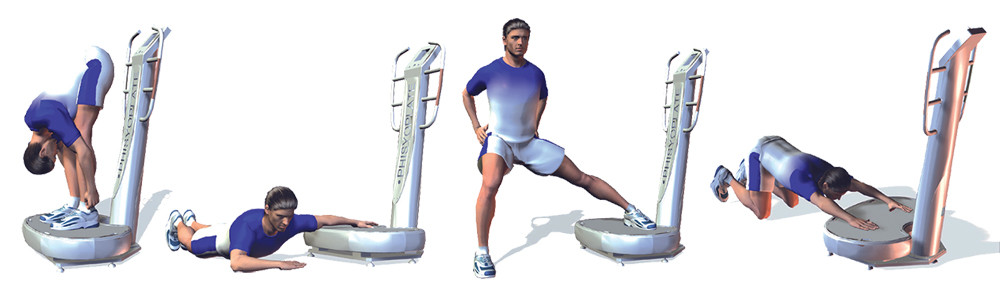
1. Hamstring stretch. Stand on the platform with your knees slightly bent, then bend forwards with a straight back until you feel tension in the back of your thigh — your face moves towards your knee. This stretches the hamstrings and their tendons.

2. Chest and abdominal stretch. Lie on your stomach in front of the trainer, with one arm on the platform; as you raise the opposite arm, you will feel a gentle stretch in the chest and abdominal muscles.

3. Adductor stretch. Stand with your legs apart: one foot on the floor and the other on the platform, hands on your hips. Bend the leg on the floor while keeping your back straight, until you feel tension on the inner side of your thigh.

4. Shoulder and back stretch. Kneel in front of the platform, extend your arms onto it, then reach forwards with your torso — this relaxes the back and chest muscles.

 My advice on choosing a device
If you decide to buy one, do not compromise on two things: stability and a handrail. Cheap platforms without a handrail are particularly risky for older people and those with balance problems — precisely the target group that could gain the most from this method. Choose a device with a stable frame, a console and handles, and gradually adjustable vibration levels. You can exercise in the evening, but bear this in mind: vibration energises many people — if you are a sensitive sleeper, morning or late morning is more suitable.
 Who must avoid it — and who needs medical approval?
Vibration puts strain on the whole body, so the list of contraindications is longer than for many other home methods. Do not stand on the platform if any of the following applies to you:
- Pacemaker or implanted electronic device – vibration may interfere with its operation.
- Pregnancy – whole-body vibration should be avoided; after childbirth, it may be started no earlier than 6 weeks later, with medical approval.
- Recent venous thrombosis – vibration carries a risk of the blood clot breaking loose.
- Cancer – vibration training should be avoided during active disease.
- Epilepsy – only after consultation with a specialist.
- Untreated, acute disc herniation – it is prohibited with a fresh, extruded herniation; with a stable, treated spinal disc herniation, only exercises agreed with a doctor are appropriate.
- Recent joint inflammation or recent fracture – vibration is harmful during the acute phase; after healing, only with medical approval.
- Severe cardiovascular disease – prohibited in an unstable condition; even with treated high blood pressure, ask your doctor first.
- Recent knee or hip replacement – prohibited during the first 3 months after implantation, and thereafter only with the surgeon's approval.
- Severe diabetic neuropathy – because of impaired sensation, feedback from the load is unreliable.
- Retinal detachment or risk of retinal detachment – vibration transmitted towards the head should be avoided.
- Severe migraine – vibration may trigger an attack.
 Important information
If you have gallstones, kidney stones, treated diabetes, high blood pressure or any chronic illness, ask your doctor for advice before starting vibration training. Correct technique is also part of safe use: in a standing position, keep your knees slightly bent — this allows the muscles to absorb the vibration rather than the spine and head.
 What does the research say?
“Does vibration training really benefit my bones?”
In postmenopausal women — the main risk group for osteoporosis — a recent analysis of almost 50 studies involving more than 3300 participants compared the effects of different forms of exercise on bone density. The result: for femoral neck bone density, vibration training was among the methods with a measurable beneficial effect — while combined (aerobic + strength) exercise ranked first overall.1 The lesson is twofold: vibration can indeed benefit the bones, but it provides the most value as part of a varied exercise programme — not as the sole method.
“Could it help my elderly parents with their balance?”
A summary of studies in older people found that vibration training measurably improved basic balance indicators and the speed of standing up and initiating movement — and the effect was most pronounced in weaker and more frail older adults.2 This makes sense: when someone's muscle strength and balance are far from their maximum, even a gentle, safe stimulus can make a significant difference. The practical requirement is a stable device with a handrail and a gradual start — balance training should not involve a risk of falling.
“What can it definitely do — and what is still uncertain?”
According to the latest review of 36 studies, the most consistent result is increased lower-limb strength — particularly knee extensor strength: around two-thirds of the studies confirmed an improvement. Results from balance and functional tests are more mixed, and no adequately sized study has yet confirmed that the method actually reduces the number of falls.3 Two reassuring findings, however, are that side effects were rare, mild and temporary, and no serious event linked to training occurred — so the method can be considered a safe additional form of exercise, provided expectations remain realistic.
Frequently asked questions
No. Vibration increases muscle activity and stimulates metabolism, but visible weight loss requires exercises on the platform 3-4 times a week, a suitable diet and 2-3 months of patience. For maintaining your shape, 2-3 sessions a week may be enough. The vibration trainer may support a weight-loss programme, but it does not replace one.
Gradually: as a beginner, if you are overweight or undergoing rehabilitation, increase the time by no more than 1 minute every 1-2 days. A sensible maximum for standing exercises is 20-25 minutes per session — up to 30 minutes including gentle massage and stretching positions. Longer is not better: quality, controlled positions are what matter.
Probably not — quite the opposite. Research shows the most pronounced improvements in strength and balance among older users with a weaker physique. The conditions are medical approval (especially with cardiovascular disease, a prosthesis or osteoporosis medication), a device with a handrail, a gentle setting and a gradual start.
It depends on its condition. It is prohibited with a fresh, extruded or untreated disc herniation. With a stable, treated spinal disc herniation that is symptom-free or causes only mild symptoms, gentle exercises agreed with a doctor or physiotherapist may be considered — always starting with bent knees and a gentle setting. Do not make the decision alone: discuss it with your doctor.
You can exercise in the evening, but vibration energises many people — if you are a light sleeper, do it earlier. It is sensible to skip intense exercise during the first days of menstruation; afterwards, gentle work at a low setting is trouble-free for most people. Listen to your own body — it knows better than the data.
With correct use, side effects in research were rare, mild and temporary. The key is correct technique: keep your knees slightly bent (so the muscles absorb the vibration rather than the spine and head), increase the load gradually and respect the contraindications. In most cases, it is incorrect use that causes harm — standing with straight knees for hours without a handrail is not training.
 Summary – Quick overview
Sources
- Xiaoya L, Junpeng Z, Li X, et al. (2025). Effect of different types of exercise on bone mineral density in postmenopausal women: a systematic review and network meta-analysis. Scientific Reports. PubMed: 40188285
- Lam FM, Lau RW, Chung RC, Pang MY. (2012). The effect of whole body vibration on balance, mobility and falls in older adults: a systematic review and meta-analysis. Maturitas. PubMed: 22609157
- Dong M, Choi Y, Li N, et al. (2026). Effects of whole-body vibration training on fall-related physical capacities in older adults: a systematic review. Journal of the American Medical Directors Association. PubMed: 42391776