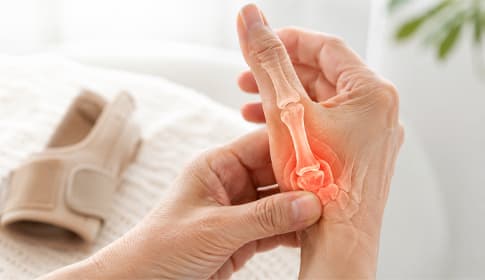

 What is thumb-base arthritis?
This unmatched freedom of movement also makes the joint vulnerable. When you grip a key, open a bottle or pick up a small object with a pinch grip, force is transferred through this small joint almost every time. Over decades, several tonnes of load may accumulate on it. It is no wonder that the cartilage eventually starts to wear, the ligaments stabilising the joint loosen and the joint surfaces shift in relation to each other.
The condition typically appears after the age of 50 and is 6–10 times more common in women than in men. People affected usually report pain at the base of the thumb, reduced grip strength and difficulty with pinch grip. In more severe cases, visible deformity may also develop: the base of the thumb “pops out”, while the upper part of the finger bends in the opposite direction.
 Key point
Thumb-base arthritis is not simply “wear and tear”. It is a combined imbalance involving the cartilage, ligaments and muscles that stabilise the joint. That is why effective home treatment also needs to target two things at once: strengthening the muscles that stabilise the joint (therapeutic exercise + muscle stimulation) and reducing inflammation (laser, magnetic and ultrasound therapy).
 How can these treatments help?
Home therapy devices do not work on their own. Each one supports a specific biological process. The following four mechanisms explain why it is worth combining stabilisation and anti-inflammatory methods. Each contributes in a different way, through different tissues, to helping your joint cope better with everyday load.
The small muscles around the joint – especially the first dorsal interosseous (FDI), along with the thumb’s own muscles (the thenar group) – are like the ropes that tension a tent canvas. When they become weak, the joint surfaces slide out of alignment and every movement causes pain. A fluoroscopic examination showed that tightening the FDI muscle can pull the displaced end of the thumb metacarpal back into position. Targeted strengthening of this muscle therefore provides real, measurable mechanical support.1,2
Therapeutic exercise is effective on its own. Studies show that regular, targeted exercises can significantly reduce pain and improve hand function.3 Electrical muscle stimulation (EMS/NMES) can complement this. It can reach small muscles that are difficult to tighten selectively through voluntary movement. Used together, active exercise and passive stimulation work on a similar principle to combining weight training with massage: one teaches the muscle, while the other helps maintain its tone.
Low-level laser therapy (LLLT or photobiomodulation) uses red or near-infrared light with a specific wavelength and low intensity. The light passes through the skin into deeper tissues, where it acts on the mitochondria of the cells. It works like an “internal energy switch”: increased ATP production in the cells may help reduce inflammation and support tissue regeneration.
This is particularly relevant at the thumb base because the joint lies directly beneath the skin, only a few millimetres deep. Laser light can therefore reach the target tissues effectively. According to systematic reviews published in 2025, photobiomodulation appears promising as an adjunct in hand OA, although the optimal dose still needs to be defined more precisely.4
Pulsed electromagnetic field therapy (PEMF) passes through the hand and the joints, acting at cell-membrane level. Pulsed magnetic fields may influence ion-channel function and thereby support the calming of inflammatory processes and the metabolism of cartilage cells.
In 2025, the first double-blind, randomised controlled trial specifically testing magnetic therapy in people with thumb-base arthritis was published. Participants wore a PEMF device for 8 hours each night over 4 weeks. Interestingly, the reduction in pain became statistically detectable after the treatment period, at week 6. This suggests that magnetic therapy is not a rapid painkiller, but may provide a slower-developing yet longer-lasting effect.5,6
Therapeutic ultrasound is a high-frequency sound wave that cannot be heard by the human ear. It creates tiny mechanical vibrations and a mild heat effect in the tissues. Think of it as a microscopic massage that works through the connective tissue around the cartilage, ligaments and muscle attachments. This microvibration may support blood circulation, fluid movement between cells and the removal of inflammatory substances.
The SUR study (Study of Medical Ultrasound for Rhizarthrosis), launched in 2020, may provide detailed data specifically on thumb-base arthritis in the near future. The studies are still in progress. For now, ultrasound is considered an accepted, well-tolerated treatment in hand OA, particularly as part of combined physical therapy programmes.7
What home therapies are available?
The table below shows what each method targets and how it can fit into a comprehensive home programme. Notice that the four main pillars each work through a different mechanism. They do not exclude one another. They complement one another.
| Method | What does it target? | Typical daily duration | When is it worth choosing? |
|---|---|---|---|
| Therapeutic exercise | Muscle strength, stabilisation, joint position | 10–15 minutes | At every stage; the cornerstone of treatment |
| EMS / muscle stimulation | Activation of small stabilising muscles | 15–20 minutes | When the muscles are already weak or difficult to activate selectively |
| Low-level laser | Cell-level reduction of inflammation, regeneration | 5–10 minutes | During an active inflammatory phase, in treatment cycles |
| Magnetic therapy (PEMF) | Inflammation, cartilage-cell metabolism | 30–60 minutes or overnight use | For chronic, persistent symptoms, as a long-term treatment |
| Therapeutic ultrasound | Soft tissues, microcirculation, joint capsule | 5–8 minutes | For a stiff, swollen joint, in treatment cycles |
| TENS (symptomatic only) | Pain relief through nerve fibres | 20–30 minutes as needed | For acute pain, as an adjunct – it provides symptomatic relief only |
 Important distinction
TENS (transcutaneous electrical nerve stimulation) and EMS (electrical muscle stimulation) often work on the same device, but they serve entirely different purposes. TENS “quiets” pain nerve fibres. It provides symptomatic pain relief, but does not help stabilise the joint. EMS, by contrast, activates the muscle and therefore contributes actively to long-term improvement. In treating thumb-base arthritis, the focus is clearly on EMS and anti-inflammatory physical therapies.
Guardians of the joint: targeted muscle strengthening
Training the muscles that stabilise the joint is the most important pillar of treatment. A 2024 study in post-menopausal women showed that targeted muscle strengthening and proprioceptive training significantly reduce pain and improve hand function.3,8 The following exercises can also be performed at home for 10–15 minutes a day.
Place your palm on a table with your fingers naturally spread. Place the index finger of your other hand between your thumb and index finger at the joint, in the web-space. Now try to move your index finger towards your thumb while pressing against the finger of your other hand. The finger should not move; only the muscle should tense. Hold for 5 seconds, then relax for 3 seconds. Repeat 10 times, twice a day. This is isometric strengthening, which directly targets the FDI muscle that stabilises the joint.
Touch the tip of your thumb in turn to your index, middle, ring and little fingers, forming an “O” shape each time. Move slowly and firmly, feeling the muscles at the base of the thumb working. Do 10 repetitions in each direction, twice a day. This classic opposition exercise trains the thumb’s own muscles, the thenar group.
Close your eyes and rely only on your sense of touch as you move your thumb into different positions: extended, bent, towards the centre of your palm and out to the side. Hold each position for 3–5 seconds. This exercise retrains the joint receptors, or proprioception, and according to 2024 studies has a notable effect on improving hand function.8
Use a small (2.5 cm, round PALS) electrode or a motor-point pen. Place one electrode at the base of the thumb and the other on the thenar pad. These stimulate the thumb’s own muscles. Start at a low intensity and gradually increase it to a level where you feel a visible but painless contraction. Use for 15–20 minutes, 3–5 times a week. EMS is particularly useful if, during therapeutic exercise, you feel that you “cannot find” the muscle. The stimulation shows you what correct activation feels like.
 Home therapy devices for thumb-base arthritis
Home-use devices are available for each of the four main technologies. The overview below will help you find your way:
EMS / muscle stimulation devices
For targeted activation of the muscles that stabilise the joint. Most models include both EMS and TENS functions, allowing you to address stabilisation and pain relief with the same device. Look for devices supplied with electrodes designed specifically for the hand and small joints.
Home low-level laser devices
With small joints, the laser can be directed straight at the painful area. For home use, devices with an 808 nm wavelength and medium output are the most common. A treatment session typically lasts 5–10 minutes, daily or every other day.
Magnetic therapy devices
Pulsed magnetic fields can pass through a larger area. Small joints can be treated with special hand applicators or low-intensity devices designed for longer use. They are suitable for chronic, persistent symptoms because their effect develops slowly but may last longer.
Therapeutic ultrasound devices
Home therapeutic ultrasound devices operate at 1 or 3 MHz. For small joints, 3 MHz is appropriate because this higher frequency acts in more superficial tissues. Apply with gel, using slow circular movements.
 Before you start treatment
It is worth discussing any home therapy with a doctor before you begin. In certain conditions, the methods listed below may not be recommended or may require special precautions.
When should you be careful?
- Pacemaker or implanted electrical device – EMS, TENS and magnetic therapy generally cannot be used in this situation because they may interfere with the implant.
- Active malignant tumour in the treatment area – the heat effect of ultrasound and laser, as well as effects that improve circulation, are not recommended in this situation.
- Pregnancy – with magnetic, ultrasound and laser therapy, pregnancy is an absolute contraindication for treatment of the abdominal and pelvic areas. Use on the hand requires medical advice.
- Acute inflammation or infection – if the base of the thumb is hot, red, swollen and causes throbbing pain, this may indicate acute inflammation. The cause must be clarified first. During the active phase, most physical therapy treatments are not recommended.
- Fresh surgical wound in the treatment area – wait until the surgical wound has healed completely before starting home therapies. Your doctor can advise you on this.
- Clotting disorder or anticoagulant treatment – extra caution is needed with ultrasound and magnetic therapy. Consultation with your doctor is recommended.
- Epilepsy – with electrotherapy devices such as EMS and TENS, use on the head is specifically prohibited. Use on a limb requires medical assessment.
Important information
Home therapy devices are intended to complement conventional medical treatment. They do not replace it. If your symptoms significantly affect your quality of life, your condition suddenly worsens, or you do not notice improvement after 4–6 weeks despite treatment, consult your doctor or a hand-surgery specialist.
 Scientific background
The key studies below provide the evidence base supporting the recommendations above. All are publicly available on PubMed, and the full text can be accessed through the cited links.
2024 meta-analysis – effect of exercise in CMC-I arthritis
In a pooled analysis of 14 randomised controlled trials, involving 1280 patients with a mean age of 62.2 years, Karanasios and colleagues showed that exercise-based interventions significantly reduce pain intensity and wrist-related functional impairment compared with no treatment. The study was published in Healthcare.3
2024 randomised trial – PNF + strengthening in post-menopausal women
Campos-Villegas and colleagues compared the effectiveness of proprioceptive neuromuscular facilitation (PNF) and strengthening training in post-menopausal women with thumb-base arthritis. The results showed that both methods contribute to pain reduction and improved function, highlighting the importance of targeted muscle training. Published in the Journal of Hand Therapy.8
2022 study protocol – the FDI muscle as a key stabiliser
The study by Tossini and colleagues explains in detail why targeted strengthening of the first dorsal interosseous (FDI) muscle may be more effective than training the conventional thumb abductors and extensors. Biomechanical and electromyographic studies show that this muscle plays a decisive stabilising role at the CMC-I joint.2
2025 RCT – pulsed magnetic field for thumb-base arthritis
In the double-blind, randomised controlled trial by Durtschi and colleagues, 61 patients with thumb-base arthritis wore a PEMF device for 8 hours each night over 4 weeks. At week 6, average daily pain intensity had decreased significantly more in the PEMF group than in the sham-treatment group (P = 0.02), suggesting a lasting pain-relieving effect extending beyond the treatment period. Published in Hand.5
2025 systematic review – comprehensive treatment of hand OA
The systematic review by Kjeken and colleagues, published in 2025, assessed all non-pharmacological, pharmacological and surgical treatments for hand OA. Among non-pharmacological interventions, certain combinations of exercise and anti-inflammatory physical therapies, including magnetic and laser therapy, showed the most favourable benefit–side-effect profile in the analysis published in RMD Open.4
 Practical advice
Based on clinical studies and everyday experience, the following principles are the most important if you want to start treatment at home.
Start with stabilisation
The most common mistake is that people look only for pain relief, such as TENS or occasional laser use, and leave out stabilising muscle strengthening. Yet the key to long-term improvement is restoring the function of the muscles around the joint. Plan for at least 6–8 weeks: this is how long it takes for the effect of muscle training to become tangible. Do not give up during the first few weeks.
Combine the methods
An ideal daily/weekly protocol might look like this: in the morning, 10 minutes of therapeutic exercise; during the day, 15–20 minutes of EMS, 3–4 times a week; when painful, laser or ultrasound treatment directed at the affected joint for 5–8 minutes; and overnight, magnetic therapy if you have a suitable device. Monotherapy rarely provides the same effect as a combined approach.
Protect the joint
Alongside treatment, it is also important to rethink your everyday movements. Use a jar opener when opening bottles or jars. Balance a jar in the centre of your palm. Do not hold your mobile phone with only two fingers. A simple thumb stabilising orthosis, particularly for night-time use, can also provide significant support during the active treatment period.
Frequently asked questions
The pain-relieving effect of laser, TENS and ultrasound may be noticeable after a few treatments. Improvement in muscle strength and stabilisation, however, typically becomes tangible after 4–6 weeks of regular training. With magnetic therapy, the 2025 study found that the lasting effect became clearly detectable at week 6. It is therefore worth thinking in longer-term terms.
Yes. In general, a combined approach is the most sensible option. Stabilisation methods, such as therapeutic exercise and EMS, and anti-inflammatory methods, such as laser, magnetic and ultrasound therapy, do not exclude one another. They complement each other. You can use 2–3 different methods in one day, but allow enough rest between treatments.
TENS is effective for symptomatic pain relief, but it does not address the cause of the pain: joint instability and inflammation. If you treat the symptoms only with TENS, the joint may continue to deteriorate and the pain-relieving effect may weaken over time. TENS should therefore be regarded at most as an adjunct for symptom relief. Real improvement depends on muscle strengthening and anti-inflammatory therapies.
During an acute phase when even touch is painful, start with the gentlest methods. Rest the hand in an orthosis, apply a cold compress and begin active exercises only after the pain has eased. Laser therapy and gentle magnetic therapy may also be used at this stage because they do not require firm contact. This is why they can be useful early in treatment.
According to current professional guidelines, including EULAR and ACR, surgery is considered only when conservative treatment – therapeutic exercise, physical therapy, orthosis, medicines and injections – has not produced improvement after 6 months. Targeted, regular home therapy may therefore contribute meaningfully to postponing or avoiding surgery. In advanced cases, however, surgery such as trapeziectomy or joint replacement may be the most appropriate option. This should always be assessed with a hand-surgery specialist.
Both deliver low-frequency electrical impulses, but for different purposes. TENS (transcutaneous electrical nerve stimulation) acts on pain-sensing nerve fibres and provides symptomatic pain relief. EMS (electrical muscle stimulation), by contrast, contracts the muscle and therefore provides active training. This is important for joint stabilisation. Most devices available on the market offer both modes, so one device can cover both purposes.
 Summary – quick overview
Sources
- McGee C, O'Brien V, Van Nortwick S, Adams J, Van Heest A (2015). First dorsal interosseous muscle contraction results in radiographic reduction of healthy thumb carpometacarpal joint. Journal of Hand Therapy. PubMed: 26209165
- Tossini NB, Pereira ND, de Oliveira GS, da Silva Serrão PRM (2022). Effect of first dorsal interosseous strengthening on clinical outcomes in patients with thumb osteoarthritis: a study protocol for a randomized controlled clinical trial. Trials. PubMed: 35241133
- Karanasios S, Mertyri D, Karydis F, Gioftsos G (2024). Exercise-Based Interventions Are Effective in the Management of Patients with Thumb Carpometacarpal Osteoarthritis: A Systematic Review and Meta-Analysis of Randomised Controlled Trials. Healthcare (Basel). PubMed: 38667585
- Kjeken I, Bordvik DH, Osteras N, Haugen IK, et al. (2025). Efficacy and safety of non-pharmacological, pharmacological and surgical treatments for hand osteoarthritis in 2024: a systematic review. RMD Open. PubMed: 39793978
- Durtschi MS, Rajakumar V, Kenney DE, Pham NS, Ladd AL, Chou RC (2025). Clinical Efficacy of Pulsed Electromagnetic Field Therapy on Thumb Carpometacarpal Joint Pain: A Double-Blind, Randomized, Controlled Trial. Hand. PubMed: 41015912
- Wu Z, Ding X, Lei G, Zeng C, Wei J, Li J, Li H, Yang T, Cui Y, Xiong Y, Wang Y, Xie D (2018). Efficacy and safety of the pulsed electromagnetic field in osteoarthritis: a meta-analysis. BMJ Open. PubMed: 30552258
- Bock M, Eisenschenk A, Lorenzen H, Lautenbach M (2020). Study of Medical Ultrasound for Rhizarthrosis (SUR): study protocol for a randomized controlled single-center pilot-trial. Trials. PubMed: 32487163
- Campos-Villegas C, Pérez-Alenda S, Carrasco JJ, Igual-Camacho C, Tomás-Miguel JM, Cortés-Amador S (2024). Effectiveness of proprioceptive neuromuscular facilitation therapy and strength training among post-menopausal women with thumb carpometacarpal osteoarthritis. A randomized trial. Journal of Hand Therapy. PubMed: 35948454