
Train and rest! – What is supercompensation?
Recently I was invited as a speaker to the national meeting of the BSI running ambassadors. The topic we discussed was SUPERCOMPENSATION — which is what the title above refers to. In other words, it is not enough just to train… Positive changes caused by (running) training require something more. But is it enough to just rest and refuel?
Since then I have received many questions (not only from runners). Instead of answering them one by one, I thought it might be useful to summarize the topic again here: the distilled "textbook facts" and the exciting questions that point toward the FUTURE. A bit of training theory can’t hurt, even for an athlete preparing for a triathlon.
ATP – the energy source
FACT: it is accepted textbook knowledge that every biological system needs energy to function. That is one reason we eat and try to pay attention to quality nutrition — "you are what you eat"…
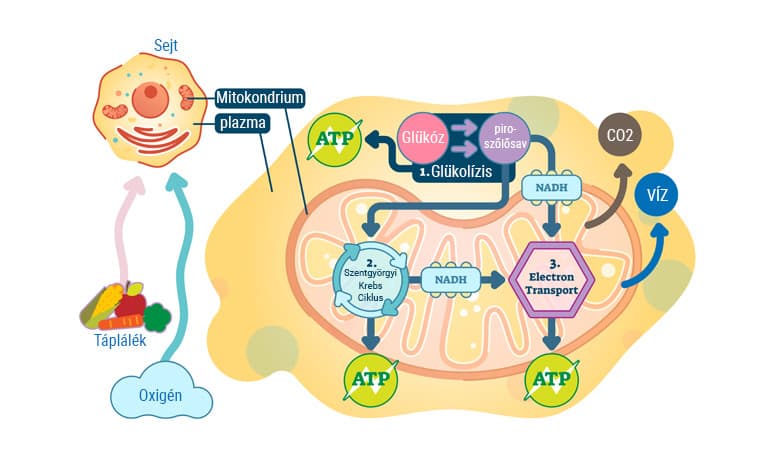
The body’s "small change," the means of paying the energy cost of nearly every biochemical process, is ATP. ATP is produced inside the cell power plants, the mitochondria, and requires the cooperation of many enzymes ("molecular scissors"). This is where the process described in biochemistry textbooks takes place: biological oxidation, an internal, "slow combustion" (the simplified version is shown in the figure below).
Homeostasis – constancy of the internal environment
Efficient enzyme function requires a constant physical and chemical environment inside the cell. We call the constancy of the internal environment HOMEOSTASIS. The body maintains homeostasis via the nervous and hormonal systems and reacts immediately when it detects any change.
Many classical regulatory processes could be mentioned. Think, for example, about the mechanisms that control our body temperature: their goal is to keep biochemical processes happening as if in a "37-degree water bath." We deliberately put on clothes, we shiver (generate heat), or we sweat (cool down) when needed. Or consider the body's series of buffer systems that help regulate the pH of that "37-degree water bath."
This process becomes especially visible when the nervous system "realizes" that the blood pH is becoming even slightly acidic: if an athlete performs above the anaerobic threshold and can’t clear lactate through metabolism during the effort, the respiratory center kicks in and, with very intense exhalation (expelling carbon dioxide), tries to rid the body of the accumulating acid…
And we’ve only mentioned two physical (temperature) and chemical (pH) factors that fundamentally determine the speed of biochemical processes. What about hemodynamics (pulse, blood pressure), tissue perfusion and the regulation of other interrelated systems! Listing them all is difficult and would obscure the main point.
The point is that we deliberately target and exploit these control functions — or rather a certain "hypersensitivity" of this system — during our training.
See-saw – load and rest so it can be integrated!
It’s like a see-saw: on one side, training causes a little "damage," then during the recovery phase on the other side "everything is rebuilt," and the end result is a biological system capable of higher performance than the starting point. The miracle is that after a few months — indeed after a whole "training year" — the athlete’s appearance can change as a consequence of the rebuilt tissue structures.
During loading the body becomes "worn" due to catabolic processes (mostly breakdown processes) — in other words we become a little sick… Inflammation and even "cell death" can occur!
During rest and refueling anabolic (building) processes take place: new proteins, new cell components, new cells, and, over the longer term, renewed tissues are formed…
What must be emphasized repeatedly is "No short cut" (Scott Molina) — that is, work, work and more work…!
Supercompensation – the body optimizes its function to the load
Although the literature vividly illustrates the changes characteristic of a properly timed and regularly loaded organism and the performance changes over time resulting from supercompensation — and we ourselves experience this in our own examples — the truth is the system is not that flexible. The oscillations of change may be most visible at first, but later the supercompensation bump becomes barely noticeable… yet it is always present.
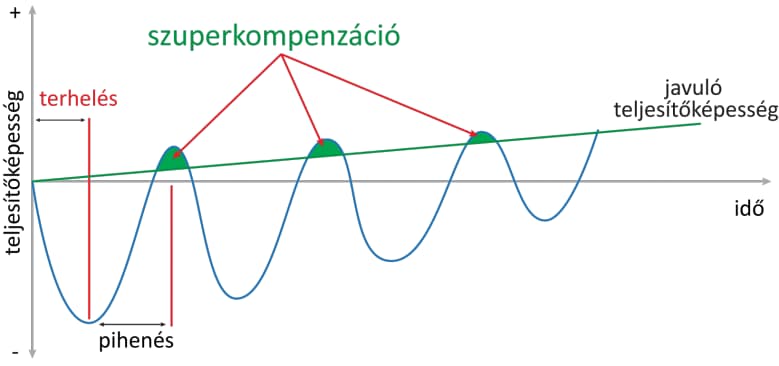
The body optimizes its function and performance in response to regularly repeated loading.
Choosing the rhythm and magnitude of training stimuli is the art of exercise science — it depends entirely on the individual and can only be achieved through a long learning process.
Moreover, most amateur triathletes try to balance family-work-training, which makes planning training even more difficult. It’s no coincidence that an amateur triathlete can make remarkable progress simply by going to a training camp (and of course training there): suddenly, time previously spent at work is freed up across the 168 hours of the week… There is time both to train and to rest.
And if they also pay attention to the "building blocks" (i.e., don’t skimp on meals), the training camp achieves its purpose because the SUPERCOMPENSATION mechanism will work.
Speeding up recovery processes
Now we reach the hour of questions: what options do we have to accelerate our recovery processes?
Adequate sleep and conscious nutrition I would treat as absolutely basic, so I won’t elaborate on them at length.
For further evidence-based measures there are four more widely known but perhaps underused options that help recovery.
1. Stretching
Muscles that have been worked shorten by the end of the load, which reduces joint range of motion.
This process can be well counteracted by conscious stretching, while neglecting stretching will reduce movement efficiency as a resultant of negative processes.
Stretching exercises should be done while the muscles are still "warm"… they will appreciate it!
2. Strengthening
This applies to every muscle, which is why we run uphill or do "Kraft mit Rad" workouts, for example…
The body is especially grateful for strengthening the postural muscles, the "frame" (the core musculature). Our good friend here is planking…
3. Cross-training is worth considering in triathlon circles
After all, we train in three sports to begin with, and we also do strength work (see point 2).
To the running ambassadors I of course extolled the beneficial effects of our other two base sports. But why not add a little extra sport? Many of us use MTB. Even more!
If our cross-training includes a bit of play, it can also be perfect for giving the nervous system a break! For example: table tennis, badminton, basketball, gentle football (!)…
4. Massage
A well-trained masseur using creams and oils can do wonders when they gently "smooth out" and stretch your tired, almost "contracted and knotted" muscles.
It is especially fortunate if the masseur also works on the sole of the foot… Stimulating plantar "reflex points" can almost completely relieve muscle stiffness caused by minor injuries.
And after this introduction I’d like to share a few thoughts that friends gave me as impulses right after the presentation!
In the United States a new type of gym has appeared in recent years: the Recovery Lab. Here you don’t go to train, but rather to cool down and regenerate after training!!!!
Massage (with recovery creams), sauna, ice baths, ice massage, cooling compression, intermittent compression, electrostimulation, soft laser, ultrasound therapy are among the available options.
Thinking about the physiological background laid out in the introductory slides, I must say this is not just some fashionable trend, but it will be the future! Evidence is accumulating in the literature about the beneficial effects of muscle cooling or stimulation on recovery.
It’s no coincidence that Ironlady (Katinka Hosszú) or Movistar’s cyclists use these recovery options immediately after training and competition.
Perhaps the first Recovery Labs will soon open in our country too… and supercompensation can be made more effective for us as well.
The Recovery Lab concept (English video)

