
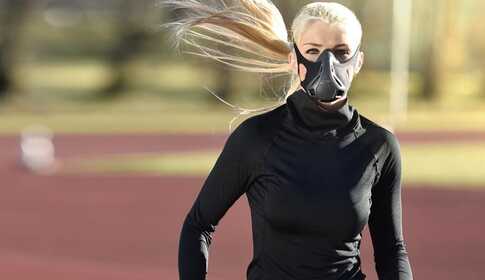
Using the training mask – more in detail
The importance of breathing has already been covered in several articles on this site. This article on using the training mask is primarily aimed at athletes, since they are the ones who most often use this device to improve breathing and strengthen the respiratory muscles. Jarmila Kratochvílová, the great Czechoslovak 400 and 800 m runner of the last century—who still holds the world record in the 800 m—sometimes trained in a military gas mask to boost her performance [...]
The importance of breathing has already been covered in several articles on this site. This article on using the training mask is primarily aimed at athletes, since they are the ones who most often use this tool to improve breathing and strengthen the respiratory muscles.
Jarmila Kratochvílová, the great Czechoslovak 400 and 800 m runner of the last century—who still holds the 800 m world record—occasionally trained in a military gas mask to improve her performance. Today there are better tools available for this purpose. Training masks are designed so that the resistance on both inhalation and exhalation can be adjusted. This ensures that the load on the respiratory muscles can be set for specific exercises and training periods.
You can buy a training mask here.
The importance of dead space
A very important part of training masks is the dead space, which is usually not mentioned when discussing these devices. This dead space is the volume inside the mask and under the mask that causes the athlete to re-inhale the last portion of their previous exhalation with every inhalation.
Why is this interesting, you may ask?
Because during the use of a training mask the composition of the inhaled air changes!!! The carbon dioxide concentration increases significantly and the oxygen concentration decreases slightly.
The next question: What does this lead to?
It means that the carbon dioxide concentration rises throughout the athlete’s body, and they will experience the effects not only as heavier breathing.
These effects are:
- increased oxygen delivery at the cellular level
- reduced ventilation both during exercise and at rest
- increased carbon dioxide tolerance
- dilated blood vessels and relaxed smooth muscles
- reduced appetite after training and other effects
Let us look at the effects triggered by using the training mask one by one
Increased oxygen delivery at the cellular level
This is due to the Bohr effect, already described by Christian Bohr in 1904. If the carbon dioxide concentration increases in the human body and in the cells, hemoglobin in the blood—responsible for transporting oxygen—releases more oxygen to the cells than it would if the carbon dioxide concentration were lower. Using a training mask raises the carbon dioxide concentration; that is clear.
Human respiration works in such a way that, if carbon dioxide concentration in the blood and cells increases over a longer period, the body gradually adapts and the higher levels persist even during periods when the person is not using the training mask.
This results in all of the athlete’s cells being continuously better oxygenated, which improves training and competition performance and speeds up recovery, while also improving the immune system (allergies or asthma-like complaints may even disappear, if present). Naturally, this also brings about increases in VO2max, for example.
Faster recovery allows for a greater amount of training to be completed and also means that an athlete who is exhausted after training will be able to perform mentally at a higher level sooner. This is especially helpful for those who study or work alongside training. Not insignificant: if cellular oxygenation improves, sleep requirements often decrease as well.
Why does ventilation become reduced during exercise and at rest?
Because oxygen delivery and utilization at the cellular level have improved. Simply put, less air is sufficient during both exercise and rest.
Why is this important? Because during intense aerobic exertion, more than 3% of all muscle work goes to the respiratory muscles. If regular mask use reduces that to 2%, you can gain more than 1% overall performance while VO2max may also have increased. In some cases that 1% can be very significant.
Increasing carbon dioxide tolerance
Why is this important? Because when an athlete is tired at the end of a race or in the final minutes of a match, their carbon dioxide level is already high and they are gasping for air; at the same time their muscles become more acidic—more precisely, lactate concentration increases. Higher carbon dioxide together with better cellular oxygenation slows down acidification and lactate accumulation; thus, in the final sprint the athlete who can tolerate more carbon dioxide—e.g., through regular training mask use—gains an advantage. With a training mask incorporated into preparation, it is less likely that, for example, a swimmer’s last 25 meters of a 200 m race will become sheer pain with shortened strokes and slowing down. (It is no coincidence that László Cseh and Katinka Hosszú also use the training mask during their dryland training.)
Dilated vessels, relaxed smooth muscles
This occurs because carbon dioxide is a very effective muscle relaxant, especially for smooth muscle and less so for striated muscle. It relaxes the smooth muscle in arterial walls and airways, improving blood flow and easing breathing. It reduces heart rate and blood pressure. It protects the heart, blood vessels and respiratory system. Besides the heart, the brain benefits most because training with a mask greatly supports cerebral blood flow and function, allowing better concentration even when tired.
Since the intestines also contain smooth muscle, increased carbon dioxide can relax them as well, so those who are sensitive may literally experience a laxative effect from the training mask. (For constipation problems, training mask therapy can be excellent. :))
Reduced appetite after training
This is particularly interesting for those who tend to exceed their competition weight easily. Carbon dioxide is mildly acidifying. It has been observed that a more alkaline body is hungrier than a slightly more acidic one. This difference in pH may be only a few hundredths but has a significant effect on appetite. Do not be surprised if after mask training you feel less hungry and eat later than usual. The mask may even change your food preferences a bit.
Strengthening of the respiratory muscles
The training mask strengthens the respiratory muscles (diaphragm, intercostal muscles) because it makes inhalation and exhalation harder. It also slightly increases vital capacity and significantly increases the volume of air that can be inhaled and exhaled per unit time. It makes breathing easier even when large volumes of air are required, although with mask training the overall need for air is reduced.
It has also been observed that when someone trains with a mask, the trunk muscles not directly involved in breathing also strengthen more than without mask use. The explanation is that the increased strength of the respiratory muscles provides support for other trunk muscles. This is especially useful in sports where trunk strength is important (tennis, ball games, kayak-canoe, rowing, combat sports, swimming, ice hockey, and many others). In sports where trunk strength is less critical (cycling, running, triathlon), this effect is less significant.
With extensive mask use, especially if one trains with strong restriction, even the respiratory muscles can become sore. In more serious cases this can be very unpleasant because we tense and use the respiratory muscles at least eight times per minute, and if they are sore that is painful eight times or more per minute. Therefore, progress gradually. Start with 5 minutes, then increase time depending on tolerance. (The training mask can also be used without restriction. In that case it won't strengthen the respiratory muscles as much, but it still develops endurance and improves recovery.)
Is the training mask recommended for everyone? NO!!!
The training mask is a great tool, but only if the user is already prepared to use it.
Preparedness is easy to measure. The control pause method developed by Professor Buteyko is useful here. The control pause is the time that elapses in normal, resting conditions from the end of an exhalation until the first appearance of the urge to breathe, while the person holds their breath. It is especially important to measure this value in the morning immediately after waking. The control pause is a useful metric because its value does not depend on how much the athlete can tolerate holding their breath.
The control pause should be measured as follows:
Sit with a straight back on a chair or on the edge of the bed so that your thighs are horizontal and your feet are on the floor. Breathe quietly as you normally would. Precede the measurement with at least 4–5, preferably 10 minutes of quiet sitting. (After waking, 1 minute is enough.) After a normal exhalation, pinch your nose closed and keep your mouth closed for the duration of the measurement. When you pinch your nose at the end of an exhale, glance at a second-hand watch for one second, and then wait—maintaining the resting position—for the first sign of air hunger in your chest.
The sign is usually a small contraction or tension of the diaphragm or chest muscles. At that moment check the watch again: the control pause is the elapsed time between the two readings. The measurement is valid if, after the measurement and resuming breathing, your breathing is the same as before. It is not valid if you need much bigger breaths after the test than you normally do. That would only deceive yourself.
Anyone wishing to use the training mask should have at least a 20-second control pause. The control pause measures carbon dioxide tolerance and is also an excellent indicator of cellular oxygenation. Because the training mask significantly increases the carbon dioxide ratio in the body, a baseline—generally 20 seconds—is necessary to achieve beneficial results with the device and avoid various problems.
What problems can occur if someone with a control pause of 20 seconds, and especially under 15 seconds, tries to use the training mask?
Headache, heart rhythm disturbances, sleep disorders, insomnia (especially with evening use), diarrhea, dizziness, fainting. (Fainting can occur especially in people with sugar problems because increased cellular oxygenation boosts insulin production and reduces insulin resistance, which can easily lead to fainting.)
So, using a training mask is not a game!
Measure your control pause first and if it does not reach 20 seconds, find appropriate tools and exercises to reach it before you begin using the training mask. Exercises and methods can be found in two books published this year on the subject. From Miklós Ferenc Barna: The Healing Power of Breathing and from Patrick McKeown: The Oxygen Advantage, you can find plentiful methods and exercises.
It is worth noting that as the control pause increases, so-called cleansing or detoxification symptoms may occur (cold-like sensations, fatigue for a few hours or 1–2 days, more colorful and more odorous urine, smellier sweat, breath odor). This is part of the process.
Plan mask use so that you use it less before very important events and more in the preparation periods to reduce risk. Again: regular training mask use strengthens the immune system, so its use tends to reduce health problems rather than increase them.
How much training mask use is needed to feel results?
Good question. The answer is complex because it depends on several factors. Which are these?
- Initial control pause value
- Daytime breathing habits
- Handling of stressful situations
- How the athlete breathes during training when not using a mask
- Posture
- Sleeping position
- Daily usage time and its distribution
- Use of other breathing techniques and individual factors
Nice list. Let us look at them one by one:
The higher the starting control pause, the harder further progress becomes. Athletes typically have control pauses around 20–25 seconds (others 15–20). Initially rapid progress can be achieved up to about 35–40 seconds. After that progress slows. The first 5 seconds of improvement, which is already clearly noticeable in vitality and endurance, usually takes about two weeks. The next 5 seconds may require a month.
Daytime breathing habits are important because if they are good, the results achieved with the training mask are easier to maintain during non-training periods.
What are common problems? Mouth breathing, unnecessary talking, taking a big breath through the mouth before speaking, chest breathing.
What is good?
Nasal breathing, abdominal breathing at rest, and inhalation through the nose even when speaking.
Managing stressful situations is important because stress automatically makes people chest breathers and sometimes mouth breathers, which is not good for overall breathing; abdominal nasal breathing is the healthy pattern.
Even in training, when you are not using a training mask (during matches or competitions), it is worth paying attention to breathing. If possible, breathing should be abdominal and through the nose. A little (really a little) air hunger does not make completing the training program significantly harder, but it greatly improves breathing overall and helps preserve the results achieved with the training mask. So, pay attention to breathing throughout training. It is of course even better if the coach and teammates remind each other of correct breathing (if they possess the necessary knowledge).
The role of correct posture in breathing
Posture is important because during the day, while lying in front of the TV, using a computer, traveling or at any other time, if the spine is not in the right position (straight is good), breathing becomes more chest-dominant due to slouching or rounded shoulders. Abdominal breathing is healthier than chest breathing because the lower regions of the lungs near the diaphragm have more blood vessels and better blood flow, allowing better utilization of both oxygen and carbon dioxide (the upper part is essentially a reservoir). Correct posture also helps maintain the benefits gained from mask training.
The importance of sleeping position
Sleeping position matters because people (including athletes) spend about one third of their time asleep and this affects their overall breathing. The recommended sleeping position is prone (on the stomach) with the mouth closed. This minimizes the amount of breathing and encourages abdominal breathing. If someone sleeps on their back with an open mouth, they will likely undermine the benefits of the training mask at night. No matter how much someone uses a training mask during training, if they sleep on their back with an open mouth and over-breathe, they may negate what they achieved.
Nighttime over-breathing also impairs recovery. Lying on the back makes breathing easier and an open mouth halves the airway resistance. (By now it should be clear that the goal is to use as little air as possible through nasal and abdominal breathing when not exercising, of course within healthy limits.)
Recommended training time with a mask
Daily usage time and its distribution are important because the breathing center in the brainstem and the whole body need enough time to develop and maintain increased carbon dioxide tolerance. Professor Buteyko, who laid the foundations of the method, prescribed up to 3 hours daily of breathing exercises for his patients.
You do not need that much mask time. Thirty to forty minutes per day in two 15–20 minute sessions is enough if you also support healthy breathing in other ways. If someone wants to use only the training mask and nothing else, twice a day for half an hour is the suggested "dose." To achieve more significant changes in breathing patterns (and not just strengthen respiratory muscles) this amount is needed. Even better would be three sessions of 15–20 minutes well distributed during the day, but that is not realistic for most athletes.
Within a single training session, it is advisable to perform mask exercises at the end of the session because this most effectively supports recovery: the increased cellular oxygenation will persist longer than if the mask is used at the start or middle of training. If mask use takes place at the end of training, any post-training cold bath or shower is easier to tolerate and can even feel good (incredibly as it may sound). The explanation lies in dilated vessels and improved blood flow. Cold baths also help make recovery more complete because blood from the core flows more to the cooled outer parts, bringing nutrients to the muscles and joints.
It is not advisable to use the mask outside of training.
After finishing intense exercise it is advisable to keep the mask on for at most 2–5 minutes to aid recovery. If someone keeps the mask on for a longer period without movement after training, the previously described unpleasant effects may occur, even if their control pause is over 35–40 seconds. With light breathing at rest, the mask increases cellular oxygenation and carbon dioxide concentration so much that it becomes excessive.
Think of the mask (and other breathing exercises) like a medicine or dietary supplement: take only as much as benefits your health and do not overdose.
If someone uses other breathing techniques and methods alongside the mask, less mask time is sufficient. The two books already mentioned provide plenty of ideas for athletes and coaches.
Does it really "replace" high-altitude training camps?
Training masks are sometimes advertised as replacements for high-altitude training camps. This is true, but they work differently than high mountains. In a training mask the composition of the air changes, while at high altitudes the atmospheric pressure is lower than at sea level.
You do not need to go several thousand meters up and train there for weeks. The effects achieved in those camps can be obtained at sea level. If someone performs breathing exercises adequately and uses the mask properly, the effect can be very similar or even better than a high-altitude camp. (After returning from a high-altitude camp, an athlete typically reverts to their normal state in about two weeks, which limits the utility of such camps.)
Training masks are not recommended for children; they should be started later for both physiological and psychological reasons. I consider it appropriate to begin at the earliest at age 15–16.
Thus, the training mask is a very good tool for strengthening respiratory muscles, improving endurance, and enhancing recovery. There are limits to its use. It is useful and health-serving to take these into account.
You can buy a training mask here.
Read our earlier articles on this topic as well:

