TECAR therapy is one of the most effective yet gentle modern animal physiotherapy methods for treating musculoskeletal problems. It works by using an alternating, high-frequency electric field to generate endogenous (within tissue) heat: the heat is produced directly in the treated area, stimulating circulation and regeneration while the treatment remains non-invasive, painless, and fast.
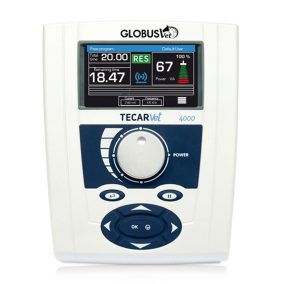
The Globus TecarVet 4000 is a professional TECAR therapy device offering both capacitive and resistive modes, enabling targeted treatment of superficial and deeper tissues. With a maximum power of 160 W and emission frequencies of 400/470/700/1000 kHz, it is suitable for a wide range of indications—from musculoskeletal cases in dogs and cats to equine protocols. The large 4.3” touchscreen provides a clear interface, the control panel is programmable, and it supports multi-user operation.
Price includes: 1× TecarVet 4000 device, 1x counter-electrode (plate), 1× monopolar resistive handpiece with 3 heads (Ø 30/50/70 mm), 1x monopolar capacitive handpiece with 3 heads (Ø 30/50/70 mm), 1x cream (250 ml), 3x elastic bands, 1x power supply, 1x professional carrying bag.
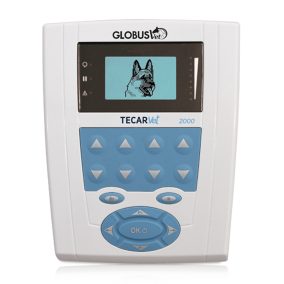
The Globus TecarVet 2000 is a compact, portable TECAR therapy device that offers the quality of the manufacturer's professional solutions with reduced size and weight. The device operates with a special bipolar, resistive handpiece that speeds up animal preparation and treatment procedures while maintaining therapeutic effectiveness. It includes programs specially designed for dogs and cats (e.g., osteoarthritis, muscle contracture, tendinopathy, edema).
Price includes: 1× TecarVet 2000 device, 1× bipolar handpiece Ø 50 mm, 1× 260 ml contact gel, 1× power adapter, 1× professional carrying bag
Veterinary TECAR Therapy (capacitive–resistive energy transfer)
TECAR therapy is one of the most effective yet gentle modern animal physiotherapy methods for treating musculoskeletal problems. Its essence is that it creates endogenous (within tissue) heat using an alternating, high-frequency electric field: the heat generates directly in the treated area, thereby promoting circulation and regeneration, while the treatment is non-invasive, painless, and fast.
How does it work?
- Capacitive mode – focuses on more superficial tissues: skin, connective tissue, superficial circulation, and lymphatic system. In this mode, the current flow occurs between an insulated active electrode and a non-insulated return electrode placed on the opposite side, with the most intense effect appearing under the active electrode area.
- Resistive mode – targets deeper, higher resistance tissues: bone, cartilage, tendons, ligaments, fasciae, fibrotic areas. Here, thermal effects develop between two non-insulated electrodes throughout the entire field.
Main effects
- Biostimulation – supports tissue metabolism and regeneration: increased nutrient and oxygen supply, physiological modulation of cell proliferation and differentiation, activation of cell functions.
- Inflammation and edema reduction – deep heat induces vasodilation, lymphatic drainage, and a “wash-out” effect, thereby reducing swelling and pain. The method is fast, non-toxic, non-invasive, and painless.
Applications
Small animals (dog, cat):
- osteoarthritis/arthrosis, spondylarthrosis
- sprains, muscle strains, muscle contractures
- trigger points, tendinopathies
- inflammatory edema, hematomas/bruises
For horses:
- osteoarthritis/arthrosis, spondylarthrosis
- back pain
- sprains, muscle strains, muscle and tendon injuries
- muscle contractures, trigger points
- inflammatory edema, hematomas/bruises
Device types and features (examples)
- Globus Tecarvet 4000 – capacitive and resistive modes; 160 W power (±20%); 400 / 470 / 700 / 1000 kHz emission frequencies (±10%); capacitive and resistive electrodes of various diameters (30/50/70 mm). Suitable for equine physiotherapy but also applicable to other animals.
- Globus Tecarvet 2000 – compact, portable device with bipolar resistive handpiece; 50 W (±10%) power; 470 kHz emission; dedicated programs for dog/cat protocols (arthrosis, muscle contracture, tendinopathy, edema).
Specific therapeutic protocols (power, frequency, mode, duration) should always be selected based on diagnosis and device factory programs, under veterinary or physiotherapist supervision.
When is it especially useful?
- Acute injuries (bruises, sprains) for rapid reduction of swelling and pain.
- Chronic musculoskeletal problems (arthrosis, back pain) to alleviate symptoms.
- Tendon and muscle injury healing support – combined with targeted rehabilitation.
Safety and usage recommendations
TECAR is a professional medical technology procedure. It should be applied following veterinary examination and according to the manufacturer’s instructions; contraindications and precautions are specified in the device’s manual. Treatments are fast, non-invasive, and well tolerated by most animals, especially when performed in a calm environment.