

 EMS Sport programs – what is each for?
With modern sport stimulators you don't need to have therapist-level knowledge — the manufacturers solve this for you: in the device menu you choose the goal (e.g., warm-up, hypertrophy, recovery), and the device's program "knows" the correct parameters. In this article I'll guide you through the most important sport programs so you know what each is for, when to use them, and what to avoid relative to your training goals.
 Key idea
EMS training programs are organized around three main themes: (1) warm-up and preparation, (2) actual strength development (endurance or strength), and (3) recovery. Most modern literature recommends EMS as a complement to conventional training – medical studies, however, confirm that combining the two yields much better results than either alone.1, 2
 EMS training vs conventional training – what's the difference?
EMS training WORKS DIFFERENTLY than conventional training. Understanding the differences is key to using sport programs effectively:
Conventional training
In conventional training the activation of muscle fibers is regulated by voluntary load. According to Henneman's "size principle," the smaller (slow, endurance-capable) type I fibers are activated first. Only heavy weights and high force investment activate the larger (fast, explosive) IIa and IIb fibers. Therefore it is difficult to "isolate" and train specific fiber types.
EMS training
In EMS it is not volition but the electrical impulse that activates motor nerve fibers. According to modern literature, EMS activation is non-selective, spatially fixed, and temporally synchronized – therefore it "ranks" muscle fibers differently compared to voluntary contractions.4 Program parameters (frequency, pulse width, intensity, work-rest cycle) together influence which adaptation (oxidative/endurance or glycolytic/strength) predominates during LONG-TERM application.
In other words, "program names" (endurance, hypertrophy etc.) do not produce acute fiber selection; they promote the adaptation over chronic application. This is an important nuance: the marketing simplification "low frequency = only type I fibers" is common, but modern physiological literature is more nuanced.
Combination (superimposed) – strong evidence
The 2023 network meta-analysis by Micke et al. (36 RCTs, 1,092 athletes) found the best results when EMS was used simultaneously with voluntary training (superimposed mode).1 The largest effects on strength, explosive power and sprint outcomes were seen with combined protocols. The 2022 systematic review/meta-analysis by Happ et al. found that EMS produces comparable strength gains to conventional resistance training when matched for volume.2
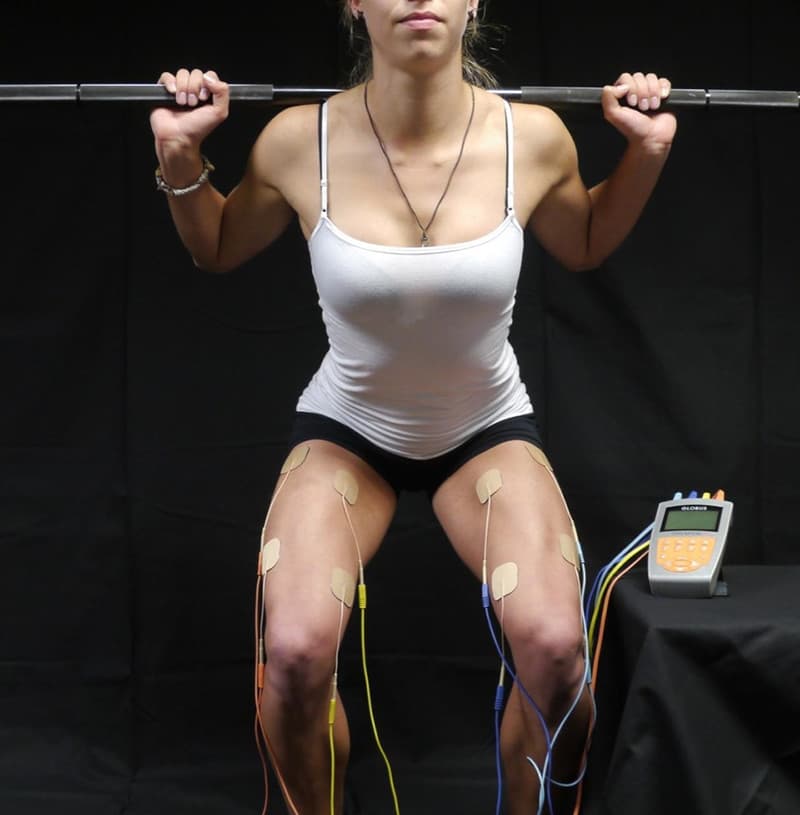
Guidance for sport program choice: EMS does NOT replace conventional training, it supports it. The Globus sport device family developed a unique program group for this superimposed principle: ActionNOW is specifically designed for simultaneous active exercise and EMS (see the next section). The sport pillar article on EMS for athletes provides detailed integration guidance.
 Globus ActionNOW – active exercise and EMS simultaneously
Globus has built a unique program group into its sport package specifically based on the superimposed principle: the ActionNOW programs are designed for the simultaneous execution of voluntary, active exercises and electrical stimulation. This is not just another program name – it's a standalone training methodology that implements the highest evidence-level application of modern EMS literature.1
How is ActionNOW different from traditional EMS programs?
| Aspect | Traditional EMS program | ActionNOW |
|---|---|---|
| User position | Passive (lying, sitting, resting) | Active (performing an exercise) |
| Muscle activation | Only from the stimulator | Volition + stimulation SIMULTANEOUSLY (superimposed) |
| Training timing | Before or after training, separately | DURING training, synchronized to exercise rhythm |
| Movement coordination | Does not develop (only muscle contractions) | Strengthens sport-specific movement patterns |
| Nervous system adaptation | Limited (volition not involved) | Stronger (volition + stimulation jointly activate the brain) |
Why does this matter? – Scientific background of the superimposed principle
The 2023 meta-analysis by Micke et al. (36 RCTs, 1,092 athletes) clearly showed that superimposed EMS — that is, stimulation running simultaneously with voluntary training — produced significantly better effects on strength, jump height and sprint results than standalone EMS or standalone conventional training. The meta-analysis found the best outcomes specifically with combined "resistance + jump training + EMS" protocols.1 ActionNOW translates this principle into home/amateur use.
How to use ActionNOW programs?
- Prepare the exercise: decide which sport-specific movement you will perform (e.g., squat, jump, trunk rotation, running pattern).
- Place the electrodes on the targeted muscle group (e.g., quadriceps for squats, glutes + thighs for jumps, trunk muscles for rotation).
- Start the ActionNOW program at the desired frequency and intensity.
- Perform the exercises synchronized to the stimulation rhythm – exert force during the contraction phase, recover during the rest phase. Execute the exercise at your usual voluntary training intensity.
- Duration: typically 15–25 minutes per session, in 2–3 sets.
- Weekly frequency: 2–3 sessions – similar to conventional strength training.
 What does this mean for your training?
ActionNOW provides two simultaneous benefits: (1) time efficiency — you don't do EMS separately and training separately, you do both at once; (2) sport-specific transfer — because stimulation occurs DURING real movement, the brain learns the reinforced movement pattern. Traditional passive EMS does not provide this.
 My advice for starting ActionNOW
Begin with gentle intensity — active movement + stimulation together is more fatiguing than each alone. The first 1–2 weeks should be an adaptation phase. The classic rule: "feel the stimulation, but DO NOT let it determine movement quality." If the current is so strong that your movement coordination deteriorates, reduce it. The aim is to increase muscle recruitment alongside the existing movement — not to oppose it.
Which Globus devices include it?
The ActionNOW program group is available in Globus's top-tier sport models – the detailed program list is available in the Globus electrotherapy documentation per model. Generally, the Sport line and the Genesy high-end include it. Check the specific model's program list before purchase.
The 13 main EMS sport programs – detailed overview
The following 13 programs constitute the typical sport program offering of Globus sport stimulators (Cycling Pro, Runner Pro, Triathlon Pro, Soccer Pro, Premium 400, The Champion etc.). For each program you'll find:
- What it does (physiological effect)
- When to use it (training goal)
- When not to use it (injury, contraindication)
What it does: a short-duration program that, through gentle twitch-like muscle contractions, increases blood flow, reduces muscle and tendon stiffness, and raises muscle temperature.
When to use: 5–10 minutes before every training and competition.
In injury treatment: useful due to its circulation-enhancing effect — supports delivery of nutrients and oxygen and the removal of waste products.
What it does: longer-lasting and deeper acting than the basic Warm-up. It provides the best preparation on the muscles relevant to the specific sport.
When to use: a few minutes before competition — or if you train daily, use this instead of the basic Warm-up.
In injury treatment: the circulation-enhancing effect is useful here as well.
What it does: enhances the network of capillaries (small blood vessels) around the muscle — improving oxygen and nutrient delivery. By improving blood supply it reduces fatigue during hard physical work.
When to use: recommended for endurance sports and for everyone during the first weeks of the preparation period. During the season use it ONLY for endurance sports.
What it does: improves the muscle's long-term ability to produce high-level force. By preparing against metabolite formation it reduces fatigue.
When to use: in endurance sports (running, cycling, swimming, rowing).
After injury: begin strength-recovery treatments with this program. Details: Recovering lost muscle strength.
What it does: improves the ability to exert force in mid-distance anaerobic (low-oxygen) conditions. Long powerful muscle contractions are followed by short active rest phases. Reduces fatigue due to acidosis (lactate accumulation).
When to use: in sports where several minutes of near-maximal effort are required — kayak/canoe, 800–1500 m running, combat sports.
What it does: improves the capacity to sustain long-duration efforts. A long-duration stimulation program that optimizes the aerobic capacity of slow fibers.
When to use: in preparation for prolonged endurance events (marathon, ultra, long cycling tours).
After injury: use it only after you have completed a 10–14 day "Resistance" course.
What it does: used to increase muscle mass — intense muscle work helps increase fiber size. It can be focused on one important muscle or muscle group.
When to use: for muscle mass gains (bodybuilding, general strength development), targeted development of weaker muscle groups.
After injury: use ONLY after full recovery.
Details from a bodybuilding perspective: I'm a bodybuilder – how a muscle stimulator helps
What it does: improves maximal force capacity and increases muscle mass. Helps reduce the risk of trauma during maximal weight training.
When to use: combat sports, weightlifting, and generally in preparation for high force-demand sports.
After injury: use ONLY after full recovery.
What it does: improves contraction speed — with short, intense, fast stimulation cycles. Develops fast fiber activation and the sensitivity of myotactic receptors.
When to use: ball sports (soccer, tennis, basketball), combat sports — where quick reaction and coordination are decisive.
After injury: use ONLY after full recovery.
What it does: develops the capacity for short-duration maximal force output. Optimizes the mass of fibers that can be deployed at the highest force levels.
When to use: sprints, jumping and throwing sports, volleyball, basketball, athletics.
After injury: use ONLY after full recovery.
What it does: supports muscle recovery AFTER training. Increasing blood flow and reducing fatigue are the main effects. Systematic reviews indicate EMS recovery reduces blood lactate compared to passive rest, but active aerobic recovery (e.g., light cycling, swimming) is generally better for pure lactate clearance.5, 6
When to use: after every training/competition, especially in repeated-load situations (multiple sessions in one day, multi-round competitions).
What it does: longer and more intense than Active regeneration. Promotes the clearance of metabolites and helps overcome muscle fatigue.
When to use: after every competition or major training session in any sport.
What it does: provides muscle relaxation, increases circulation, and helps remove waste products.
When to use: anytime a muscle has stiffened or cramped after training or a long day — even in the evening before rest.
How to choose programs for your goals?
Program selection is optimal when aligned with your training goal. It's useful to group them into two main directions:
| Training goal | Recommended programs | Programs to avoid |
|---|---|---|
| Endurance (running, cycling, swimming, rowing) | Warm-up / PreCompetition, Capillarisation, Resistance, Aerobic resistance | Hypertrophy, Max. strength, Explosive strength (only late in competition preparation) |
| Strength and muscle mass (bodybuilding, combat sports) | Warm-up / PreCompetition, Hypertrophy, Max. strength, Explosive strength, Reactivity | Capillarisation, Aerobic resistance (only in basic preparation) |
| Mixed sports (ball games, martial arts) | Warm-up / PreCompetition, Resistance, Endurance, Reactivity | (no strict forbiddens – cycle them mixed) |
| Post-injury rehab | Warm-up, Resistance (to start!), after 10–14 days Aerobic resistance | Hypertrophy, Max. strength, Reactivity, Explosive strength (until full recovery) |
General rule – WARM-UP and RECOVERY are always required
Whatever your goal, the Warm-up program BEFORE every training/competition and a recovery program AFTER every training/competition are prerequisites. Vary the other programs according to your goals and sport.
 What do studies say about EMS sport training?
"Does EMS really add to conventional training?"
Yes, and substantially. A large 2023 network meta-analysis (36 RCTs, 1,092 athletes) found that EMS given WITH conventional training (superimposed) produced the largest effect sizes in strength, jump and sprint performance development.1 EMS alone does not replace training, but combined it significantly AMPLIFIES results.
"Does it give as much strength gain as weight training?"
Yes, when compared with matched volume. A 2022 systematic review and meta-analysis (19 RCTs, volume-matched) concluded EMS produces practically identical strength development to conventional resistance training (effect size 0.023 — essentially no difference).2 This is interesting for biohacking: you can achieve similar results with less time and equipment. (limitation: EMS only affects the treated muscle!)
"Can EMS be used for warm-up too?"
Yes. A 2025 clinical trial found that HVPC (high-voltage pulsed current) warm-up stimulation combined with voluntary activation measurably increased jump height compared to control.3 The physiological effect is increased circulation and muscle temperature — exactly what a conventional warm-up targets.
"What does it do for recovery – does it really reduce muscle soreness?"
Partly. A 2014 systematic review and meta-analysis (13 studies) found EMS recovery reduces blood lactate compared to passive rest, but active aerobic recovery (e.g., light swimming, cycling) is generally BETTER for pure lactate clearance.5 A 2009 clinical study (sprint swimmers) showed active swimming produced significantly lower lactate after 20 minutes than EMS.6 So: EMS recovery is BETTER than passive rest, but active aerobic recovery is the "gold standard." EMS has the advantage that it can be used when active recovery is not possible (e.g., tight competition schedules, long journeys home).
"Does low frequency selectively activate slow fibers?"
This needs nuance. Modern literature (Maffiuletti 2010, Bickel 2011) states EMS activation is non-selective, spatially fixed and temporally synchronized — thus it does not operate with immediate fiber-selective activation as often claimed in marketing.4, 7 Program names ("endurance" vs "hypertrophy" etc.) rather influence the direction of CHRONIC adaptation generated by parameter combinations. This means programs work over long-term training, but not via immediate fiber-type selective effects.
The essence in brief
According to literature from 2020 onwards, EMS sport programs are mainly useful for: combined superimposed training (largest effect sizes), strength gains at matched volume (similar to conventional training), warm-up support (small but measurable performance gains), and recovery (better than passive rest, worse than active aerobic). The claim of "instant fiber selection" is a traditional marketing nuance — long-term adaptation is the real effect.
 Devices for accessing the 13 sport programs
Every model in Globus's athlete-focused line contains most of the 13 programs listed below (exact program availability may differ by model — consult before purchase). The "Pro" designation refers to sport-specific added expertise:
Globus Premium 400
Multifunctional 4-channel device with the full sport program package. Includes TENS, EMS, MCR, and iontophoresis programs. Ideal for beginner sport rehab and general strengthening use.
Cycling Pro
For cyclists: sprint, hill, endurance and capillarisation programs specially developed.
Runner Pro
For runners: special focus on the calf, anterior thigh and trunk strengthening. Running-specific recovery programs included.
Triathlon Pro
For triathletes: programs optimized for the three disciplines (swimming + cycling + running).
Soccer Pro
For football players: kick-focused programs, hip and trunk rotation, emphasis on reactivity development.
The Champion
The flagship of the Sport line – a program package tailored to multiple sports (running, swimming, cycling, football, skiing, cross-country skiing, volleyball, golf, combat sports, triathlon, sailing, tennis).
Advice for choosing
If you focus on a single sport, choose the sport-specific model (Cycling, Runner, Soccer, Triathlon). If you combine multiple sports, The Champion or the Premium 400 is a better choice. For beginners, the Premium 400 is the most "universal" solution.
 Before you start sport EMS training
The following situations make sport EMS training contraindicated or require specialist consultation:
- Implanted pacemaker, ICD or other active implant – the current may interfere with device function.
- Pregnancy – treatment of the abdomen, breasts and lower back is forbidden in any stage of pregnancy.
-
Epilepsy or other seizure disorders – stimulation can be a trigger.
- Active deep vein thrombosis (DVT) – urgent medical care is required; do not start home treatment.
- Active malignant tumor in the treatment area – avoid the affected region.
- Fresh surgical area – wait for wound healing and start only with medical approval.
- Skin disease, injury or loss of sensation in the treatment area – the skin should be intact and sensate.
- Acute muscle injury, recent strain – Hypertrophy / Max. strength / Explosive programs are FORBIDDEN until full healing. Warm-up / Active regeneration may be used gently with medical approval.
- Acute fever or infectious illness – wait for recovery.
- Severe cardiovascular disease – for arrhythmia or heart failure, seek cardiology approval.
Further reading
For the full contraindication list read our article on electrical treatment contraindications.
Frequently asked questions
It depends on the program. Typical durations: Warm-up 5–10 minutes, recovery 20–30 minutes, endurance / hypertrophy 30–45 minutes. A full sport-EMS routine (warm-up + main program + recovery) is usually 45–75 minutes. When added to training it's best to split: warm-up before conventional training, recovery after.
Clinical trials typically use 2–3 sessions per week (4–6 week build-up period). Too frequent use with hypertrophy / max strength programs can impair recovery. Recommended: 2–3 main-program sessions per week + 4–5 recovery sessions (after trainings), 5–6 warm-ups (before trainings).
Not recommended. The 2023 Micke meta-analysis indicates the best results come from combining EMS with voluntary training (superimposed).1 The volume-matched 2022 Happ meta found EMS alone yields similar strength gains to weightlifting2 – but for full movement coordination, respiratory and cardiovascular adaptations, conventional training remains fundamental.
Partly. EMS recovery is better than passive rest for lactate clearance, but active aerobic recovery (e.g., light swimming, cycling) is generally BETTER.5, 6 EMS is useful when active recovery is not realistic (long trips home). It's not a "miracle" but a helpful tool in many cases.
Always start with gentler programs: Warm-up and Resistance. Use Hypertrophy, Max. strength, Explosive and Reactivity ONLY after full recovery — never during an acute injury. After 10–14 days of rehab you can switch to Aerobic resistance. For a precise protocol consult your treating physician or physiotherapist.
Partly. Throughout the season endurance programs (Capillarisation, Resistance, Aerobic resistance) are the main pillars. But for short-term speed (e.g., last 200 m of a marathon, cycling sprint finish) you need some fast-fiber activity. During preparation, 1–2× weekly Hypertrophy / Max. strength can be useful — but it should not be the main focus.
Traditional EMS programs are performed passively (lying, sitting) — only the stimulator moves the muscle. ActionNOW is used DURING ACTIVE MOVEMENT — you perform an exercise (squat, jump, trunk rotation, etc.) while stimulation reinforces it. This is the highest evidence-level form of EMS in modern literature (superimposed protocols) and develops not only muscle activation but movement coordination and nervous system adaptation.1
 Summary – Quick overview
Sources
- Micke F, Held S, Lindenthal J, Donath L. (2023). Effects of electromyostimulation on performance parameters in sportive and trained athletes: a systematic review and network meta-analysis. European Journal of Sport Science 23(8):1570-1580. PubMed: 35913269
- Happ KA, Behringer M. (2022). Neuromuscular electrical stimulation training vs. conventional strength training: a systematic review and meta-analysis of the effect on strength development. Journal of Strength and Conditioning Research 36(12):3527-3540. PubMed: 34417404
- Wachi M, Jiroumaru T, Satonaka A, Tanaka K, et al. (2025). Effect of passive warm-up using high-voltage pulsed-current electrical stimulation on jump performance in young adults: a randomized controlled trial. Cureus 17(4):e81594. PubMed: 40322448
- Maffiuletti NA. (2010). Physiological and methodological considerations for the use of neuromuscular electrical stimulation. European Journal of Applied Physiology 110(2):223-234. PubMed: 20473619
- Malone JK, Blake C, Caulfield BM. (2014). Neuromuscular Electrical Stimulation During Recovery From Exercise: A Systematic Review. Journal of Strength and Conditioning Research 28(9):2478-2506. PubMed: 24552796
- Neric FB, Beam WC, Brown LE, Wiersma LD. (2009). Comparison of swim recovery and muscle stimulation on lactate removal after sprint swimming. Journal of Strength and Conditioning Research 23(9):2560-2567. PubMed: 19910818
- Bickel CS, Gregory CM, Dean JC. (2011). Motor unit recruitment during neuromuscular electrical stimulation: a critical appraisal. European Journal of Applied Physiology 111(10):2399-2407. PubMed: 21870119