
 Relationship between leg ulcers and circulation
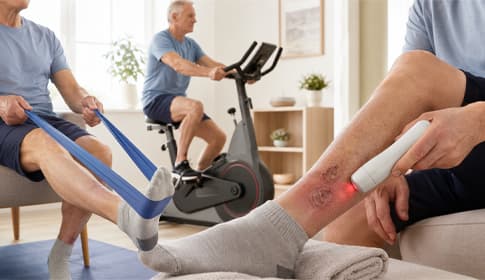
Supporting blood circulation is fundamentally important to eliminate a leg ulcer: this creates the conditions for healing. If circulation does not improve, the wound cannot close. Venous-origin (CEAP C5–C6) ulcers are the most common form — the home protocol aims to support venous return, strengthen the muscle-pump function, and stimulate cellular-level regeneration.
 Key idea
Three complementary home devices: (1) Moves resistance bands — strengthening the calf muscle pump, (2) Oxycycle 1 ergometer — support for lower-limb microcirculation, (3) B-Cure Laser Classic — cellular-level wound healing support. The daily routine combining these three devices forms the "round protocol" for the ulcer cluster alongside the two modality deep-dive articles (EMS deep analysis and softlaser deep analysis).
 Why these three devices?
Healing venous leg ulcers requires threefold support: muscle strength, circulation activation, and cellular regeneration. These three devices precisely cover that triangle:
- Resistance band — targeted lower-limb muscle strengthening (calf, thigh) that supports the muscle-pump function for venous return.
- Ergometer — continuous, gentle movement for 20–30 minutes to boost microcirculation. Can be used seated or reclined, suitable even with limited mobility.
- Softlaser (B-Cure 808 nm) — photobiomodulation that supports ATP synthesis via mitochondrial activation, collagen production and reduction of inflammation.
This combined approach is positioned to support CEAP C5–C6 stages of venous disease at home, as an adjunct to medical wound care and compression therapy.
The 3-tip daily protocol – weekly summary
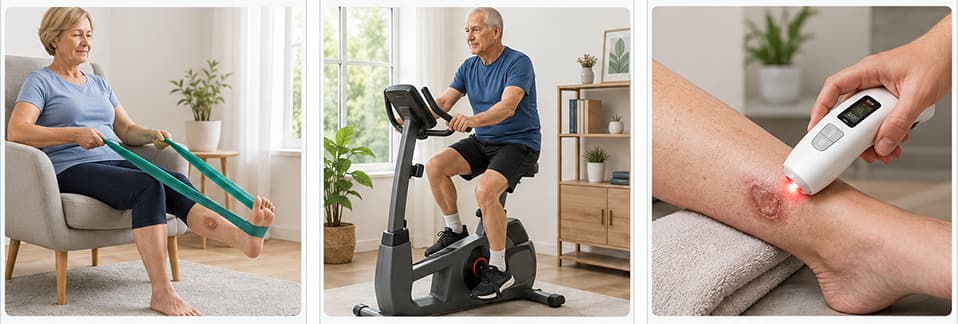
The infographic below summarizes the full weekly routine: when to use each device, for how many minutes, and at what intensity:
| Device | Duration | Frequency | Goal |
|---|---|---|---|
| Moves resistance band | 10–15 minutes | Once daily | Calf and thigh muscle strengthening |
| Oxycycle 1 ergometer | 20–30 minutes | Once daily (min. 2–3× weekly) | Microcirculation and endurance |
| B-Cure Laser Classic | 1–2 × 8 minutes | First 3 weeks: daily; from week 4: every other day | Cellular-level wound healing support |
The exact weekly rhythm and combination order are also shown in the infographic — to be used together with compression stockings.
Tip 1 – Resistance band leg strengthening, daily 10–15 minutes
The daily foundation is resistance-band exercises. With Moves resistance bands you can perform exercises that activate the foot and leg muscles: ankle dorsiflexion/plantarflexion, knee flexion, and lateral movements (abduction / adduction).
These exercises not only strengthen the muscles but also improve local blood flow and can reduce edema. The advantage of resistance bands is that they are progressively loadable (extra-light → light → medium → strong), so they can safely be started even in patients with ulcers.
Specific products
- Moves Band resistance band – classic 1.5 m band in multiple resistance levels
- Moves Loop band – closed-loop form, extra-light for beginners
- Moves FIT Superloop – advanced-level strengthening loop
Selection logic
- Extra-light / light — beginner level, elderly patients, severe mobility limitations
- Medium — typical rehabilitation load
- Strong — advanced rehabilitation, athletes
Tip 2 – Ergometer (pedal) daily 20–30 minutes
The Oxycycle 1 pedal ergometer can be used in a seated (or even reclined) position, allowing you to actively support lower-limb microcirculation. Daily use would be ideal, but at minimum incorporate 20–30 minute sessions 2–3 times per week.
This supports oxygen and nutrient delivery — essential for healing — strengthens muscles, and gently conditions the cardiovascular system. It is applicable for patients with limited mobility and during supine rehabilitation, which is particularly valuable in elderly patients with ulcers.
Tip 3 – B-Cure Laser Classic softlaser treatment
The B-Cure Laser Classic is an 808 nm wavelength, 250 mW softlaser device that clinical studies have shown can support healing of chronic wounds and leg ulcers.
The effect occurs at the cellular level: laser light activates cytochrome c oxidase in mitochondria, which can support ATP synthesis, collagen production and decrease inflammation.
Protocol
- First 3 weeks: 1–2 × 8 minutes daily
- From week 4 until full wound closure: once every other day
- Technique: do NOT touch the open wound with the device — keep a few millimetres distance, or treat the wound edges with a scanning technique
Detailed clinical background of the softlaser modality and alternative devices (Personal Laser L200, Energy Laser L800 Pro): Treating leg ulcers with softlaser.
 The indispensable 4th element: compression therapy
The 3-tip protocol assumes daily use of compression stockings. Compression is the cornerstone of healing venous-origin ulcers (Cochrane evidence: O'Meara 2012). The three devices work alongside compression, NOT instead of it. If you do not yet have compression stockings, consult a vascular surgeon to agree on the appropriate compression class (in CEAP C5–C6 stage typically 30–40 mmHg).
 Product recommendations for the 3-tip protocol
B-Cure Laser Classic softlaser
808 nm, 250 mW softlaser device. Class 1 laser, usable without protective goggles. Clinically proven effect on chronic wounds and leg ulcers.
Oxycycle 1 pedal ergometer
Tabletop / chair-mounted pedal ergometer usable seated or reclined. Suitable when mobility is limited. Full ergometer range available in the category.
Moves resistance band family
Moves Band, Moves Loop, Moves FIT Superloop — strengthening bands and loops in different resistances that target calf and thigh muscles. Full elastic band range available in the category.
 Before you start treatment – contraindications
The 3-tip protocol is generally safe, but there are some conditions when one or another element is contraindicated or requires cautious consideration.
Softlaser (B-Cure)
- Malignant tumour in or near the treatment area
- Pregnancy – avoid treating the abdominal and lumbar region out of precaution
- Directed over the thyroid gland
- Active purulent bacterial or severe viral infection
- Photosensitive conditions – consult a physician in case of light sensitivity
Ergometer and resistance band exercise
- Suspected acute deep vein thrombosis
- Acute cellulitis or other active skin infection in the treatment area
- Severe, decompensated heart failure
- Recent postoperative period – wait for wound healing and obtain treating physician's permission
- Severe, throbbing pain during treatment – stop immediately
Important note
Always consult your treating physician (vascular surgeon, surgical outpatient clinic or dermatologist) before starting the protocol. The 3-tip protocol is an adjunct to medical wound care and compression therapy, NOT a replacement. Also read the user manuals for the B-Cure Laser and the ergometer.
 Scientific background
All three elements of the 3-tip protocol are built on clinical evidence.
Padberg 2004 – muscle-pump function and venous circulation
Randomized clinical trial with 6 months of structured exercise: significant improvement in calf muscle-pump function and venous hemodynamics in chronic venous insufficiency. Resistance-band calf strengthening and ergometer training follow this principle.1
Hulsdunk & Haesler 2025 (WHAM) – softlaser and venous ulcers
The WHAM 2025 evidence summary reports that in venous leg ulcers after 16 weeks, 58% of patients treated with softlaser had complete wound closure versus 36% in the control group.2
Cardoso 2024 – photobiomodulation in diabetic ulcers
Cardoso et al.'s randomized controlled trial (2024) found that 904 nm photobiomodulation significantly reduced diabetic ulcer size. The B-Cure Laser at 808 nm works via a similar mechanism.3
O'Meara 2012 (Cochrane) – compression therapy in venous ulcers
O'Meara et al.'s Cochrane review (2012) confirms that compression therapy is the cornerstone of healing for venous leg ulcers — the 3-tip devices work alongside compression, not instead of it.4
 When NOT to expect miracles
Start with realistic expectations. The 3-tip protocol will not heal an ulcer if:
- you do not treat the underlying disease – wearing compression stockings is essential in venous insufficiency;
- severe arterial insufficiency is present – vascular surgery is required first;
- the wound is infected (purulent, sharply demarcated redness, fever) – antibiotic treatment is needed first;
- you do not follow hygiene rules – without regular dressing changes and wound cleaning the 3-tip protocol will not help;
- you are not consistent – ulcer healing may take 8–16 weeks (or longer), and skipping the daily routine slows the process.
Consistency and perseverance are key to successful healing — always set the protocol together with your treating physician.
Frequently asked questions
Healing of venous leg ulcers is always prolonged: optimally 8–16 weeks, in more severe cases 2–6 months. The 3-tip protocol is an adjunct to conventional treatment (compression stockings, wound dressings) and clinical evidence suggests it can favorably influence the wound closure rate. Adhere to the protocol until complete wound closure; do not stop at the first signs of improvement.
Yes, the EMS modality represents a parallel approach — it can be used instead of or alongside resistance-band exercises. Detailed EMS protocol: Venous leg ulcer with muscle stimulation (EMS). The two approaches (3-tip + EMS) can be used together with physician consultation.
In case of active purulent infection (cellulitis), pause the 3-tip protocol and see a doctor immediately: antibiotic therapy is necessary. After the infection has healed, the routine may be resumed with treating physician's permission.
Yes, the Oxycycle 1 ergometer is specifically designed for this: it can be used seated or even lying in bed. Pedalling can be performed with minimal effort and progressively increased. Among the three devices, this is the easiest to introduce for patients with limited mobility.
No. Compression therapy is the cornerstone of healing for venous leg ulcers (Robertson 2014 Cochrane evidence). The 3-tip protocol works alongside compression, not instead of it. Without compression stockings the chances of ulcer healing decrease significantly.
Further guides on the topic
In addition to the 3-tip protocol, the following articles provide detailed clinical background for home management of venous leg ulcers and related conditions:
Leg ulcer modality articles (deep analysis)
- Venous leg ulcer with muscle stimulation (EMS) – detailed EMS protocol, parallel modality
- Treating leg ulcers with softlaser – detailed softlaser background, device comparison (B-Cure, Personal Laser, Energy Laser)
Background conditions and symptom articles
- Home treatment of varicose vein disease – pillar article, CEAP classification
- Reddish-brown spot on the lower leg – hemosiderin, a precursor of an ulcer
- Cellulitis – bacterial infection of the skin – ulcer complication, urgent antibiotic treatment
- Post-thrombotic syndrome (PTS) – a common background for ulcers
- Leg swelling triage – varicose vein section – differential diagnosis
Home devices
- B-Cure Laser Classic softlaser
- Ergometer category
- Moves resistance band family
- Muscle stimulator (EMS) devices – parallel modality
- Lymphatic massage device (IPC) category – adjunct modality for severe venous oedema
 Summary – 3-tip daily protocol for leg ulcers
Sources
- Padberg FT Jr, Johnston MV, Sisto SA (2004). Structured exercise improves calf muscle pump function in chronic venous insufficiency: a randomized trial. Journal of Vascular Surgery. PubMed: 14718821
- Hulsdunk K (2025). Low level laser therapy for healing venous leg ulcers: a WHAM evidence summary. Wound Practice and Research. Link to full text
- Saura Cardoso V, de Souza Lima da Silveira PR, Dos Santos CM, Miranda MB, Silva Barros AC, Veloso LC, Magalhães AT, da Rocha RB, Hazime FA (2024). Dose-response and efficacy of 904 nm photobiomodulation on diabetic foot ulcers healing: a randomized controlled trial. Lasers Med Sci. PubMed: 38805069
- O'Meara S, Cullum N, Nelson EA, Dumville JC (2012). Compression for venous leg ulcers. Cochrane Database Syst Rev. PubMed: 23152202