
 Complementary asthma treatment with salt therapy
Asthma is a chronic respiratory disease affecting more than 300 million people worldwide and approximately half a million people in Hungary. The good news that everyone affected should hear first is this: asthma can be well controlled today – with appropriate treatment, the vast majority of patients can lead a full, active life, take part in sport and travel. Medication is the foundation of control; alongside it, salt therapy is a complementary method that may support symptom-free periods and has a surprisingly detailed research background in asthma, including randomised controlled trials and a review covering 18 studies.
It is important to understand the basics of asthma – because salt therapy can only build on them. I will show you what the studies have demonstrated, and then give you a practical protocol for home use. You can read about how salt therapy works in general in the salt therapy guide.
 Key point
The research record for salt therapy in asthma is encouraging: in a scientifically rigorous study, a course in a salt room significantly reduced bronchial hyperresponsiveness in children and improved their quality of life1, while an analysis of 18 studies found salt therapy to be a reliable, side-effect-free COMPLEMENTARY treatment for asthma.2 The key word is “complementary”: the favourable results were described alongside medication. Stopping medication is not an option, and a salt course is not a matter of bargaining with your doctor. It is support alongside treatment.
 Asthma basics – what salt therapy builds on
Asthma is a chronic inflammatory disease of the airways: the lining of the bronchi becomes persistently sensitive and responds to certain triggers – allergens, cold air, physical exertion, respiratory infection and tobacco smoke – in three ways: the bronchial wall swells, the smooth muscle around the bronchi contracts and mucus production increases. The result is the familiar group of symptoms: wheezing, coughing, chest tightness and shortness of breath.
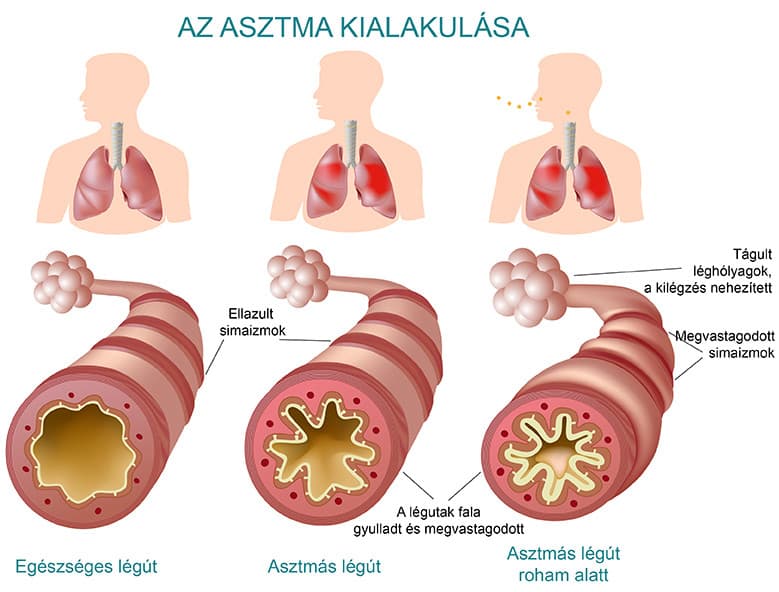
The main forms are allergic asthma (the most common in childhood and linked to allergens), non-allergic asthma (typically starting in adulthood) and exercise-induced asthma (where symptoms are triggered by physical exertion). This distinction is not academic: the research on salt therapy mainly comes from mild-to-moderate allergic asthma.12
| Pillar of treatment | What does it mean? | Negotiable? |
|---|---|---|
| 1. Maintenance medication | An inhaled anti-inflammatory (steroid) taken daily, even when symptom-free, which treats the underlying process of the disease: airway inflammation | NO – stopping or changing it is solely a medical decision |
| 2. Reliever medication | A fast-acting bronchodilator that is always kept at hand – during an attack, this is the only correct treatment | NO – it must always be available |
| 3. Trigger avoidance | Consciously avoiding triggers (allergens, smoke and cold air), and reducing allergens in the home for people with allergies | Flexible – this is where you can do a lot for yourself |
| 4. Complementary methods | Breathing exercises and an exercise programme, as well as salt therapy – supporting symptom-free periods and airway comfort | Yes – it can be freely added in consultation with your doctor |
 What does salt aerosol do in asthmatic airways?
Inhaled salt particles measuring 0.5-5 microns act at three points in asthmatic airways. The first is mucus: the osmotic effect dilutes thickened mucus and supports airway self-cleaning – measurements in people with asthma also support this mechanism: inhaled salt aerosol visibly accelerated mucus clearance during treatment.7 The second is bronchial hyperresponsiveness: in the Israeli randomised study, the salt course measurably reduced the bronchi’s hypersensitive response – one of the key mechanisms of asthma.1 The third is the allergic component: the literature has also described a reduction in IgE levels (a key factor in the allergic response) with salt therapy.6
Bronchial hyperresponsiveness and quality of life improved in the study, but baseline lung function values (spirometry) and exhaled nitric oxide (FeNO) did not change1 – in other words, the salt course helped with airway “irritability” and everyday comfort, not with measured lung capacity. In another study, morning and evening peak expiratory flow (PEF) improved by the second week of the course.3
The lesson is twofold: the effect is real, but gradual – and there were no side effects in any of the studies.123 Anyone expecting a miracle will be disappointed; anyone looking to support symptom-free periods will have a good chance of being satisfied.
Based on the research data, the most promising candidates for salt therapy are people with mild-to-moderate, stable, well-controlled asthma – particularly the allergic type – during a symptom-free period or a period with few symptoms.12 The experience in children is especially good: the major studies were carried out in 5-14-year-olds, without side effects.138
When it is NOT appropriate: during an asthma attack (then use only the reliever medication!), during an unstable period with frequent attacks (medical adjustment comes first), and during a feverish respiratory infection. The review of 18 studies mentions another promising observation: salt therapy may help reduce night-time asthma symptoms2 – which is also consistent with home use at night while asleep.
 Home salt therapy protocol for asthma
| Aspect | Recommendation |
|---|---|
| Prerequisite | Well-controlled, stable asthma + informing your treating doctor about the salt course; medication CONTINUES UNCHANGED |
| Device | Ultrasonic salt generator that atomises salt in the therapeutic 0.5-5 micron range – use only natural, additive-free rock salt |
| Starting | Shorter, lower-intensity use during the first few days, then increase to a daily routine – this allows sensitive airways to adapt |
| Daily routine | Use at night while asleep in the bedroom (6-8 hours) – the study courses also showed an effect with 2-3 sessions per week13, while daily home use provides more frequent “dosing” |
| When can a change be expected? | Measurable changes appeared in the studies within 2-7 weeks13 – plan a course of at least 4-6 weeks |
| Follow-up | Keep an asthma diary (symptoms, reliever use and, if you have a home PEF meter, morning and evening readings) – bring it to your review appointment |
 My advice
Data is the most faithful friend of asthma care – and the same is true of your salt course. If you have a home peak flow meter (PEF meter), measure in the morning and evening for one week before the course and during the course as well: in the Iranian study, PEF was the measure on which improvement appeared as early as the second week.3 This means you base your assessment on numbers rather than impressions – and your respiratory physician also gets an accurate picture. One important rule: if you feel that you need fewer relievers during the salt course, that is good news – but do not change even a single dose of your MAINTENANCE medication without authorisation: this must be considered at your review appointment together with your doctor.
What you need for a home salt course
SaltDome salt therapy device
Ultrasonic salt generator producing particles in the therapeutic 2-5 micron range – quiet and designed for overnight bedroom use, with a remote control. For several rooms, the Duo and Family kits provide a solution.
Natural, additive-free rock salt
Parajdi or Himalayan rock salt without additives – only this type should be used in the device.
 When should you NOT use salt therapy if you have asthma?
- During an asthma attack – during an attack, only the reliever medication (and, if necessary, an ambulance) is the correct response; a salt therapy device is not suitable for treating an acute episode
- Unstable, uncontrolled asthma – during frequent attacks or worsening symptoms, first seek respiratory specialist assessment and adjustment; the salt course can be started when the condition is stable
- Feverish, acute respiratory infection – pause the course until the fever has passed
- Severe, oxygen-dependent lung disease – only with the approval of your treating doctor
- If symptoms remain aggravated during the course – a temporary period of increased coughing during the first few days may be normal as mucus starts moving, but persistent worsening is a warning: stop the course and consult your doctor
 Your asthma action plan is more important than any course
Every person with asthma should have a written action plan: what to do if symptoms worsen, when to increase medication (as instructed by a doctor) and when to call for help. If your wheezing does not ease even after using the reliever, your lips or nails turn blue, or you find it difficult to speak – call an ambulance immediately. Salt therapy is a tool for calm everyday periods; emergencies are for medication and doctors.
Frequently asked questions
No – and this is how the research frames it, not merely a matter of caution: every favourable study result came from salt therapy used ALONGSIDE medication.12 Maintenance inhaled medication treats asthmatic inflammation – salt aerosol cannot replace it. The correct question is not “or” but “and”: medication AND a salt course, with your respiratory physician’s knowledge. If your condition improves persistently, discussing a reduction in medication is a matter for the review appointment – never a decision to make at home.
No. An attack is acute narrowing of the bronchi, relieved by a fast-acting bronchodilator within minutes – salt therapy is a slow, preventive method whose effects build over weeks; it does not help during an attack, and lost time can be dangerous. During an attack: use the reliever according to your action plan, and call an ambulance if it does not work. The role of the salt course is to support the airways during calm periods – in the studies, it was the state between attacks (hyperresponsiveness and quality of life) that improved.1
The study schedules provide a useful guide: in the Iranian study, peak expiratory flow improved by the SECOND week of the course3, while at the end of the Israeli 7-week course, bronchial hyperresponsiveness and quality of life showed a significant difference.1 A realistic plan is therefore a daily course lasting at least 4-6 weeks, followed with a symptom diary and, if possible, PEF measurements. If your diary shows no change at all after 6-8 weeks, that is also valuable information for your next respiratory review.
The research situation is particularly reassuring here: the strongest studies were carried out in children – the Israeli study in 5-13-year-olds and the Iranian study in 6-14-year-olds – and neither reported side effects.13 The Russian school programme also described fewer respiratory infections in children who were frequently ill.8 Night-time use while asleep is the most convenient option for children. There are two conditions: your child’s respiratory physician must know about the course, and medication (maintenance and reliever) must continue unchanged.
Mild-to-moderate, allergic asthma: the randomised studies were carried out in children with mild asthma13, and the mechanism (mucus clearance and reduced IgE6) also fits the allergic form most closely. In severe, unstable or oxygen-dependent asthma, a salt course should only be considered with the individual approval of the treating doctor. If allergic rhinitis is also present (a frequent companion), our hay fever article is also for you.
Simply: your medication schedule does not change in any way, while the salt course takes place at night – switch the device on at bedtime on the bedside table and the course runs while you sleep. This avoids timing conflicts and extra tasks that might make you stop. Continue using maintenance inhaled medication as prescribed (typically followed by rinsing your mouth); salt therapy does not interfere with it. If you are preparing for allergy season, it is worth starting the course 2-4 weeks before the season begins.
 What the research says – answers to readers’ questions
“Is there actually a serious study showing that a salt room is good for asthma?”1
Yes, and it is one of the most rigorous types: a double-blind, randomised, controlled trial. In Israel, 55 children aged 5-13 with mild asthma attended a salt room 14 times over 7 weeks – half went to a genuine halogenerator room, and half to an identical salt room without a working generator, so neither the families nor the assessors knew who received the real treatment. The result: bronchial hyperresponsiveness improved significantly in the group receiving the real treatment, and most quality-of-life questionnaires also showed more favourable results – without side effects. To be honest, spirometry and exhaled NO did not change.1 The authors call for larger studies – but the direction was visible even with placebo control.
“One study is not enough. What is the overall picture?”23
The 2021 comprehensive review analysed 18 studies on the relationship between asthma and salt therapy – from diagnostic applications to treatment studies – and concluded that salt therapy may be a reliable, side-effect-free complementary treatment for asthma, potentially helping to delay exacerbations and even reduce night-time asthma symptoms.2 The Iranian crossover study (34 children, three 1-hour salt-room sessions per week) measured improved morning and evening peak expiratory flow as early as the second week, but did not change the frequency of coughing and wheezing.3 The broader picture is consistent too: a review of 13 studies on chronic respiratory diseases summarised improvements in lung-function measures and quality of life5, while the classic placebo-controlled study of 124 patients described a measurable reduction in airway resistance.4 The overall picture is therefore consistent: a gentle, real and safe additional benefit – as a complementary method.
“Mucus clearance sounds like a nice theory – but has anyone measured it in people with asthma?”7
Yes. American researchers used isotope imaging to track airway mucus clearance in adults with asthma and found that inhaled salt aerosol more than doubled clearance DURING treatment – the effect subsided a few hours after treatment.7 This study used nebulised hypertonic saline (not dry halotherapy), but it provides two important lessons for home salt therapy too: the mucus-clearing effect of salt aerosol is real and measurable in asthmatic airways – and because the effect is temporary, REGULAR daily repetition is the logical strategy. This is exactly what night-time home use provides.
Summary
What is this article about? A guide to complementary salt therapy for asthma: the basics of asthma and its four treatment pillars, the points of action of salt aerosol, an honest assessment of randomised studies, a home protocol and safety rules.
Who is it for? People living with controlled, mild-to-moderate asthma and parents of children with asthma who are looking for research-supported, drug-free support ALONGSIDE medication.
Main message: Salt therapy is one of the more thoroughly researched complementary methods for asthma: a randomised study found improvements in bronchial hyperresponsiveness and quality of life, while the review of 18 studies found it to be a safe complementary method. The effect is gentle and builds over weeks – while the pillars of medication (maintenance and reliever treatment) remain non-negotiable.
Next step: Inform your respiratory physician, start night-time salt therapy for at least 4-6 weeks and track it with numbers: a symptom diary plus, if possible, morning and evening PEF measurements – at your review appointment, your diary will tell you more than any impression.
Read more
Scientific sources
- Bar-Yoseph R, Kugelman N, Livnat G, et al. (2017). Halotherapy as asthma treatment in children: a randomized, controlled, prospective pilot study. Pediatric Pulmonology. DOI: 10.1002/ppul.23621
- Crisan-Dabija R, Sandu IG, Popa IV, et al. (2021). Halotherapy – an ancient natural ally in the management of asthma: a comprehensive review. Healthcare. DOI: 10.3390/healthcare9111604
- Mazloomzadeh S, Bakhshi N, Ahmadiafshar A, Gholami M. (2017). The effect of salt space on clinical findings and peak expiratory flow in children with mild to moderate asthma: a randomized crossover trial. Iranian Journal of Allergy, Asthma, and Immunology. PubMed: 28732433
- Chervinskaya AV, Zilber NA. (1995). Halotherapy for treatment of respiratory diseases. Journal of Aerosol Medicine. DOI: 10.1089/jam.1995.8.221
- Barber D, Malyshev Y, Oluyadi F, et al. (2022). Halotherapy for chronic respiratory disorders: from the cave to the clinical. Alternative Therapies in Health and Medicine. PubMed: 32827399
- Wasik AA, Tuuminen T. (2021). Salt therapy as a complementary method for the treatment of respiratory tract diseases, with a focus on mold-related illness. Alternative Therapies in Health and Medicine. PubMed: 34726628
- Bennett WD, Burbank A, Almond M, et al. (2021). Acute and durable effect of inhaled hypertonic saline on mucociliary clearance in adult asthma. ERJ Open Research. DOI: 10.1183/23120541.00062-2021
- Khan MA, Chervinskaia AV, Mikitchenko NA. (2012). The use of halotherapy for the health improvement in children at institutions of general education. Voprosy Kurortologii, Fizioterapii i Lechebnoi Fizicheskoi Kultury. PubMed: 22908472