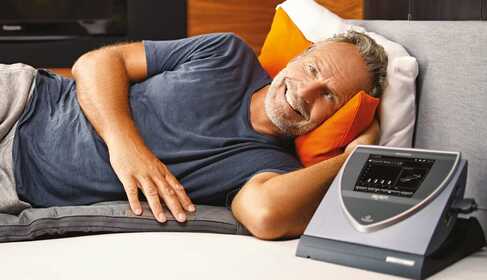

 The common foundation: pulsed electromagnetic field
Both traditional PEMF devices and BEMER use a pulsed electromagnetic field to stimulate the body.
The basic principle is the same: electromagnetic impulses pass through the tissues, may influence cell function and may support the body’s natural regenerative processes. Both technologies are non-invasive and painless, and versions suitable for home use are available.
 The difference: signal form and target
Most PEMF devices use sinusoidal or square-wave impulses and focus primarily on stimulating the bones, muscles and joints. This is why they are used to help relieve musculoskeletal pain, support fracture healing, treat joint inflammation and support implant integration.
By contrast, BEMER has developed a patented, complex signal form that has been specifically optimised to influence microcirculation – that is, blood flow in the smallest blood vessels.
This special signal may act specifically on arterioles and venules, favourably influencing blood flow in the capillaries. BEMER is therefore not a general-purpose PEMF system, but a specialist in a narrower, more extensively researched area of application.
 Key point
BEMER is therefore not a general-purpose PEMF system, but a specialist in a narrower, more extensively researched area of application – it was developed to support microcirculation.
Intensity and frequency
Traditional PEMF devices operate across a wide range of intensities and frequencies – some even generate very strong fields. BEMER deliberately uses low intensity because, according to its research, the key to influencing microcirculation is not strength but the appropriate signal form.
Which one should you choose?
If your aim is specifically to support microcirculation, improve general vitality or optimise the oxygen supply to cells, BEMER is a solution developed specifically for this purpose.
If your main aim is local pain relief or addressing bone, joint or muscle problems – for example osteoporosis, knee pain or rehabilitation after a hip fracture –, traditional PEMF devices may be an excellent choice.
 What does the research show?
The effects of PEMF therapy on microcirculation have been investigated in several scientific studies:
A 2014 study showed that PEMF treatment significantly dilated cerebral arterioles and increased microvascular blood flow and tissue oxygenation in rats. The effect was mediated by nitric oxide (NO).1
A 2003 study found that PEMF stimulation caused significant arteriolar vasodilation (a 9% increase in diameter after 2 minutes of treatment), which may support healing processes.2
A 2012 study in diabetic rats showed that PEMF therapy improved limb perfusion and angiogenesis in an ischaemic state.3
A 2020 human study found improvements in blood pressure and vascular function in people with hypertension after 12 weeks of PEMF therapy.4
The role of microcirculation
The function of the circulation is to move and circulate blood throughout the body. Blood carries vital oxygen, energy sources, minerals and nutrients to every part of the body. Near the heart, blood vessels are still large, but as they move farther from the heart, they become increasingly smaller until they shrink to microscopic dimensions so that they can reach the cells.
Where microcirculation does not work properly, cell metabolism may become impaired. Vital substances do not reach the cell. Think of it like your car. If fuel does not reach the engine, it stops running and you cannot move forward.
If a cell does not receive “fuel” in the form of oxygen, the function of its mitochondria may decrease. Their tasks include energy production, replacing dead cells, repairing damaged cells and renewing and replenishing tissues.
The poorer the microcirculation, the slower regeneration may be, and the body’s ability to heal itself may decrease.
What is BEMER recommended for?
By supporting microcirculation, BEMER therapy may provide complementary support in the following areas:
| Area | Possible benefits |
|---|---|
| Energy and vitality | Improved cellular supply may contribute to better general physical and mental performance |
| Regeneration | Healthy microcirculation may support regenerative and healing processes |
| Wound healing | Complementary support in cases of chronic wound-healing disorders |
| Pain | May be used as a complementary therapy for acute and chronic pain |
| Sports performance | Support for post-exercise recovery in athletes |
 Important information
People whose circulation is already restricted may notice the effects of BEMER treatment most strongly. If you are healthy and have no circulatory problems, BEMER treatment will not make healthy circulation “even better”. It will not turn you into Superman! However, it may help with other aims, such as supporting sports performance, improving physical and mental performance and disease prevention.
About the treatment
 Important note
The BEMER impulse itself does not heal! It “only” starts processes in the body that may gradually become beneficial as they strengthen day by day.
It follows that you should not expect a miracle from a single treatment. Use BEMER consistently, as a course of treatment. It is worth evaluating the effect only after at least 30-60 days of daily treatment.
Treatment recommendations:
- A BEMER treatment usually lasts 8, and no more than 20, minutes
- Treatment lasting more than 20 minutes does not necessarily produce better results
- Its effect may last for 8-10 hours
- Ideally, 2-3 treatments a day are recommended
 Gradual progression is important!
The poorer your general condition, the more carefully you need to monitor treatment intensity. Start at the lowest intensity and increase it every few days. Healthy people and athletes start from a different condition and have different treatment aims, so the first treatments may already be carried out at a higher intensity.
A common mistake when using BEMER is (significantly) exceeding the recommended treatment time and immediately setting the intensity to maximum.
 Before starting treatment
For safe use, it is important to know the contraindications. If any of the conditions below apply to you, consult your doctor!
Absolute contraindications (DO NOT use!)
- Active medical implants designed to deliver medication (e.g. implanted medication or insulin pumps) – BEMER MUST NOT be used with these
- Immunosuppressive therapy – for example after an organ, bone marrow or stem cell transplant
Relative contraindications (medical consultation required)
- Pacemaker, defibrillator
- Brain stimulators, muscle stimulators
With these implants, the mat is not recommended. However, local-treatment applicators may be usable with medical approval when positioned more than 20-30 cm from the implant.
Metal implants
BEMER therapy generally does not cause a problem with modern metal implants. Modern metal implants are usually made from alloys that are not, or are only minimally, attracted to magnets. However, with very old metal prostheses (more than 10 years old) made from ferromagnetic material, it is worth consulting a doctor.
Possible side effects
BEMER therapy is generally well tolerated. The following may occur rarely:
- Feeling unwell (particularly at excessively high intensity)
- Headache
- Trembling
These symptoms are usually caused by increasing the intensity too quickly or by treatment sessions that are too long. If you experience such symptoms, reduce the intensity and treatment time!
Important information
BEMER and other PEMF devices are intended to complement medical treatment; they do not replace specialist care. The risks of BEMER therapy must be assessed and approved by your treating doctor.
 Home use
BEMER is one of today’s recognised complementary therapy methods. An increasing number of hospitals and clinics also have a device. However, because treatment courses are long, BEMER is most practical for home use. It is not realistic to travel to a distant clinic or hospital every day for several months for a treatment lasting only a few minutes. The best place for this is the comfort of your own home.
If you are interested in PEMF therapy but are looking for a solution mainly for musculoskeletal problems, take a look at the Magnum range of magnetotherapy devices.
Frequently asked questions
No. BEMER therapy is a complementary method and does not replace specialist care.
At least 30-60 days of regular treatment are needed for a lasting effect.
The mat is not recommended, but local applicators may be used with medical approval when positioned 20-30 cm from the implant.
 Summary – Quick overview
| Feature | BEMER | Traditional PEMF |
|---|---|---|
| Main target area | Microcirculation | Bones, muscles, joints |
| Intensity | Low | Variable (low-high) |
| Signal form | Special, patented | Sinusoidal/square-wave |
| Recommended use | General vitality, regeneration | Pain relief, fracture healing |
Sources
- Pena-Philippides JC, et al. (2014). Increases in microvascular perfusion and tissue oxygenation via pulsed electromagnetic fields in the healthy rat brain. Journal of Neurosurgery. PubMed: 25343187
- Smith TL, et al. (2004). Microcirculatory effects of pulsed electromagnetic fields. Journal of Orthopaedic Research. PubMed: 14656663
- Pan Y, et al. (2012). Effects of PEMF on microcirculation and angiogenesis in a model of acute hindlimb ischemia in diabetic rats. Bioelectromagnetics. PubMed: 22952041
- Kim T, et al. (2020). Impact of pulsed electromagnetic field therapy on vascular function and blood pressure in hypertensive individuals. Journal of Clinical Hypertension. PubMed: 32401418
- Klopp R, et al. (2013). The effects of the physical BEMER vascular therapy on sleep, pain and quality of life. Journal of Complementary and Integrative Medicine. PubMed: 23940071
Related articles
- Magnetotherapy (PEMF) – a guide to home use
- Fracture healing and magnetotherapy – complementary treatment at home
- Hip fracture and magnetotherapy – how can PEMF support healing?
- Osteoporosis and magnetotherapy – complementary home treatment
- Treating knee pain at home with a magnetotherapy device
- Supporting implant integration with magnetotherapy