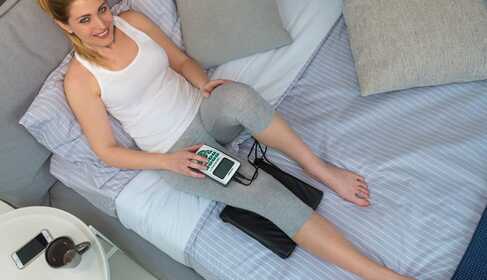

 What is magnetotherapy?
Magnetotherapy uses a low-frequency, low-intensity, pulsed electromagnetic field. The magnetic field is created by an electric current passing through a coil. During treatment, coils built into the device's mat, cushion or flexible applicator generate this field.
The principle is simple: the magnetic field has a biostimulatory effect. It is not magnetism itself that “heals” – the energy production and regenerative processes of cells and tissues placed in the magnetic field receive a boost. Cell function improves, the transport of nutrients and oxygen speeds up, and waste products are removed more efficiently.
 Key point
It is not magnetism itself that “heals” – the energy production and regenerative processes of cells placed in the magnetic field receive a boost. The essence of the method is biostimulation.
 Important to know
Magnetotherapy does not work quickly! In general, regular treatment over several weeks is needed for a noticeable effect. You will need patience and perseverance.
Magnetotherapy is one of the six main home physiotherapy technologies. If you are not sure whether PEMF is the right choice for you, read our guide Which technology is used for what?.
 How does the magnetic field affect the body?
Every cell in your body can be regarded as a kind of “tiny battery”. There is a voltage difference between the inner and outer sides of the cell membrane – around 90 millivolts in nerve cells and around 70 millivolts in other cells. When cells are damaged by illness, infection or trauma, this voltage falls.
If a cell that normally has 70 millivolts measures only 50–55 millivolts, the cell is already diseased. If it falls below 30 millivolts, the cell dies (necrosis). In this situation, inflammatory processes intensify, pain develops and healing slows down.
The main effect of magnetotherapy is that it helps regenerate cells that have lost their energy – it “recharges” them, so to speak. Treatment may:
- Restore the potential of cell membranes
- Restart the cell's own energy-producing system (mitochondria, ATP)
- Increase protein synthesis
- Reduce inflammation and oedema
- Speed up restorative processes
Demonstrated biological effects of magnetotherapy
Based on scientific research, pulsed electromagnetic fields may have the following effects:
- Stimulate connective-tissue and nerve regeneration
- Have an analgesic effect (by increasing the release of endogenous opioids)
- Reduce inflammation
- Improve cell metabolism and reduce swelling
- Promote bone formation and calcium incorporation
- Increase blood flow and microcirculation
- Support immune-system function
Magnetotherapy parameters
The effectiveness of treatment is determined by four main parameters:
Intensity (Gauss or Tesla)
Magnetic field strength is now expressed in Tesla, but many devices still use the older Gauss unit (1 Gauss = 0.1 mT, that is, 10 Gauss = 1 mT).
Therapeutic ranges based on research
- Very low: 0.1–5 Gauss, NASA research, general wellness, long treatment times required; this includes the Earth's magnetic field (approx. 0.3–0.7 Gauss) and the Bemer device (0.5 Gauss)
- Low: 5–20 Gauss, bone healing, osteoarthritis
- Medium: 20–100 Gauss, pain relief, faster results, shorter treatment times
- High: 100–400 Gauss, clinical/medical and home use, local treatment, short treatment times
- Very high: 400+ Gauss, only under medical supervision, potential side effects may occur
- Extra-strong field (above 1000 mT): May have genotoxic effects – not used in medicine
Home devices operate in the medium-intensity range. An intensity below 100 Gauss is mainly intended for biostimulation, making it suitable for home therapy, while intensities between 100 and 1000 Gauss are intended for more intensive therapeutic treatment, generally in a clinic.
Important to know
- Most scientific studies examining medical effects were conducted in the 1–50 Gauss range
- Bone-treatment programmes generally use an intensity of 15–20 Gauss
- Higher intensity is not necessarily better – it allows shorter treatment times, but prolonged exposure above 200 Gauss may cause harmful effects
- The optimum range for home devices is between 10 and 100 Gauss
- Magnum devices provide a maximum intensity of 120–800 Gauss, which falls within the medium-to-high therapeutic range.
Frequency (Hz)
Medical magnetotherapy devices generally use frequencies between 1 and 200 Hz:
- Low frequency (1–30 Hz): suitable for bone healing, improving sleep and relaxation
- Medium frequency (30–100 Hz): for pain relief, inflammation and general wellbeing
- Higher frequency (100+): for acute injuries and biostimulation
Treatment time
The duration of PEMF treatment depends on the nature of the condition.
For acute complaints – a recent injury, acute pain or inflammation – cells are particularly sensitive to electromagnetic impulses, so shorter but more frequent treatments are effective: 15–30 minutes 2–3 times a day.
For chronic conditions – persistent pain, degenerative joint diseases and long-standing complaints – tissues have already adapted to the abnormal state, so longer exposure is needed: 30–60 minutes 1–2 times a day for at least 4–8 weeks.
Bone problems – fractures, delayed fracture healing, osteoporosis and bone oedema – form a separate category because bone-tissue metabolism is slow: 2–4 hours of treatment per day is recommended, possibly for 45–90 days.
The effect is always cumulative. In other words, regular, consistent use produces the result – missed treatments set back healing.
Duty cycle (DC)
If the duty cycle is 100%, the magnetic field is continuous. Below 100%, it is pulsed. In Magnum devices, for example, it is set to 50%, meaning that the magnetic phase and the pause are the same length.
Think of pulsed mode like driving in a nail with a hammer. If you simply press the hammer against the nail, it will not go in. But if you tap it repeatedly, it works. Pulsing often produces better results than a continuous field!
 My advice
The treatment programmes in Magnum devices are programmed with scientifically supported output, frequency and treatment times. If you change these values, you change the effect! If you are not familiar with the correct parameters, do not modify the treatment programmes!
When may magnetotherapy be used?
Musculoskeletal diseases are the most important area of application. Treatment complements conventional medical therapy and may contribute to reducing healing time.
Bone problems
- Bone fractures (carpal bones, wrist, shoulder, forearm, pelvis, tibia, femoral-neck fracture)
- Delayed bone healing, non-union
- Bone necrosis, bone oedema
- Osteoporosis
Joint problems
- Osteoarthritis (knee, hip, shoulder, hand, cervical spine)
- Arthritis, rheumatism
- Cartilage injuries
- Rehabilitation after knee and hip replacement, support for implant integration
Soft-tissue conditions
- Tendinitis, tennis elbow (epicondylitis)
- Carpal tunnel syndrome
- Rotator-cuff problems
- Ankle sprains, bruises
Other areas of application
- Back pain, lower-back pain
- Algodystrophy (Sudeck syndrome)
- Oedematous conditions
- General tissue regeneration, immune support
Detailed guides by condition
If you have a specific complaint, you will find specialised treatment advice and the scientific background in the detailed guides below:
Bone health
- Osteoporosis and magnetotherapy – complementary treatment at home
- Fracture healing and magnetotherapy – complementary treatment at home
- Femoral-neck fracture and magnetotherapy – how may PEMF support healing?
- Supporting implant integration with magnetotherapy
Joint complaints
Alternative PEMF technologies
 Before you start treatment
For safe use, it is important to know the contraindications. If any of the conditions below applies to you, consult your doctor before using the device.
When must you NOT use it? (Absolute contraindications)
- Pacemaker, implanted defibrillator or other electronic implant – magnetotherapy is prohibited with these devices.
Relative contraindications
In the following conditions, treatment is not necessarily ruled out, but the potential benefits and disadvantages must be weighed. Consultation with your doctor may be necessary:
- Heart disease (cardiomyopathy, heart failure, severe arrhythmia) – magnetotherapy improves circulation, which may put strain on a very ill heart
- Severe circulatory disorders
- Acute dermatitis and fungal infections – the biostimulatory effect may also stimulate the growth of pathogens
- Bleeding disorder
- During heavy menstruation – do not treat the abdomen, hip or lower-back area; other body parts may be treated
- Pregnancy – although no harmful effect is known, avoiding treatment is the safer option
- Old metal prosthesis (more than 10 years old) – the material of very old implants may be magnetisable
- Severe blood-pressure disorder – if it cannot be controlled even with medication
- Tumour disease – consult your oncologist; direct treatment of tumour tissue is not recommended
- Febrile illness
 Important warnings
- Do not use it on your head or over the thyroid gland
- Do not allow children under 15 to use the device without supervision
- If you have a metal implant, consult the doctor who implanted it
Possible side effects
Side effects have been reported only very rarely in connection with magnetic-field treatment. In extremely rare cases, the following may occur:
- Temporary drowsiness, restlessness or insomnia (mainly after treatment of the cervical spine)
- Mild nausea
If you develop a problem after treatment around the neck, it is advisable to use shorter treatments (under 30 minutes), repeated more frequently instead.
Practical use of magnetotherapy
Positioning the magnetic coils
How you position the applicator depends on the area and condition being treated:
Coils positioned next to each other (same polarity): If you need to treat a large, extensive area (for example, the spine from the neck to the lower back), place the coils with the same pole facing the skin. This creates a uniform magnetic field.
Opposingly positioned coils: For small areas (for example, a wrist or lower-leg fracture), place the coils on opposite sides of the injured area, facing each other. The magnetic fields from both sides then connect and penetrate more deeply.
My advice
When you pick up the magnetic coils, check the polarity first. “S” (South) identifies the south pole and “N” (North) the north pole.
Treatment protocols by condition
| Condition | Daily treatment time | Duration |
|---|---|---|
| Bone fractures | 6–8 hours | 30 days |
| Non-union | 8 hours | 5 months |
| Bone necrosis | 8 hours | 5 months |
| Osteoporosis | 8–10 hours | 12 weeks |
| After knee/hip replacement | 3–4 hours | 60 days |
| Joint cartilage wear, osteoarthritis | 30 minutes | 6 weeks |
| Joint pain | 15–40 minutes | 3 weeks |
| Back pain, lower-back pain | 20–45 minutes | 3 weeks |
| Tennis elbow, tendinitis | 30 minutes | 3 weeks (5 days per week) |
| Carpal tunnel syndrome | 30 minutes | min. 15 days |
| Algodystrophy | 4–6 hours | 4–8 weeks |
If you are wearing a cast or brace, increasing the field intensity by 50–60% is recommended because the thickness of the cast increases the distance between the coil and the bone.
When should you change the settings?
The programmes in Magnum devices are set according to medical guidelines. They generally do not need adjustment unless your doctor recommends otherwise.
Increase the intensity if the area being treated is covered by a thick dressing, cast or brace.
Increasing the treatment time may be advisable for severe bone conditions (non-union, osteoporosis or fracture) – longer treatment may produce better results in these cases.
Magnetotherapy and tumour diseases
This is a controversial area. Some people recommend magnetotherapy as a complement to tumour treatment. Although many patients receiving treatment reported improved wellbeing and tolerated the side effects of chemotherapy more easily, no objective, measurable effect on the tumour could be demonstrated.
According to opponents of magnetotherapy, cellular processes – including those of tumour cells – may accelerate as a result of treatment. So far, neither claim has been convincingly demonstrated.
If you have a tumour disease
Be sure to consult your oncologist before using magnetotherapy. Direct treatment of tumour tissue is not recommended.
Magnetotherapy devices and accessories
Comparison of Globus Magnum devices
| Feature | L | XL | 2500 | XL Pro | 3000 Pro | 3500 Pro |
|---|---|---|---|---|---|---|
| Number of channels | 1 | 2 | 2 | 2 | 2 | 4 |
| Intensity/channel (Gauss) | 120 | 140 | 160 | 200 | 200 | 200 |
| Max. intensity (Gauss) | 120 | 280 | 320 | 400 | 400 | 800 |
| Rehabilitation programmes | 8 | 16 | 52 | 32 | 70 | 70 |
| Treating multiple patients | No | No | No | No | Yes | Yes |
Applicators and their use
Flexible applicator (30x10 cm): 2 magnetic coils with opposite polarity. Ideal for arm and leg fractures, wrist fractures and ankle sprains. It should be wrapped around the area being treated.
Large flexible applicator (40x15 cm): 4 magnetic coils with the same polarity. Suitable for treating the spine, pelvis and hip. It should be laid along the area being treated.
Soft4 treatment mat (25x25 cm): 4 magnetic coils in a soft foam cover. It can be used under the back, lower back and smaller body parts – even while working.
MAT 100 mat (70x45 cm): Can be placed on a chair or armchair. Ideal for treating the femur, hip, pelvis, lower-back area and back.
TotalBody mat (70x180 cm): For whole-body treatment, it can be used on a bed, even while sleeping. Recommended for osteoporosis, multiple joint inflammation and spinal complaints. It has two versions. The Total Body 400 consists of four mat sections, each containing 4 magnetic coils. This provides an even magnetic field along the full length of the body. The Total Body 200 also consists of 4 sections, but only two are active, meaning that they contain magnetic coils. The position of the sections can be varied. For example, to treat the hips and femurs, place the active sections in the centre, with the passive mats under the head and feet.
How should you choose a device?
When choosing, consider:
- Which area needs treatment? One wrist requires only a 1-channel device. Both knees require a 2-channel device.
- How severe is the complaint? Higher intensity may produce a stronger effect, but a lower-intensity device can also be effective – it will simply require more treatments.
- Which programmes do you need? Check that the device includes the treatment programme you need.
You do not necessarily need the most expensive device – you need one that suits your current needs. A basic Magnum L is perfectly adequate if you only need to treat one limb at a time.
 Summary – Quick overview
- People with musculoskeletal complaints (osteoarthritis, fractures, joint pain)
- People undergoing rehabilitation (after prosthesis or surgery)
- People with osteoporosis
- People looking for home physiotherapy
Frequently asked questions
Magnetotherapy has a slow, gradual effect. Meaningful improvement is generally noticed after 2–4 weeks of regular treatment. Fractures and osteoporosis require a longer course.
NO! Magnetotherapy is prohibited for people with a pacemaker, implanted defibrillator or other electronic implant.
No. Magnetotherapy is painless – you do not feel anything during treatment. At most, you may experience a slight sensation of warmth.
Yes. Magnetotherapy may be used as a complement to medical treatment and alongside drug therapy. Consult your doctor.
It depends on the condition. For soft-tissue problems, 20–45 minutes a day is sufficient. For fractures and osteoporosis, 6–8 hours a day may be necessary.
Sources
- Peng L, et al. (2020). Effectiveness of Pulsed Electromagnetic Fields on Bone Healing: A Systematic Review and Meta-Analysis of Randomized Controlled Trials. Bioelectromagnetics, 41(5):323-337. PubMed: 32495506
- Wu Z, et al. (2020). Effects of Pulsed Electromagnetic Field Therapy on Pain, Stiffness, Physical Function, and Quality of Life in Patients With Osteoarthritis: A Systematic Review and Meta-Analysis. Physical Therapy, 100(7):1168-1181. PubMed: 32251502
- Markovic L, et al. (2022). Effects of pulsed electromagnetic field therapy on outcomes associated with osteoarthritis: A systematic review of systematic reviews. Wien Med Wochenschr. PubMed: 35362792
- Aaron RK, et al. (2021). Pulsed Electromagnetic Field Stimulation of Bone Healing and Joint Preservation: Cellular Mechanisms of Skeletal Response. J Am Acad Orthop Surg Glob Res Rev, 5(5). PubMed: 33970582
- Chen Y, et al. (2022). Pulse Electromagnetic Field for Treating Postmenopausal Osteoporosis: A Systematic Review and Meta-Analysis. Bioelectromagnetics, 43(6):381-393. PubMed: 35864717
- Zhu S, et al. (2021). Efficacy of Pulsed Electromagnetic Fields on Experimental Osteopenia in Rodents: A Systematic Review. Bioelectromagnetics, 42(5):415-431. PubMed: 34004034