
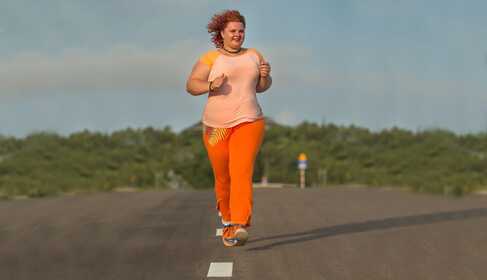
Why I Don't Recommend Running if You're Overweight
I do not recommend running for people struggling with overweight! Even though running is proven to burn the most fat in a given time — in other words it is the most powerful fat-burning exercise — why am I so “stupid” to advise against it? I'll explain that now.

Movement is produced by muscle contraction, and that requires energy. Just like your car only starts and moves from the parking lot if it has fuel.
However, your body doesn't run on gasoline but on bio-energy, namely ATP. Your muscle cells produce it directly from glucose or fatty acids, depending on the composition of your muscle fibers and the intensity at which you move.
Just as you know your car uses more fuel when you “push the gas pedal”, your body can perform more intense movement only by using more energy.
You also know that a small city car consumes less than a truck. Moving a larger body requires more fuel. In other words, the same exercise represents different energy use for a 50 kg and a 90 kg person.
The table below shows how many calories a given sport consumes during 20 minutes of exercise, depending on body weight and intensity.
| Exercise type | MET* | 50kg (kcal) |
60kg (kcal) |
70kg (kcal) |
80kg (kcal) |
90kg (kcal) |
| running slow (10 min/km) | 9.8 | 172 | 206 | 240 | 274 | 309 |
| running moderate pace (6 min/km) | 11.5 | 201 | 242 | 282 | 322 | 362 |
| running intense (4.5 min/km) | 11.8 | 207 | 248 | 289 | 330 | 372 |
| cycling, low intensity | 6.8 | 119 | 143 | 167 | 190 | 214 |
| cycling, moderate intensity | 8 | 140 | 168 | 196 | 224 | 252 |
| cycling, high intensity | 10 | 175 | 210 | 245 | 280 | 315 |
| resistance training | 5 | 88 | 105 | 123 | 140 | 158 |
| rowing, moderate intensity | 4.8 | 84 | 101 | 118 | 134 | 151 |
| rowing, high intensity | 8.5 | 149 | 179 | 208 | 238 | 268 |
| walking, 4 km/h | 3 | 53 | 63 | 74 | 84 | 95 |
| brisk walk, 6.4 km/h | 5 | 88 | 105 | 123 | 140 | 158 |
| power walking, 8 km/h | 8.3 | 145 | 174 | 203 | 232 | 261 |
*MET = a unit expressing the amount of energy consumed by the body
From the data you can see that running indeed burns the most energy. But if that's the case, you might think: great, the more and harder I run, the faster I lose kilos.
In theory that's true, but in practice there is a serious obstacle to this! Namely,
the trap of overweight
When a woman who originally weighed 50 kg rises to 75 kg, or a man from 75 to 105 kg, the body weight increases by 50%. This has a significant impact on many physiological processes.
Change in weight distribution
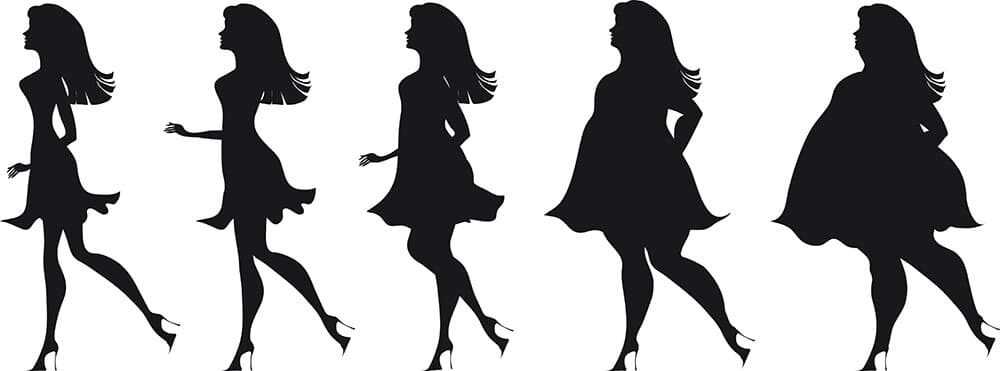
Fat accumulation happens differently in each person. For one it gathers on the buttocks, for another on the thighs, hips, or chest. This upsets proper posture, which affects the load on the joints.
It is well known that men with large abdominal fat suffer from back pain because they compensate for the heavy front weight by increasing the lumbar curvature, leaning back. Otherwise they would fall forward because of the belly weight. Women who have given birth know this well — the growing fetus causes similar postural changes and many pregnant women have back pain.
If the thighs are fat, walking becomes somewhat like a “straddle” because the legs cannot fit side by side. In this case the hips are open, and the knees, ankles, and the bones and ligaments of the foot arch receive load in completely wrong positions. Hip, knee and ankle pain are common because the joint surfaces are loaded from inappropriate directions.
Relative muscle weakness
Muscles around a joint provide its stability. These muscles are “designed” for maintaining normal body weight. They could only handle the extra 50% body weight if they had been trained for it beforehand! If a muscle's capacity is for 50 kg, then an extra +25 kg is an additional overload you must carry constantly.
The muscles can cope for a while, but they get tired.
In overweight people the muscles around joints cannot compensate to reduce the load, so the load is taken directly by the bones forming the joint. If bones slide on each other, and the direction and distribution of force are wrong, pain and inflammation follow, and soon the cartilage surfaces begin to break down and wear. Overweight directly leads to osteoarthritis.
Relative circulatory and respiratory deficit
It should be obvious that a larger body requires more activity from your heart and breathing to supply blood and oxygen than normal.
If your body mass is one-and-a-half times larger, the heart can only supply it by beating faster and with higher blood pressure. You may be sitting still while your heart is working as if you were in competition. It's like putting a tiny engine into a truck — it will struggle to move the load and will wear out quickly.
A larger body consists of more cells and thus needs more oxygen. Visceral fat in the abdomen leaves less space in the abdominal cavity and pushes up the diaphragm, compressing your lungs and hindering proper inhalation and expansion. To meet the greater demand you can only increase the number of breaths.
Because of the greater load, your heart and lungs fatigue faster and deplete sooner than if you were a normal weight.
Metabolic disorder
Overweight is generally caused by poor eating habits, particularly carbohydrate abundance. If you eat baked goods, potatoes, pasta, rice, sugary drinks, etc. at each meal, your metabolism becomes carbohydrate-dependent.
Your mitochondria that produce energy are damaged by constant glucose burning and their number decreases. Due to poor mitochondrial health, switching to fat-burning for energy can take 2–3 days.
Therefore you are constantly hungry and devour carbohydrates, yet you feel lethargic and tired.
Why don't I recommend running?
Based on the above, running is a “shock” to an obese body that is already under great stress. Sudden running can even endanger your life, especially if you are not aware of the physiological processes. Let’s see what happens during running.
Heart function and blood pressure
I already mentioned that supplying blood to an overweight body is a serious task for the heart even at rest. But this is nothing compared to when you start running. After only about 50 steps your heart rate can jump to 150–160/min, at 100 meters you may feel your temples throb and a headache because your blood pressure rises to 200/110.
This indicates that your heart and circulation are responding to the sudden demand. In an untrained state, raising only heart rate and blood pressure is the only option.
What can be the result of this?
The higher your pulse, the less time there is for the coronary arteries to fill. The heart muscle (and brain cells) are most sensitive to lack of blood and oxygen.
Circulatory disturbance of the heart muscle causes chest pain; if you continue to strain it can lead to a heart attack or sudden cardiac arrest — that is, a rapid death.
If your heart does not fail, your high blood pressure may cause cerebral blood flow disturbance, i.e., a stroke.
Breathing
As soon as you start moving, your breathing rate increases. You gasp for air. Your throat dries out, but that's the least of the problems.
Your muscles need energy to move, and to produce that energy they need oxygen. Without enough oxygen energy production shifts to lactic acid formation, making your muscles stiff and fatigued quickly. You simply cannot take in enough oxygen for the demands of running. The whole experience will be extremely unpleasant.
Joint load
During running, every step subjects your joints to substantially greater forces than at rest. I have already explained that due to overweight your joints are in unfavorable static positions. Meanwhile your muscles cannot sustain your weight even without extra load. They certainly cannot tolerate extra stress, so the energy from each step is transmitted directly to the joint bones.
Running with overweight causes joint pain after just 1–2 sessions. If you force it, inflammation can develop in a few days. If you keep running, within 1–2 weeks you can push yourself into a vicious circle. Pain will eventually prevent you from moving, your weight will increase further, and the damage to your joints will progress.
What exercise is recommended for someone overweight?
Exercises where joint loading is minimal.
Cycling/stationary bike
While during running your entire body weight loads the joints, on a bike the saddle (and your buttocks) supports most of the load. The knee, ankle, hip joints and the spinal joints receive considerably less “shock”.
At the same time cycling still burns a good amount of calories! It raises heart rate and breathing less (because fewer muscles are involved in the cycling motion, so oxygen demand is lower).
I recommend this the most!
Swimming/water aerobics
Statically excellent — remember from physics: “a body immersed in water loses as much of its weight as the water it displaces.” Due to buoyancy the joints are subjected to much less load during movement in water than on land.
The main problem is that not everyone has access to such facilities nearby.
Anti-gravity treadmill (vacuum treadmill)
If you absolutely want to run, do it on an anti-gravity treadmill. You will likely find such a machine only in a well-equipped gym or a weight-loss clinic. The idea is that the treadmill's special design uses an "air cushion" to reduce your effective weight, thereby reducing the load on your joints while running. This method was developed for rehabilitation after joint injuries so that the joint can be progressively loaded with minimal stress.
Such machines are usually operated with professional assistance, because a specialist is needed to run the device, monitor your movement, and recommend tempo, etc.
If running is not recommended, how should I lose weight?
I am not forbidding you to run — I simply don't recommend it!
Weigh the facts: do you want to completely ruin your already vulnerable joints because of overweight, or not? If you do… then run. But if you have any sense, choose something else.
Think about how you gained the weight! By constant overeating!
I believe you have a better chance of success by fixing your nutrition. Changing your eating habits (what and when you eat) is the only thing that leads to lasting results.
Count your calories and make sure you expend more than you consume. For many people this alone works, but not for everyone because they compose their diets poorly, often consume carbohydrates and snack late at night. You can read my article here.
Try the 16/8 intermittent fasting method, which limits main meals and especially carbohydrate intake to an 8-hour window. I think this is the most successful and sustainable method, and importantly it doesn't require starving(!). You can read my article here.
Start running only after you have already lost a significant portion of the excess weight. If you have only 10–15% excess left, then with care, starting at a slow pace and short distances and gradually increasing load, you will not harm your joints.
And from that point on you can run as much as you like…

