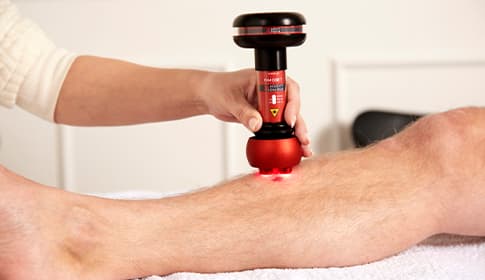

 Treating leg ulcers with soft laser
A leg ulcer is one of the most stubborn chronic wounds: healing is measured in months rather than weeks, and anyone affected knows exactly how demanding daily wound care, discharge and pain can be – along with the slow progress. It is important, however, to see the underlying situation clearly: a leg ulcer is not simply “bad skin”, but the visible consequence of an underlying condition – most often a venous circulation disorder or diabetes. That is why treatment is always a team effort: wound care, compression and management of the underlying disease – and home laser therapy, or soft laser, can have a well-defined role in this team.
This article shows you what types of ulcers there are and how they differ, what basic treatment laser can never replace, what research says about the added value of laser – and you will also get a precise home protocol: wavelength, dose, frequency and hygiene.
 Key point
Laser therapy for chronic wounds is not theory but measured data: in a Cochrane review of diabetic foot ulcers, the wound closed completely during follow-up in 64.5% of patients who received laser light treatment, compared with only 37% in the control group without laser treatment – in other words, laser treatment increased the chance of complete healing by more than one and a half times alongside conventional wound care.1
The key word is “alongside”: laser is an adjunct to basic treatment – it produces results together with it, not without it.
 Which type of ulcer do you have? The entire treatment plan depends on this
“Leg ulcer” is a collective term – and treatment differs fundamentally between the three main types. That is why the first and unavoidable step is a medical examination: the doctor determines the type of ulcer using vascular ultrasound, an ankle-brachial index measurement and the medical history.
| Type | What does it look like? | What is the basis of treatment? |
|---|---|---|
| Venous ulcer (70-80% of cases) | Typically around the inner ankle; an irregular-edged, oozing wound; brownish skin discolouration around it, a swollen lower leg and a history of varicose veins | COMPRESSION (bandage or compression stocking) – without it, a venous ulcer does not close meaningfully6; together with wound care, movement and activation of the muscle pump |
| Arterial ulcer | More often on the foot, toes or heel; a “punched-out”, sharply edged, deep and very painful wound; a cold, pale foot and a weak pulse | Vascular surgical assessment and restoration of circulation – compression is PROHIBITED here because it further worsens the already inadequate arterial blood supply |
| Diabetic (neuropathic) ulcer | Typically on the sole, at a pressure-bearing site; often painless – and this is precisely the danger, because damaged nerves do not signal the problem | Blood glucose control, offloading (special shoes or insoles), regular surgical debridement – and this is where the research evidence for laser therapy is strongest123 |
Determining the type is not a formality but a safety issue: what is the key to healing for one ulcer (compression for a venous ulcer) can be specifically harmful for another (an arterial ulcer). If your ulcer has not yet been assessed, that is the first step – all home treatment, including laser, comes afterwards.
 Why does healing stall – and how can laser help?
Healthy wound healing follows a set sequence: stopping of bleeding → inflammatory clean-up → formation of new tissue → remodelling. A leg ulcer is a chronic wound because this sequence becomes stuck – typically in the inflammatory phase. The underlying problem is that the tissues do not receive enough oxygen and nutrients. In venous disease, stagnant blood and fluid forced into the tissues suppress the microcirculation; in diabetes, damaged small blood vessels and nerves are responsible; and in arterial narrowing, the problem is inadequate blood supply.
This explains the logic of treatment: first, the “fuel supply” must be put in order (compression, improving circulation and blood glucose control) – and methods that move the local healing process out of its deadlock can then build on this foundation. Laser therapy is one of these methods.
The energy of red or infrared laser light is absorbed by the cells’ energy-producing centres (the mitochondria), making the metabolism of the slowed-down, “energy-deficient” cells at the wound edge more active. The effects documented in research include more active cell division at the wound edge, support for collagen production and the formation of new small blood vessels, improved local microcirculation and reduction of prolonged inflammation – in other words, laser light acts precisely where the chronic wound has stalled.2
A realistic view is important: laser light improves the LOCAL healing environment – it does not affect venous congestion, arterial narrowing or high blood glucose. That is why it is an adjunct, and why it works only together with basic treatment.
The strongest data have been produced for diabetic foot ulcers. According to the Cochrane review, 64.5% of wounds closed completely with laser light treatment, compared with 37% in the control group.1 A meta-analysis combining 13 randomised studies measured an almost 23 percentage-point greater reduction in wound size in the laser groups.2 In the latest, 2024 dose-finding study, the ulcer healed completely in 60% of patients treated with 904 nm laser at a dose of 10 J/cm² – and this dose proved the most effective.3
The overall picture is more mixed for venous ulcers – I discuss the reasons and lessons in detail in the research section. The short version is this: compression overwhelmingly determines the outcome of a venous ulcer6, while laser may provide a more modest additional benefit, primarily in pain relief.5
 Basic treatment – what laser cannot replace
Before we turn to the laser protocol, let us set out the order of priorities – because this is what everything depends on with a leg ulcer. First comes professional wound care: the wound must be cleaned and dressed according to the method established by a doctor or specialist nurse experienced in wound care; modern dressings based on the moist wound-healing principle provide the appropriate wound environment that is fundamental to healing. Second comes treatment of the underlying disease: for a venous ulcer, consistently worn compression – the research is clear: among physical methods, compression is the most effective for closing a venous ulcer6 –; for diabetes, blood glucose control and offloading; and for an arterial ulcer, vascular surgical care. Third comes movement: the calf muscle pump drives venous return – daily walking and ankle exercises keep it working, and where movement is limited, electrical muscle stimulation can help.
Laser therapy can then come fourth, building on this foundation as support for local healing. I have written a separate practical article on coordinating the three home methods (movement/muscle pump + laser + consistent wound care alongside compression): 3 tips for healing a leg ulcer. You can find the full picture of the venous underlying condition in the article on varicose vein disease.
Home laser treatment protocol
| Parameter | Recommendation |
|---|---|
| Wavelength | Studies producing good results used the 630-690 nm red2 and around 900 nm infrared3 ranges – red is the logical choice for the superficial wound bed, and infrared for deeper tissues and the area around the wound |
| Dose | 3-6 J/cm² is the range shown to work in the meta-analysis2; in the 2024 dose-finding study, 10 J/cm² produced the most complete healing3 – use the wound-care programme from your device’s table |
| Frequency | From three sessions a week to daily treatment – three times weekly was most common in the studies2; regular treatment is more important than one long session |
| Technique | Treat ABOVE the open wound, moving a few millimetres above it, WITHOUT contact – the device head must never touch the wound; you can also treat the area around the wound (intact skin) by contact |
| Hygiene | Time the treatment for dressing changes: treat after removing the old dressing and cleaning the wound, BEFORE applying the new dressing; disinfect the device head after every use |
| Duration | A chronic wound is measured in months: plan a course of at least 8-12 weeks – in the studies, the difference became clear after 5-10 weeks13 |
 My advice
In ulcer treatment, your most important instrument is your camera: once a week, photograph the ulcer from the same angle, with a ruler next to the wound. Looking at it every day shows nothing – but the weekly series shows the truth. If the pictures show no change after 4-6 weeks of consistent combined treatment, this is not a lack of perseverance but information that needs medical review: the compression may be too weak, the infection may have returned, or the underlying condition may need further management. The good news in the other direction is that a shrinking wound edge in the weekly photographs is the most reliable confirmation that you are on the right track – and that is exactly what you need to keep going.
Home soft lasers for wound care
For ulcer treatment, a device with a large treatment area or a wound programme is practical:
B-Cure Laser Classic
A class 1 laser device with a 4.5 cm² treatment area – safe to use without protective glasses, and convenient for covering a larger wound surface.
Personal-Laser L200
A laser with 660 nm red light – precisely the wavelength range most commonly used in diabetic foot ulcer studies; ideal for superficial wound care.
Energy Laser L500 Pro
A professional 500 mW device with ready-made wound-care programmes – practical for larger, deeper or multiple ulcers because treatment times are shorter.
You can find the full range in the soft laser devices category.
 When NOT to use laser – and when to see a doctor immediately
- Unassessed wound – do not start any home treatment until the type of ulcer (venous, arterial or diabetic) has been medically clarified
- Signs of infection – spreading redness, warmth, foul-smelling discharge or fever require medical care first (spreading, sharply edged redness may also be erysipelas – I have written a separate article about this); treat an infected wound with laser only with medical approval
- Dead (black, necrotic) tissue in the wound – surgical debridement is needed first; laser treatment of a wound with a slough-covered, dead wound bed is pointless
- Cancer in the treatment area – laser must not be used over a known or suspected skin lesion
- Medicines that cause photosensitivity – some antibiotics and medicines have a photosensitising effect: consult your doctor or pharmacist before starting
- Pregnancy – the abdomen and lower back must not be treated; ask your doctor’s opinion before treating the lower leg as well
 Take extra care if you have diabetes
A diabetic foot can deteriorate quickly and insidiously because damaged nerves do not signal pain. If spreading redness, swelling or darkening tissue appears around the wound, or foul-smelling discharge comes from it, do not wait for your next check-up – see a doctor immediately. With a diabetic ulcer, regular specialist wound checks (every 2-4 weeks) are needed even if you are making good progress at home.
Frequently asked questions
Yes – one of the major advantages of laser therapy is precisely that it does not require contact. In the studies, the open wound surface was treated while the device was held a few millimetres to centimetres above the wound.23 Follow two rules: the device head must never touch the open wound (risk of infection), and always treat the clean, freshly treated wound before applying the new dressing. Disinfect the device head after every use.
A chronic wound is measured in months, not weeks. In the studies, the additional effect of laser treatment typically became clear after 5-10 weeks13 – complete closure may take 2-6 months depending on the size of the wound and the underlying condition. Weekly photographic documentation is therefore essential: slow but continuous shrinking is a good sign, even if looking at the wound each day shows nothing. If there is no change in the photographs after 4-6 weeks of combined treatment, a medical review is needed.
Not only can you – you should, if you have a venous ulcer. The routine is simple: remove the compression for the dressing change and laser treatment, then put it straight back on after applying the fresh dressing. Laser never replaces compression; it is added to it: research is clear that compression does the heavy lifting in closing a venous ulcer6 – laser light may improve the local healing environment and pain alongside it.5
The research evidence is strongest precisely for diabetic foot ulcers: in the Cochrane review, complete wound closure was achieved by 64.5% of those treated with laser, compared with 37% of the control group.1 There are three conditions: blood glucose control and offloading are the foundation (laser cannot replace them), regular specialist wound checks are essential, and infection warning signs (spreading redness, foul-smelling discharge or darkening tissue) require immediate medical attention. If you also have numbness or burning in your foot alongside the ulcer, our article on peripheral neuropathy is also for you.
Three factors matter. The size of the wound: for a larger ulcer, a device with a large treatment area (for example, B-Cure Classic) or a more powerful device with a shorter treatment time (Energy Laser) is practical. The wavelength: red light (around 660 nm) suits a superficial wound bed, while the infrared range suits deeper tissues – studies have used both.23 And convenience: the right device is one you will actually use daily or several times a week for months. The soft laser guide provides detailed help with your choice.
 What the research says – answers to readers’ questions
“Does laser really speed up ulcer healing, or is it just marketing?”13
For diabetic foot ulcers, the answer is measured data: in the meta-analysis of the Cochrane review, the wound closed completely in 64.5% of patients in the laser therapy group, compared with 37% in the control group – more than one and a half times the chance of complete healing (RR 1.57).1 The 2024 placebo-controlled dose-finding study also confirmed in 80 patients that 904 nm laser reduced wound size at every dose tested, while the 10 J/cm² group had a 60% complete healing rate, with a significant difference compared with placebo.3 The authors call for more and larger studies – but the direction is consistent, and the method proved free of side effects.
“And what about venous ulcers? Does it work there too?”456
This requires an honest qualification: a recent summary of venous ulcer studies found no clear additional benefit in wound closure – while also noting that the studies were small, their protocols (dose, wavelength and number of treatments) varied greatly, and there is still no standardised treatment protocol.4 In other words, the question is not settled but poorly measured. Even so, two things stand out: ulcer pain decreased meaningfully in the laser groups5, and the real key to closing a venous ulcer is consistent compression6 – laser can be a convenient, side-effect-free companion to this, with realistic expectations. The lesson is the dose-and-time rule: anyone who tries it should use a regular dose shown to work in diabetic studies and continue for several weeks.
“What settings produced the good results?”23
According to the meta-analysis of 13 studies, the proven recipe is: a wavelength of 630-685 nm, a dose of 3-6 J/cm², half to one and a half minutes per point per session, three times a week, for at least one month.2 In the 2024 dose-finding study, the higher dose of 10 J/cm² in the 904 nm infrared range was found to be the most effective – over 20 treatments, given weekly.3 The common factor in both studies is a known, regular dose plus a persistent course lasting several weeks. A device used randomly and occasionally will not produce these figures – one used according to the protocol may.
Summary
What is this article about? A complete guide to treating leg ulcers with soft laser: the vital differences between ulcer types and their treatment, basic treatment (wound care, compression and management of the underlying condition), the role of laser and its research background, plus a precise home protocol with dose, frequency and hygiene rules.
Who is it for? People living with venous or diabetic leg ulcers and their relatives who want to support faster wound closure at home alongside medical treatment.
Main message: Ulcer treatment is a team effort: professional wound care, compression (for venous ulcers) and management of the underlying condition form the foundation – soft laser is an adjunct built on this foundation which research has shown to increase the chance of complete healing by more than one and a half times in diabetic foot ulcers. The effect depends on a regular dose and a persistent course lasting several weeks.
Next step: Once the ulcer type has been assessed, discuss the combined plan with your doctor, start a laser course of 3-7 sessions per week timed to dressing changes – and photograph the wound weekly: after 4-6 weeks, the series of images will show whether you are on the right track.
Read more
- 3 tips for healing a leg ulcer – combined home programme
- Leg ulcer: supporting healing with muscle stimulation
- Varicose vein disease: causes, symptoms and treatment
- Erysipelas: a bacterial skin infection
- Peripheral neuropathy: causes and pain relief
- Soft laser therapy guide: how it works, doses and laser classes
- The scientific background of soft laser therapy – an evidence map
Scientific sources
- Wang HT, Yuan JQ, Zhang B, et al. (2017). Phototherapy for treating foot ulcers in people with diabetes. Cochrane Database of Systematic Reviews. DOI: 10.1002/14651858.CD011979.pub2
- Santos CMD, Rocha RBD, Hazime FA, Cardoso VS. (2020). A systematic review and meta-analysis of the effects of low-level laser therapy in the treatment of diabetic foot ulcers. International Journal of Lower Extremity Wounds. DOI: 10.1177/1534734620914439
- Saura Cardoso V, de Souza Lima da Silveira PR, dos Santos CM, et al. (2024). Dose-response and efficacy of 904 nm photobiomodulation on diabetic foot ulcers healing: a randomized controlled trial. Lasers in Medical Science. DOI: 10.1007/s10103-024-04090-3
- Rasul A, Plum F, Karmisholt KE, Kirketerp-Møller K. (2026). The healing effect of photobiomodulation on venous leg ulcers: a systematic review and meta-analysis. Wound Repair and Regeneration. DOI: 10.1111/wrr.70144
- Vitse J, Bekara F, Byun S, et al. (2017). A double-blind, placebo-controlled randomized evaluation of the effect of low-level laser therapy on venous leg ulcers. International Journal of Lower Extremity Wounds. DOI: 10.1177/1534734617690948
- Taradaj J, Franek A, Cierpka L, et al. (2011). Early and long-term results of physical methods in the treatment of venous leg ulcers: randomized controlled trial. Phlebology. DOI: 10.1258/phleb.2010.010048