
 Massage gun – quick relaxation, smarter recovery
The massage gun (percussion massager) uses fast tapping and vibrating movements to target muscles and the connective tissue layers. Before exercise it helps to "wake up" the muscle, and afterwards stiffness and tightness ease sooner. With regular use it can contribute to better joint range of motion and muscle flexibility – without medicine or an appointment, at home.
 Who it suits, and what to watch for
Useful for athletes (warm-up and recovery), for people with sedentary jobs (relieving shoulder, neck and lower back tension), and as a complement to physiotherapy. When choosing, count the number of speeds, impact depth, noise level, battery life and the head set – we go through these below, together with correct usage technique.
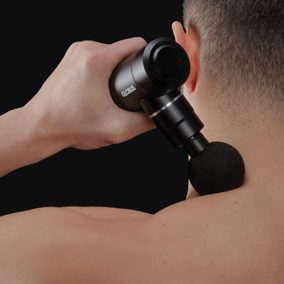


A Globus 4Vibe massage gun is a compact, portable device that uses deep-tissue vibrations (percussion therapy) to support muscle recovery and relieve pain. Aluminum housing, four adjustable speeds, and a set of 4 interchangeable heads.
 How to use it? – The right technique
The massage gun gives the best results when you know which setting and how much time to use. The basic rule is simple: aim for pleasant pressure, not heroics. Start gently, watch your body’s feedback, and back off if it hurts.
| When? | How long? | Which setting? |
|---|---|---|
| Warm-up (before activity) | 10–30 s / muscle group | low–medium, activating |
| Cool down, recovery (after training) | 1–2 min / muscle group | medium, slow sweeping motion |
| Trigger point (tense knot) | 15–20 s on one point, then move on | medium, targeted |
 Golden rule
Do not hold the massage gun on joints or bone surfaces for long – it is for muscles, not bony areas. Work more confidently on large muscle groups (thigh, calf, back), and be cautious on sensitive or thin zones.
 What to check before buying?
The best massage gun is not necessarily the strongest one, but the one that fits your needs. Four factors matter:
Rotation speed (RPM) and impact depth (amplitude) together determine how "deep" the treatment is. More adjustable settings allow finer tuning: lower for thinner, more sensitive muscles, stronger for large muscle groups. If you plan to use it for both warm-up and deep recovery, more settings are an advantage.
A quieter motor is more comfortable – you can use it in the evening, next to the TV or in shared spaces without disturbing others. Modern devices can work around 45 dB, roughly the level of quiet conversation.
Long battery life, USB-C charging and low weight give true portability – handy at the gym, while travelling or at work. A lightweight, durable body (for example aluminium) is not only robust but also more comfortable to hold during longer use.
More interchangeable heads cover more tasks: a large flat or round head for big muscles, a pointed head for precise trigger-point work, and a soft head for more sensitive zones. With a well-chosen head set, one device can serve many needs.
 What do studies say?
The research picture on percussion therapy is encouraging but nuanced. Some studies suggest it can reduce muscle stiffness and delayed-onset muscle soreness and improve range of motion. However, benefits are not always seen in direct performance measures (strength, explosiveness).
Practical takeaway: use it briefly and targeted during warm-up, but be bolder in the recovery phase – that’s where the most tangible benefits usually appear.
 When not to use it?
Avoid use on fresh injuries, inflamed or swollen areas, skin with sensory loss, and during pregnancy do not use on the abdomen and lower back. Do not use on areas with tumours, if deep vein thrombosis is suspected, with bleeding disorders or when taking anticoagulants, or over a pacemaker on the chest. In these cases consult a specialist first, and if they approve, use a gentle setting. The massage gun does not replace medical or physiotherapy treatment – it complements it.
Frequently asked questions
It shouldn’t. The goal is pleasant release of tension, not pain. If it hurts, the setting is probably too strong or you are working one spot for too long – reduce the intensity and keep moving across the area rather than holding in one place.
Both work, for different goals. Short, activating use before training helps wake the muscle; after training, longer, slower treatment relaxes and supports recovery. You can combine both—just adjust setting and time to your aim (see the table above).
No. The massage gun is a complementary tool: it can do things stretching or exercise do not, and vice versa. It works best alongside stretching and mobilisation—together they reinforce each other.
A large flat or round head for big muscle groups (thighs, back, calf); a pointed head for specific tight knots (trigger points); a soft or forked head for more sensitive, thinner areas. If unsure, start on large muscles with the flat head at medium setting.
 Summary – Quick overview

