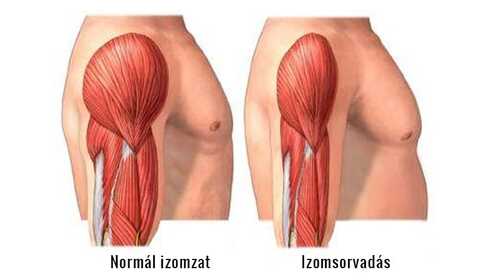

 What is muscle atrophy?
Muscle atrophy (atrophy) is the process by which the functional muscle mass and, in parallel, muscle strength continuously decrease. Today there are two main causes of muscle atrophy:
- Lack of movement (inactivity) – the far more common cause
- Disease affecting a muscle – much rarer
Disease-related muscle atrophy affects on average about 10 people in 100,000 — so it is rare. The majority struggle with muscle atrophy due to inactivity, however this is largely preventable and reversible.
 Key idea
Muscle atrophy is reversible — if we intervene as early as possible. Regular exercise is the foundation of treatment, but NMES (neuromuscular electrical stimulation) can complement or temporarily replace classic active exercise in situations (casting, illness, bed rest) when active training is not possible. Clinical trials show that NMES can significantly reduce muscle mass loss during immobilization.1
 Causes of muscle atrophy – three categories
Physical activity is vital for muscles. The more you “use” your muscles, the stronger and thicker they become. The body adapts by increasing muscle strength and muscle mass to meet the continuous physical demands placed on it.
The tragedy of our times is a comfortable lifestyle. You sit all day: on the bus, in the car, at work, and finally for hours in front of the TV. Your muscles move for minimal time and with almost no load.
Your body senses that you "do not need it" — and what is not needed is not maintained with unnecessary effort. It simply breaks down large muscles. The weaker the muscles become, the harder movement is — therefore the degeneration accelerates.
A specific acute form is immobilization after surgery or fracture. For example, two weeks of bed rest already leads to measurable decreases in muscle circumference. The muscles of a leg placed in a cast thin considerably compared to the other side by the time the cast is removed. Clinical trials show that even 5 days of one-leg immobilization causes 3.5% loss of thigh muscle mass — which could have been prevented with NMES application.1
Disease-related muscle atrophy (muscular dystrophy) is usually due to a genetically determined enzyme or metabolic disorder. There are hereditary and spontaneously occurring forms.
- Duchenne muscular dystrophy (DMD): affects only boys (X-linked inheritance). Due to a defect in the protein dystrophin, muscle cells gradually degenerate. It is a severe condition — affected children often become unable to walk around age 13, and the disease also affects respiratory and cardiac muscles.
- Becker muscular dystrophy: rarer and less severe mutation. The disease progresses more slowly and symptoms typically appear between ages 6–19.
- Myotonic dystrophy: an adult form. It affects both men and women and can appear at any age. It is associated with weakness and muscle stiffness.
Secondary muscle weakness: atrophy triggered indirectly by another disease:
- Excess growth hormone production
- Thyroid disease
- Metabolic diseases
- Chronic liver disease
- Sarcopenia – age-related muscle loss
- ICU-acquired weakness – muscle loss after intensive care
Autoimmune muscle diseases: the body recognizes the muscle as foreign and produces antibodies against it.
Neurogenic muscle atrophy: occurs due to diseases affecting nerves rather than the muscle directly (e.g., stroke, ALS, peripheral palsy). In these cases the strategy for muscle stimulation treatment differs — details in the selective stimulation article and the ALS article.
When should you see a doctor?
 Medical evaluation required
If you notice your muscles becoming inexplicably thinner and weaker — for example the circumference of your arm or thigh visibly decreases and reduced activity does not explain it — seek medical attention as soon as possible. You can start with your general practitioner or go directly to a neurology specialist clinic.
Evaluation may include: blood tests (creatine kinase, hormones), EMG (electromyographic examination), muscle biopsy, MRI — depending on the suspected cause. Early diagnosis is crucial for choosing the appropriate treatment strategy.
 Treatment options for muscle atrophy
1. Never stop moving!
Regular physical activity is vital. You don’t need Olympic-level training! Daily walks, cycling, yoga, exercise, tai chi, or 1–2 hours of gardening already make a big difference. The more movement, the more the muscles “like” it.
Clinical trials confirm: the combination of NMES + active exercise protects muscle better than NMES alone. Physiotherapy is the foundation of treatment — consult a physiotherapist or a medical fitness trainer.
2. Specific treatments in different situations
In sarcopenic patients, 4 weeks of NMES treatment in clinical trials produced significantly better sit-to-stand performance and muscle strength than usual care.2 This is especially important because sit-to-stand performance is directly related to maintaining independence.
Rapidly developing muscle weakness during weeks of intensive care (ICU-acquired weakness) is one of the most severe postoperative and post–intensive conditions. A meta-analysis of 18 randomized clinical trials indicates that NMES can reduce the incidence of ICU-acquired weakness, slow muscle mass loss, and moderately improve muscle strength.3
After total knee arthroplasty (TKA): a meta-analysis of 9 randomized clinical trials shows that adding NMES to standard rehabilitation significantly improves quadriceps strength at 1, 3–4 and 12–13 months, and benefits mid-term pain and function.4
After ACL reconstruction: a review of 11 randomized trials indicates that NMES added to physiotherapy results in better quadriceps strength, especially if started within the first postoperative week.5
Detailed information in the postoperative muscle stimulation article.
In healthy young men, clinical trials found that 5 days of one-leg immobilization resulted in a 3.5% loss of quadriceps mass in the control group — the group receiving twice-daily NMES showed no mass loss.1
In elderly hospitalized patients, NMES added to standard rehabilitation in clinical trials has been shown to improve muscle strength, preserve muscle mass, and enhance walking performance and functional capacity.7
For childhood Duchenne muscular dystrophy, steroid therapy is the classic protocol — stem cell therapies are currently under development. Treatment is always led by a specialized neurologist/pediatric specialist.
In FSHD (facioscapulohumeral dystrophy), a clinical trial found that 5 months of supervised NMES training was safe and produced meaningful improvements in maximal voluntary strength of stimulated deltoid and quadriceps muscles — without creatine kinase elevation or worsening fatigue.6
Important note: RCT-level evidence for NMES in DMD/BMD is limited — treatment is conducted under specialized institutional and multidisciplinary team supervision.
How does NMES affect muscle atrophy?
NMES devices deliver mild, painless electrical impulses to the skin, inducing muscle contractions. A 30–40 minute treatment can develop muscle strength in a way similar to exercise.
 Practical protocol
A single stimulation has no meaningful effect, just as a single workout cannot develop muscle strength. Clinical practice suggests:
- Frequency: 1–2 times daily
- Duration: 30–40 minutes per session
- Treatment period: meaningful improvement expected after 2–3 months
- Rest interval: for the same muscle group allow at least 4–6 hours between sessions
NMES treatment can prevent decreases in muscle mass and muscle strength — particularly valuable in immobilization situations (cast, bed rest, ICU) when active movement is not possible.
Combined approach
- Ultrasound before exercise: ultrasound treatment can relax stiff muscles, making physiotherapy easier.
- NMES + active exercise: clinical trials show that combining NMES with voluntary exercises yields better results than NMES alone.
- Proper nutrition: adequate protein intake (1.0–1.2 g/kg body weight) is required to maintain muscle mass.
 Which device is suitable for home NMES treatment?
In most cases of muscle atrophy (inactivity, sarcopenia, postoperative, post-ICU) the affected muscle has an intact peripheral nerve — therefore classic biphasic square-wave NMES or ETS is appropriate. For neurogenic muscle atrophy (denervated muscle) the strategy is different — detailed explanation in the selective stimulation article.
Primary recommendations (intact nerve muscle: inactivity, sarcopenia, postoperative)
Genesy 300 Pro – classic NMES (affordable entry)
Classic 4-channel NMES device, specifically suitable for muscle atrophy rehabilitation. DOES NOT include selective stimulation programs (which are not required for most muscle atrophy). Cost-effective choice for initial home treatment.
Genesy 1500 – home top-tier
4-channel device with extensive NMES functionality, including Kotz current. This is the maximum available for home use.
Genesy 3000 – professional versatile level
The pinnacle of the Genesy line. A clinically documented NMES device with professional-level rehab protocols — suitable even for specialized treatment of muscular dystrophies (this level is utilized by physiotherapists).
DuoBravo N – ETS specialist (assisted voluntary attempts)
ETS technology (EMG-Triggered Stimulation) can be particularly valuable in muscle atrophy rehabilitation: stimulation is triggered by the patient’s voluntary attempt. This ensures temporal coincidence of voluntary effort + stimulation "reinforcement" — clinical trials indicate better functional outcomes than passive NMES. Especially recommended for post-stroke muscle atrophy.
 Regaining lost muscle strength (EMS rehab) →
 Muscle stimulation after surgery (TKA, ACL) →
 Frequently asked questions
Yes, muscle atrophy due to inactivity is fully reversible if you intervene early. The combination of regular exercise (physiotherapy, walking, cycling) + NMES can produce meaningful improvement within 2–3 months. Disease-related muscle atrophy (Duchenne, Becker) is harder to treat, but symptomatic relief and slowing of progression are possible.
According to clinical trials:
- Prevention of immobilization muscle loss: muscle preservation detectable after just 5 days of NMES.
- Functional improvement in sarcopenic patients: 4 weeks of NMES yields significant improvement.
- Postoperative (TKA, ACL): measurable improvements at 1, 3–4 and 12–13 months.
- General muscle strength increase: with 1–2 NMES sessions daily, meaningful improvement expected after 2–3 months.
No. NMES complements, it does not replace physiotherapy. Clinical trials show that NMES + active exercise produces better results than either alone. NMES is especially valuable when active movement is impossible (cast, bed rest, ICU) — in such cases NMES can temporarily “replace” active training.
Partly yes, partly no. Devices used in clinical trials are generally medical-grade equipment and fall in the 100–150k HUF range. “Fitness” stimulators costing 3–5k HUF have poor impulse quality and lack the precise parameterization required by clinical protocols. For severe muscle atrophy we recommend a high-quality, medical device.
Electrode placement under a cast is generally not possible. BUT: areas not covered by the cast (proximal and distal parts of the limb, the opposite side) are worth stimulating, because the contralateral effect and maintaining overall muscle tone can reduce atrophy of the casted limb. Starting NMES immediately after cast removal is key for rapid recovery. Details in the postoperative muscle stimulation article.
Yes — it can be particularly valuable. NMES treatment for sarcopenia has been shown in clinical trials to produce meaningful improvements in sit-to-stand performance and muscle strength within 4 weeks.2 This is directly related to maintaining independence. However, use in children under 18 and in people with severe cardiovascular disease should only be under medical supervision.
 When NOT to use NMES?
NMES is generally safe, but it is contraindicated in certain cases. If any of the following apply to you, do not start using NMES without consulting your treating physician.
When to be cautious?
- Implanted pacemaker or defibrillator – use is prohibited
- Pregnancy – gynecological specialist consultation required
- Active malignancy at the treatment site – avoid
- Epilepsy – only under medical supervision
- Acute inflammation, infection, fever – postpone treatment
- Damaged or irritated skin at the treatment site – avoid
- Thrombosis or thrombophlebitis at the treatment site – muscle contraction may be dangerous
- Severe cardiovascular disease – only under medical supervision
- The chest, the front of the neck, the head – NEVER apply NMES here
- Children under 18 – only under medical supervision (for muscular dystrophy only in specialized centers)
- Undiagnosed muscle atrophy – medical evaluation required first to choose the appropriate strategy
Adjunct treatment, not standalone therapy
Home NMES is an adjunct in muscle atrophy rehabilitation, not a replacement for specialist neurological care, pharmacotherapy, or physiotherapy. Diagnostics and treatment planning are always performed by a professional. A detailed contraindication list is available in the electrotherapy contraindications article.
 Summary – Quick overview
Sources
- Dirks ML, Wall BT, Snijders T, Ottenbros CL, Verdijk LB, van Loon LJ. (2014). Neuromuscular electrical stimulation prevents muscle disuse atrophy during leg immobilization in humans. Acta Physiologica (Oxford), 210(3), 628-641. PubMed: 24251881
- Teschler M, Heimer M, Schmitz B, Kemmler W, Mooren FC. (2021). Four weeks of electromyostimulation improves muscle function and strength in sarcopenic patients: a three-arm parallel randomized trial. Journal of Cachexia, Sarcopenia and Muscle, 12(4), 843-854. PubMed: 34105256
- Nakanishi N, Yoshihiro S, Kawamura Y, Aikawa G, Shida H, Shimizu M, Fujinami Y, Matsuoka A, Watanabe S, Taito S, Inoue S. (2023). Effect of Neuromuscular Electrical Stimulation in Patients With Critical Illness: An Updated Systematic Review and Meta-Analysis of Randomized Controlled Trials. Critical Care Medicine, 51(10), 1386-1396. PubMed: 37232695
- Peng L, Wang K, Zeng Y, Wu Y, Si H, Shen B. (2021). Effect of Neuromuscular Electrical Stimulation After Total Knee Arthroplasty: A Systematic Review and Meta-Analysis of Randomized Controlled Trials. Frontiers in Medicine (Lausanne), 8, 779019. PubMed: 34926522
- Li Z, Jin L, Chen Z, Shang Z, Geng Y, Tian S, Dong J. (2025). Effects of Neuromuscular Electrical Stimulation on Quadriceps Femoris Muscle Strength and Knee Joint Function in Patients After ACL Surgery: A Systematic Review and Meta-analysis of Randomized Controlled Trials. Orthopaedic Journal of Sports Medicine, 13(1), 23259671241275071. PubMed: 39811154
- Colson SS, Benchortane M, Tanant V, Faghan JP, Fournier-Mehouas M, Benaïm C, Desnuelle C, Sacconi S. (2010). Neuromuscular electrical stimulation training: a safe and effective treatment for facioscapulohumeral muscular dystrophy patients. Archives of Physical Medicine and Rehabilitation, 91(5), 697-702. PubMed: 20434605
- Alqurashi HB, Robinson K, O'Connor D, Piasecki M, Gordon AL, Masud T, Gladman JRF. (2023). The effects of neuromuscular electrical stimulation on hospitalised adults: systematic review and meta-analysis of randomised controlled trials. Age and Ageing, 52(12), afad236. PubMed: 38156975