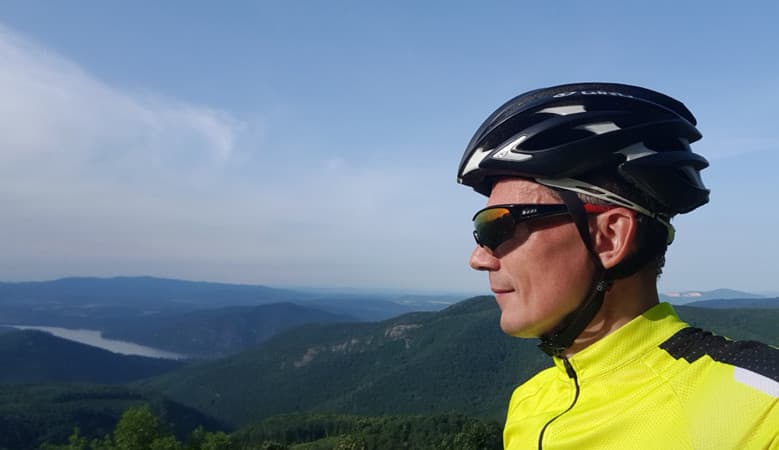
Muscle Stimulation in Cyclist Preparation
We met Misi Bodócs in our childhood. He was a member of the team from the neighboring town and we often competed against each other at pioneer Olympics. Life then took us in different directions and 35 years later we bumped into each other by chance. We ran into each other while cycling in the Buda hills (for lack of a better phrase). At Normafa we even stopped for a refreshment and a slice of homemade strudel at the little kiosk. After the usual “how are you” and “what are you doing” questions, however, our conversation took an unexpected turn…
Dr. Zátrok Zsolt (ZZs): What do you do?
Bodócs Mihály (BM): I'm the regional commercial director for the Hungarian-owned Jura group. We sell ultra-high-resolution systems and our own developed software and features for special prepress printing worldwide. Our main target groups are banknote printing houses and state printing houses that produce security documents, as well as central banks.
Few know this, but in much of the world banknotes, passports, ID cards and other secure printed forms are designed using this Hungarian-developed software.
ZZs: How large an area do you cover?
BM: Turkey, some African countries and much of Southeast Asia — a total of 22 countries.
ZZs: How much time do you spend on the road?
BM: On average I travel about 15 times a year and spend roughly 110–120 days abroad. These are strictly business trips with very packed daily schedules.
ZZs: How do you keep your fitness with so much travel?
BM: There’s almost only the hotel available for exercise. In the territories I cover, 30–40°C is the usual temperature, not to mention humidity over 90%. Under those conditions outdoor activity — like running in a park or cycling — is not an option, at least not for me. So naturally I can’t wait to get home and hop on my bike to continue preparing for the championships.
ZZs: Which championship?
BM: I'm preparing for the MTB TOP Marathon series, which refers to the combined results of the four biggest Hungarian races. (From 2019 it has five stages — ed.) Last year I was the Master 3 champion of the TOP Marathon series on the short distance (2017 — ed.). This year I’m moving to medium distance, which is usually about twice the short distance: roughly three-hour races.
ZZs: I’ve traveled plenty too, but I’ve never been in a hotel with a fitness center suitable for race preparation. At best, stationary bikes in the room.
BM: Yes… abroad I can’t really ride effectively. I run and do gym work so that my circulation doesn’t collapse and to maintain as much thigh strength as possible — which is at best just enough to maintain level, sometimes not even that. It takes about a week after returning home for my muscles to recover. So it’s like a roller coaster.
ZZs: That sounds inefficient… but there might be a solution to your problem — have you heard of muscle stimulation?
BM: Yes, I’ve tried it a few times at an e-fit studio. I put on a suit with electrical connectors and did cross-fit training while being stimulated. It’s effective, but unfortunately expensive and location-bound.
ZZs: Not that! A personal muscle stimulator. You don’t put anything on like a suit — that’s for something else. On the bike your thighs provide most of the pushing power, so you need to focus the treatments there.
BM: Come on — tell me, just push harder!
This is how Misi Bodócs became a user of muscle stimulators. He bought a Globus Cycling Pro and later a Compex SP 8.0 wireless stimulator. We went over the basics. In a few days he immersed himself in the mysteries of stimulation enough to make many physiotherapists envious. He has been using a stimulator for almost two years. I asked him about his experiences.
ZZs: What do you think about muscle stimulation now?
BM: The effectiveness of EMS was never in doubt for me even before our conversation. The workouts at the e-fit studio clearly proved that the method works. I also read a lot about it online. So it wasn’t a question whether EMS stimulation could maintain my thigh muscles during long business trips or preserve muscle condition when I can’t train in the conventional sense for several days.
What I didn’t know was an affordable, working and especially portable device/system that would make this possible. I learned from you that such devices already exist and, based on price, are accessible to anyone. It was pure chance that you happened to deal with the two best models!
You claimed it is effective even if used passively — and I have plenty of passive time. An average flight of mine is 5–12 hours. I spend my evenings in the hotel room — the gym is usually already closed — while replying to emails or flipping TV channels. I have lots of time, but no training opportunity.
We also discussed how such a simple portable device can train multiple muscle groups simultaneously, and you gave the appropriate answers. First, in my case we’re talking about cycling, where the most important muscle group is the quadriceps. Second, with the proper splitter cables you can stimulate two muscle groups at once — for example quadriceps and glutes simultaneously.
ZZs: And did reality confirm my words?
BM: I thought that as a Master 3 champion my thighs couldn’t be surprised, yet I got muscle soreness from the first Cycling Pro treatments… that was enough to totally convince me of the device’s effectiveness. If something gives you that kind of soreness, it’s effective. Of course, I dug much deeper into the topic.
ZZs: What did you start with?
BM: Before my next trip you gave me a basic training plan that included capillarization, endurance, anaerobic training and strength-building programs. Of course with warm-up at the beginning and regeneration afterwards. Since I had the time, I treated my calves, quadriceps and hamstrings, glutes and sometimes the lower back muscles separately. It took a minimum of two, sometimes three hours. But since I couldn’t ride…
ZZs: And the result?
BM: When I got home, the first thing I did was get on my mountain bike. There was no sign of the usual strength loss that would follow a 10–14 day sales trip. There was no regression. That made me an even more determined stimulator fan. Of course I must note that a stimulator cannot replace cardio training.
ZZs: That’s true. That’s why I say it’s not instead of training but as a supplement. Later you bought a Compex SP 8.0. Did you get along with that one too?
BM: Because it’s WiFi-based, without wires it can even be used in the gym. I mainly use it to support leg workouts because it automatically senses muscle contraction and, for example during squats, by tightening the thigh muscle it assists the conventionally performed exercise. It clearly made my gym leg sessions more effective.
Additionally, my wife also uses it, primarily to strengthen her lower back muscles and to quickly eliminate occasional pains. It’s an excellent device as well; with a sensor it measures the muscles’ condition and sets the optimal stimulation accordingly.
It’s for those who don’t want to learn too much about stimulation and trust the machine with everything. I, however, feel that when I control the Cycling Pro the stimulation is more effective because the Compex doesn’t let you "tamper" with the treatment program.
The Cycling Pro is the one for me. I thoroughly mapped out the device’s capabilities and I can say that its full customizability is an advantage that even its cables cannot spoil. The SP 8.0 wireless is very comfortable, but working through the full mass of a muscle group brings much more. That’s why I put the seemingly more modern device aside for the off-season/winter period — for gym training.
ZZs: Based on all this experience, how have you modified its use?
BM: From the beginning you told me to concentrate on the most important cycling muscle, the quadriceps. I can definitely confirm that. After two years of regular use I think the quadriceps constitute about 70% of the most important muscle for an average cyclist. Of course there are significant individual differences, but today I use EMS primarily to strengthen the quadriceps and only the glutes to a much lesser degree, roughly a ten-to-one ratio. My calves and hamstrings generally are not the bottleneck in races.
So I mainly focus on the quadriceps. An EMS session consists of 1–3 cycles of 15–25 minutes, depending on the day’s conventional training plan. From that you can guess that I don’t only use the device during my travels, but also to supplement cycling training. For example, if I do a strength-building cycling workout, I follow it with the appropriate EMS program. I pay attention to intensity and what the muscle needs that day. I fine-tune during the treatment and make adjustments afterwards. I try to gradually increase intensity and keep muscle contractions at the pain threshold: "only hard training is effective training"!
I should also mention that I regularly use the Globus for abdominal muscle training. There are excellent fat-burning/toning programs for the upper body/core. You might not leave that in the article, but I can say some programs are even capable of producing erotic-type sensations. Of course I mean stimulation of the abdominal and lower abdominal muscle areas, and nothing else. 🙂
ZZs: How did your results develop? 2018 was quite unlucky, for example…
BM: Indeed. I started the season in excellent form — the peak of my life. I won the first race on the medium distance with a significant lead of about 20 minutes. On the medium distance I posted better split times than I did on the short distance the previous year (when I won the championship).
So I was fully satisfied… then in early May at the Balaton Marathon I crashed. I hit a rock with my pedal and landed on my shoulder, tearing my rotator cuff muscles. I couldn’t even lift my arm — not even to shake a hand. After that I couldn’t really train for two weeks. The surgery was scheduled for July and I tried to salvage what I could and still started races.
I’m especially proud that I won the first stage of the TOP marathon series in Szilvásvárad in M3 at the end of May despite my injury and extreme stormy weather, finishing 20th overall in a field of about 400. I also won four races after that, but I was already on a continuous downhill. I had surgery in early July; that was over a year ago and unfortunately my shoulder still isn’t perfect today.
ZZs: And how are you doing in 2019 so far?
BM: Due to the long rehabilitation after my shoulder surgery I missed the winter base training. I started preparing for the season late and significantly overweight. EMS helped a lot in avoiding deterioration and in getting back into shape quickly. This year the medium-distance field is brutal — it’s never been this strong. The TOP marathon series is five-part this year. I won the first one — the Balaton Marathon — finished fourth at Szilvás, third at Nagykovácsi, and at the Bükk Marathon a slow puncture dropped me from the lead to seventh. Despite that, I’m second overall, ten points behind Gyuri Szabó.
That can be recovered. I need to beat him at the last Mátra Marathon and I’ll have the overall win. If I have further technical problems, even the podium could be in doubt.
ZZs: Could you summarize your stimulator experiences for cyclists?
BM: I consider muscle stimulation very important for any cyclist. For professionals and those who have enough time to ride, pre-workout warm-up programs and post-load regeneration should be a basic requirement. You can see this at the Tour as well. Regeneration protocols start immediately in the team buses; there are pictures of this online.
EMS is also excellent for strength development for amateurs. With stimulation you buy training time for your thigh muscles. If you combine that with riding, you gain a meaningful advantage — you can go 5–10% faster than you would without stimulation given your limited training time. Warm-up and regeneration are indispensable even for amateurs.
For a cyclist, it is generally sufficient to stimulate the quadriceps. Other muscle groups should only be targeted if they are underdeveloped compared to the quadriceps or can only be loaded to a limited extent for some reason — for example during post-injury rehabilitation. More concretely: after an ACL surgery, it is obviously possible to start EMS-based rehabilitation much earlier than physiotherapy, since it does not load the skeleton or surgical areas. The device’s microcurrent programs have also worked excellently for me in pain relief.
Mihály Bodócs uses the Globus Cycling Pro stimulator to support his preparation.