

OxyCycle 1 Pedal Exerciser | Active
236.00 €
OxyCycle 1 Pedal Exerciser | Active
CE / MDR
MVS in Motion




In stock
236.00 €
OxyCycle 1: Active | Pedal Exerciser | Adjustable resistance | Excellent for gradual strengthening of arms and legs.
Bundle offers
Details
Do you sit at your desk all day and have back pain by evening? Is an elderly relative barely leaving their armchair and growing weaker? Have you passed the difficult phase of post-op rehab and want to regain strength gradually?
The MoVeS OxyCycle 1 is designed for these situations: a simple, active pedal exerciser that lets you gently move your arms and legs while seated – in an armchair, in front of the TV, or under your desk. It contains no motor and provides no passive assistance – this model is a good choice if you can already pedal under your own power and only need regular movement and gradual muscle strengthening. CE-marked, home-use rehabilitation/fitness ergometer in a compact 9 kg design.
Why choose the OxyCycle 1?

Magnetic resistance – gradually adjustable load
The pedal resistance is provided by a continuously adjustable magnetic braking system. On stronger days you increase resistance; on weaker days you reduce it – with the turn of a single knob. Muscle-building can be planned and progressed step by step. The magnetic principle is wear-free and long-lasting, and it does not rattle like traditional belt-based resistance.

For both upper and lower limbs
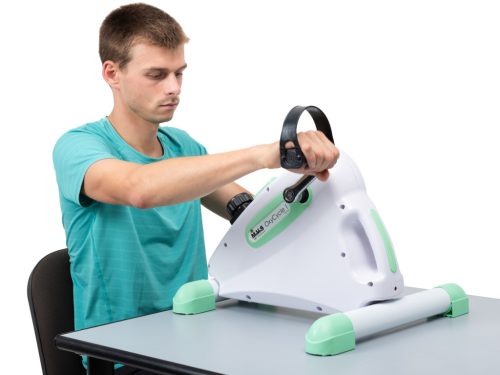
One device allows both arm and leg pedaling: place it on a table to move the arms and shoulder girdle, or on the floor for cycling motion of the legs, hips, knees and ankles. The pedal comes with interchangeable grips, and the traditional strap fastening is adjustable with Velcro to fit your foot size or palm – it will not slip even if your grip is still weak.

Quiet, motor-free operation
Because there is no motor or chain, the device is virtually silent. It can be used while watching TV, during online meetings, or on the phone – it won't disturb others. This is especially important for people who work from home and want to place the device under their desk, or for older users who appreciate a quiet background.

Compact home size with LCD display
Dimensions 50 × 46 × 38 cm, weighing only 9 kg, with a non-slip mat for stable positioning. Easy to slide under a desk or next to an armchair, and stow away after use. The multifunction LCD displays time, distance, cadence and calories – making daily consistency objectively measurable and motivating for continued use.


Our medical expert says
“Many health problems in the adult population stem not from disease but from lack of movement. Eight hours of sitting, habitual lifestyle, and elderly relatives confined to an armchair – these all quietly increase cardiovascular risk, muscle mass loss and metabolic disturbance. You don’t need strenuous workouts – just 20–30 minutes of gentle pedaling daily is a step toward regaining healthy activity. The OxyCycle 1 enables exactly that: you put it under your desk or in front of your armchair, and while watching TV or working your legs move. Simple, quiet, reliable – ideal for those who can still pedal actively but lack the occasion or convenience.”
– Dr. Zátrok Zsolt
Physician, medical technology expert, blogger
Who is the OxyCycle 1 for?

For people working from home and those with sedentary jobs
Sitting 8–10 hours a day poses serious health risks: reduced circulation in the legs, weakening of thigh and gluteal muscles, and worsened glucose metabolism. The OxyCycle 1 fits under a desk and allows quiet pedaling during meetings or typing to keep circulation moving. It does not replace sport, but it can make a measurable difference compared to complete immobility.

Active seniors who want to avoid deconditioning
For many older adults, walking becomes difficult (knee or hip pain, balance issues, fear of falling), yet regular movement is crucial to maintain circulation and muscle strength. Seated on the pedal exerciser, one can move safely for 15–30 minutes daily without fall risk. With gradually adjustable resistance, everyone can start at their own level and progress step by step.

For late-phase postoperative rehabilitation (when active pedaling is already possible)
After knee or hip replacement or other orthopedic surgery, early weeks often require passive or therapist-guided mobilization. When your treating physician allows active, resistance-based exercise, the OxyCycle 1 can be used for continued home strengthening. If you are not yet at this stage and still need passive assistance, consider the motorized OxyCycle 3 active-passive model instead.

For chronic patients, for gentle daily cardio
High blood pressure, type 2 diabetes, overweight and mild cardiovascular complaints – for these chronic conditions daily gentle cardio is an integral part of treatment. The OxyCycle 1 provides the option to exercise without going to a gym or adapting to outdoor cycling conditions. The exact daily duration and intensity should be set by your physician or cardiologist.
How to use it? – Step by step
1
Positioning on a stable surface
Place the device on a flat, horizontal surface on the supplied non-slip mat. For leg pedaling put it on the floor in front of the chair/armchair; for arm pedaling place it on a table at a comfortable reachable height. Sit comfortably with a straight back. The distance between the pedal and your knee should allow a full rotation without the knee overextending to a lock position or bending much beyond 90°.
2
Setting the pedal and strap
The pedal with interchangeable grip uses a traditional strap fastening, adjustable with Velcro to fit your foot size or palm. For leg pedaling fasten the strap loosely so the sole cannot slip off the pedal, but circulation is not constricted at the toes. For arm pedaling the grip provides a firmer hold – the strap also stabilizes here.
3
Selecting resistance
The magnetic brake system is continuously adjustable with the control knob. Start at the lowest setting to learn the pedaling rhythm and warm up your muscles. Over time you can raise resistance – the goal is not exhaustive training but gradual, regular loading. Increasing resistance 2–3 times per week is generally an appropriate pace.
4
Workout: 15–30 minutes/session
Manufacturer recommendation: daily 1–2 hours of use, with maximum 30 minutes per session. Initially shorter 5–10 minute sessions may be appropriate. The LCD shows elapsed time, virtual distance, calories burned and cadence. These motivating metrics are worth tracking to see progress over weeks.
5
Cool-down and maintenance
At the end of a workout, pedal slowly without resistance for a few minutes to "run out" the muscles – this may help reduce next-day soreness. After use wipe pedals and display dry. The strap and grip can be wiped with mild soapy water. The magnetic brake requires no lubrication or maintenance.
Magnetic resistance system: how it works
There are two main resistance types in pedal exercisers: belt (friction) and magnetic systems. The OxyCycle 1 uses the more advanced magnetic version:
A metal disc (flywheel) rotates on the pedal axle.
A permanent magnet can be moved closer to or further from the disc.
As the metal disc rotates through the magnet's field, eddy currents are generated in it, producing braking force – this is the actual resistance.
By adjusting the distance between the magnet and the disc, the resistance can be continuously adjusted without contact.
The main advantages of the magnetic system over traditional belt solutions are: no friction, no wear, no noise. The device is virtually maintenance-free, and resistance remains consistently smooth for years. This makes the OxyCycle 1 a durable choice for daily home use.
Active training – what is it good for?
Active, resistance-based pedaling combines cardiovascular and muscle-strengthening effects: the cardiovascular system receives sustained, moderate load (which can benefit circulation), while thigh, gluteal and calf muscles gradually strengthen. With arm pedaling, the shoulder girdle and arm muscles receive a similar gentle load. Regular daily movement can positively affect blood glucose control and overall fitness.
What the OxyCycle 1 CANNOT do (and when you need the 3)
The OxyCycle 1 has no motor, so it is suitable only for active pedaling – the pedals turn only when your hands or feet drive them. This means the following situations are NOT suitable for this model:
Immediately after a stroke when the limb cannot move independently;
Severe hemiparesis or hemiplegia;
When the patient is not yet able to pedal under their own power.
In these cases the motorized OxyCycle 3 active-passive model is the appropriate choice, as its 80 W motor can provide passive movement in passive mode.
What's in the package?
The box contains everything to start using the device immediately:
1 pc MoVeS OxyCycle 1 pedal exerciser (magnetic resistance, LCD display)
1 pair pedals with interchangeable grips and Velcro strap fastening
1 pc non-slip mat
1 pc LCD battery (cell)
1 pc user manual
Note: the device does not require mains power – the display runs on a battery, and resistance is provided by the magnetic system. It can be used wherever you are seated.

Maintenance and cleaning
After use wipe pedals and the area around the display dry. You can clean pedals and straps with mild soapy water; a 70% alcohol wipe may be used for disinfection – only on surfaces, not on the display or battery compartment! Occasionally soak the non-slip mat in lukewarm water. The magnetic brake requires no maintenance. The LCD battery typically needs replacement about once a year.
Frequently asked questions about the OxyCycle 1
What is the difference between the OxyCycle 1 and OxyCycle 3 models? Which should I choose?
The two models share the same form factor and packaging, but internal technology and target users differ. The table below helps with the decision:
| OxyCycle 1 | OxyCycle 3 |
|---|---|---|
Active training | yes | yes |
Passive mode (motor-driven) | no | yes, 80 W |
Resistance system | Magnetic, continuous | Adjustable resistance |
Rotation direction | Active-driven (you choose) | In passive mode: forward/reverse |
15-minute timer | no | yes |
Cramp-safety stop | no (not relevant) | yes |
Power supply | Battery only (LCD) | Mains 50 Hz |
Weight | 9 kg | 8.5 kg |
Typical user | Active seniors, sedentary workers, late rehab, chronic patients | Post-stroke rehab, severe muscle weakness, immobile limb |
Choose the OxyCycle 1 if: you can pedal under your own power and your goal is regular movement, gentle strengthening and home cardio activity.
Choose the OxyCycle 3 if: the user (or their relative) is in the early post-stroke phase, experiences severe hemiparesis, or for any reason cannot yet pedal independently – motorized passive assistance is then essential.
Can it be used under a desk while working?
Yes, this is a typical use case for the OxyCycle 1. Its 38 cm height fits under most adult desks (measure your desk height in advance when kneeling). Because of the magnetic resistance the operation is virtually silent, so it won't be disruptive during video calls or meetings. Important: desk pedaling is recommended at gentle intensity – the goal is not training but breaking sedentary behavior with 30–60 minutes of slow continuous activity per day.
Is it suitable for rehabilitation after knee or hip replacement?
Rehabilitation after prosthetic surgery has several phases. In the first weeks patients often receive passive mobilization (CPM device, physiotherapist), then cautious active exercises, and later resistance-based strengthening. The OxyCycle 1 is suitable for the final phase when active, resistance-based pedaling is permitted – typically from 4–8 weeks post-op, but individual cases vary. Earlier phases require motorized (OxyCycle 3) or therapist-guided mobilization. Your treating physician (orthopedic specialist) or physiotherapist determines when you can use this device.

How long can I use it daily? What intensity is appropriate?
Manufacturer recommendation: maximum 1–2 hours daily, with up to 30 minutes per session. Beginners may start with 5–10 minute sessions. Intensity (resistance level) depends on your goal:
Daily activity against sedentary behavior: low resistance, longer duration (20–30 minutes), gentle pace;
Cardiovascular conditioning: moderate resistance, cadence increased in intervals;
Muscle strengthening: higher resistance, shorter (10–15 minute) intensive blocks.
For chronic conditions (hypertension, heart disease, diabetes, joint problems) always consult your treating physician or physiotherapist about the optimal intensity for you.
Does it require power?
No. The OxyCycle 1 uses only a small battery for the LCD display (typically AAA). Pedaling is fully mechanical with magnetic resistance and no mains power. This means it can be used anywhere you can sit – any room, a covered terrace, or even when traveling if you can fit it.

What should I do if I experience chest pain, shortness of breath or dizziness during exercise?
Stop exercising immediately. Remove your feet/hands from the pedals, sit calmly and relax your breathing. If symptoms do not subside within minutes or worsen – severe chest pressure, pain radiating to the arm/jaw, pronounced shortness of breath, nausea, fainting sensation – call emergency services (104) or seek help immediately. These may be signs of a serious cardiovascular event. Resume training only after cardiology evaluation and medical clearance. Before starting regular pedaling, a general assessment is especially recommended for people 60+ and those with chronic conditions.
Technical specifications
Product type | Active pedal rehabilitation/fitness ergometer |
Manufacturer / Brand | MVS in Motion / Mambo Max (MoVeS series) |
Dimensions (W × D × H) | 50 × 46 × 38 cm |
Weight | 9 kg |
Mode | Active only (driven by physical force, no motor) |
Resistance system | Magnetic (eddy-current brake), continuously adjustable |
Pedal type | Pedals with interchangeable grips, Velcro strap fastening |
Display | Multifunction LCD: scan, time, distance, calories, cadence |
Display power | AAA battery (included) |
Mains power | Not required |
Accessory | Non-slip mat |
Recommended daily use | 1–2 hours/day, max. 30 min/session |
Intended use category | Home use only |
Certification | CE-marked (Fitness/rehabilitation equipment, MDR-compliant) |
When NOT to use the device?
In the following conditions using the pedal exerciser is strongly contraindicated without medical consultation:
Fresh surgical wound on the affected limb, or orthopedic/vascular surgery within the last 4–6 weeks – do not use without the operating surgeon's permission.
Acute, confirmed deep vein thrombosis (DVT) or embolic risk.
Acute arthritis flare, febrile condition, infectious process.
Severe cardiovascular instability: untreated arrhythmia, unstable angina, recent myocardial infarction, uncontrolled high blood pressure – cardiology clearance required.
Fresh fracture, non‑consolidated fracture or unstable joint prosthesis.
Severe osteoporosis – only with medical advice.
Severe hemiparesis, hemiplegia, or any condition where the patient cannot pedal independently – a motor-assisted (motorized) ergometer is required.
Pregnancy – only with approval from the treating physician (obstetrician).
Severe balance disorder if the patient cannot sit safely during exercise – use only under supervision.
Children under 14 years – only under pediatric or pediatric rehab specialist supervision.
Unsure? For chronic disease, older age (60+), or any medication, always consult your treating physician before use – optimal intensity and daily duration must be individualized.

Important information
The MoVeS OxyCycle 1 pedal exerciser is a CE-marked device classified in the fitness/rehabilitation category, for home use. The information in this description is general and does not replace medical or physiotherapy advice. Exact daily duration, intensity and resistance levels should always be based on an individual assessment by your treating physician or physiotherapist – especially for chronic patients, older adults and post-operative users.
Long-term improvement is achieved gradually, with regular use – do not expect immediate results and do not exceed the recommended daily duration. If any unusual symptoms occur (severe pain, swelling, chest pain, shortness of breath, dizziness) stop exercise immediately and consult a physician.
The product is marketed in accordance with the EU Medical Device Regulation (MDR). The scientific references in the description support the general rehabilitative/conditioning application of active pedaling; specific use always requires individual medical evaluation.
Scientific references
The rehabilitative and conditioning use of active pedal ergometers is supported by peer-reviewed research. The following sources provide an overview:
Stoller, O. et al. (2019). Ergometer Training in Stroke Rehabilitation: Systematic Review and Meta-analysis. Archives of Physical Medicine and Rehabilitation. (28 studies, 1115 participants – beneficial effects of ergometer pedaling on gait, cardiorespiratory fitness and motor function). PubMed
Aydoğan Arslan, S. et al. (2019). Ergometer cycling improves the ambulatory function and cardiovascular fitness of stroke patients—a randomized controlled trial. Journal of Physical Therapy Science. PubMed
Owen, N. et al. (2010). Too much sitting: the population-health science of sedentary behavior. Exercise and Sport Sciences Reviews. (The cardiometabolic risks of sedentary behavior and benefits of interrupting sitting). PubMed
Related content

OxyCycle 3 active-passive model (motorized, for post-stroke rehab) →

Other rehabilitation ergometers →

Rehabilitation devices category →

Data
Article recommendation :
Brand:
Moves
CE certification :
CE certified
When can it arrive? :
12/10/2026
Manufacturer :
MVS in Motion
Barcode:
5420063001144
Website:




