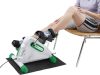
Who is the OxyCycle 3 intended for?
With partial or complete paralysis of one side (hemiparesis/hemiplegia) the affected arm and leg initially move little or not at all. In passive mode the motor takes over the movement, preventing joint stiffness and preserving basic muscle flexibility. As active movement gradually returns, resistance can be increased and switched to active pedaling. Continuous pedalling can also favourably influence limb circulation, supporting long-term recovery.
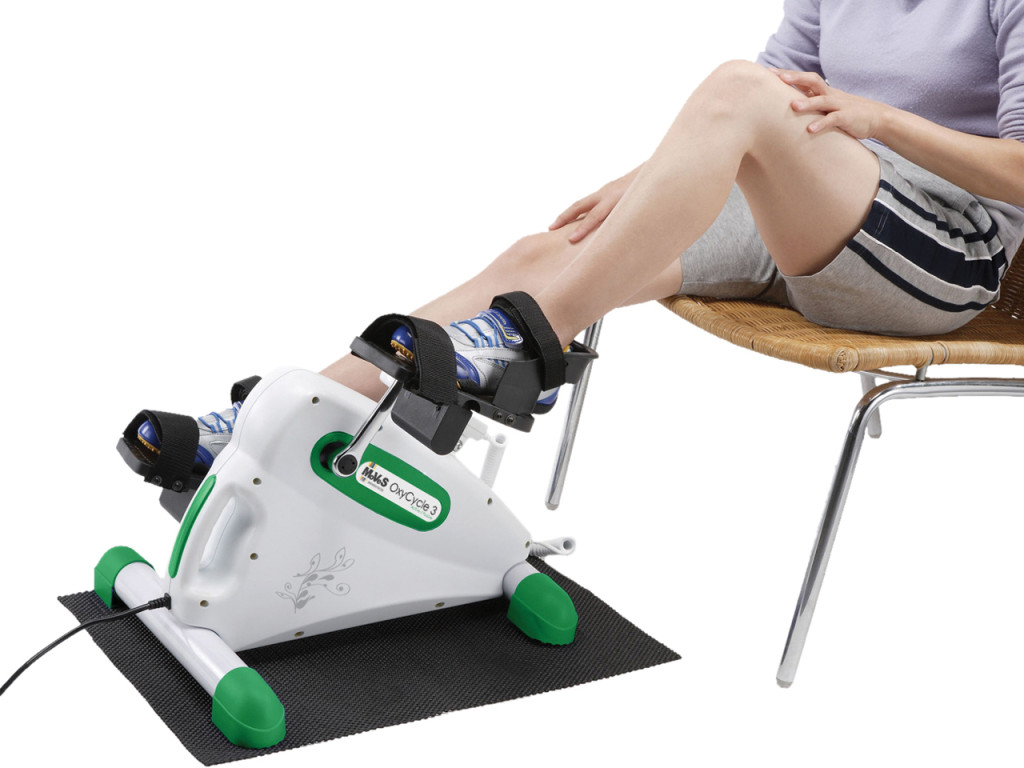
After hip or knee replacement, following extended hospital bed rest, or after any prolonged immobilisation, muscles quickly lose strength (up to 1–2% per day). Gentle, low-load pedalling can already be done while sitting in an armchair even when walking is still limited. Under the guidance of a physician or physiotherapist, the ergometer can be used as a supplementary mobilisation tool alongside the prescribed rehabilitation programme.
In chronic neurological conditions (MS, Parkinson’s, ALS, peripheral nerve injuries) the regularity and gentleness of movement therapy are especially important. The passive–active transition allows the patient to use the device according to their current condition: on worse days the motor assists, on better days they pedal more actively. A specialist (physiotherapist, neurologist) determines the recommended daily duration and intensity.
Many families face the problem of an elderly relative spending days in an armchair or bed because it’s difficult for them to go out. Motor-driven pedalling maintains blood circulation and joint range of motion even when walking is no longer feasible. The device operates quietly and can be used while watching TV — exactly the type of daily small activity that can help prevent chronic deconditioning.
Active and passive modes: how does the 80-watt motor work?
The principle of pedal rehabilitation ergometers is the combination of continuous, gentle joint mobilisation (continuous passive motion, CPM) with progressive loading as muscle strength returns. The difference between the two operating modes is as follows:
Passive mode: the motor drives the pedal
In this mode the 80-watt motor rotates the pedal axle at a steady cadence (between 25–65 RPM) — the patient’s leg or arm merely rests on the pedal and does not exert active force. Continuous passive motion can favourably influence joint range of motion, muscle length–tone relationships, and limb circulation. The CPM principle has been used for decades in post-surgical rehabilitation and neurological recovery.
↔️ Rotation in both directions (forward and backward)
In passive mode the OxyCycle 3 does not rotate in only one direction: the motor drives the pedal forward (clockwise) and backward (counterclockwise), and direction can be changed during operation. This is important because the two rotation directions produce different muscle activation patterns:
- Forward rotation: during leg pedalling this emphasises the quadriceps (knee extensors) and hip flexors in the upward phase.
- Backward rotation: places more emphasis on the hamstrings and gluteal muscles, and the joint movement pattern differs. The same applies to arm pedalling: the shoulder and elbow move through different ranges in the two directions.
Alternating direction within a session can support varied muscle-group mobilisation, which is often a clinical goal in rehabilitation practice.
Active mode: against adjustable resistance
In active mode the motor stops and the patient pedals using their own muscle strength. Mechanical resistance is continuously adjustable, so as muscle strength increases the training load can be measurably raised. This typically corresponds to the second–third phase of recovery when active movement has begun.
️ Built-in safety system (cramp-stop)
The device detects sudden increases in resistance in the limb (e.g., spastic cramp, muscle contraction) and automatically stops to avoid joint or muscle injury. This is especially important for post-stroke patients, where spasticity may occur at any time.
Frequently asked questions about the OxyCycle 3
Yes. The OxyCycle 3 (and the newer 3+ versions with the same logic) is capable in passive mode of rotating the pedal forward (clockwise) and backward (counterclockwise). Direction change is not fixed: it can be modified during operation with the switch. The device is intentionally designed this way because the two rotation directions activate different muscle groups and joint movement patterns:
- Forward rotation: emphasises quadriceps and hip flexor work during leg pedalling.
- Backward rotation: emphasises hamstrings and gluteal muscles.
The same applies to arm pedalling: the shoulder and elbow traverse different ranges in the two directions. Alternating direction within a session can support varied muscle-group mobilisation.
Significant. Motor power determines how much torque can be delivered to the pedal. A 30 W motor may cope with a healthy, thin limb, but if the affected limb is spastic, cramping, or the patient is more severely deconditioned, the motor will “stall” as resistance increases. The 80 W provides substantially more reserve: a constant cadence can be maintained even if the limb’s passive resistance is high. This difference makes the OxyCycle 3 suitable for clinical use while remaining home-sized.
Only to a limited extent. The OxyCycle 3 is designed for a seated position (sitting in an armchair or chair). In a supine (lying) position positioning is difficult because the pedal and limb axes may not be at the correct angle and the device stability is not ensured. For severely bedridden patients, special bed-mounted rehabilitation devices are recommended — discuss these with the treating physician. The OxyCycle 3 is intended for the phase when the patient can already sit (even for 30–60 minutes continuously) — e.g., time spent in an armchair, hospital chair, or at home in front of the TV.
Manufacturer recommendation: maximum 1–2 hours per day, up to 30 minutes per training block. In the initial phase 5–10 minute blocks may be sufficient — excessive use can cause joint inflammation, muscle-soreness-like states, or flares of spasticity. The exact daily duration should always be determined by the treating physician or physiotherapist based on current condition and rehabilitation goals. The device is intended for home use only and is not suitable for continuous institutional (hospital, spa) loading.
With normal home use (30–60 minutes daily) the main mechanical components (chain, bearings, motor) are designed for several years of service. Pedals and grip straps — as wear parts — have lifespans depending on use; replace them if cracks or loosening appear. Regular cleaning (see Maintenance section) significantly extends service life.
The device has a built-in safety stop that senses sudden increases in resistance and automatically stops to prevent joint or muscle injury. If it trips, do not attempt to restart immediately: remove the limb from the pedal, gently massage the affected muscle group, and wait a few minutes for the cramp to subside. If it occurs often or is accompanied by severe pain, consult your treating physician or physiotherapist: the cadence may be too high or you may still need to use the device in passive mode.
How to use it at home? – Step by step
1
Positioning on a stable surface
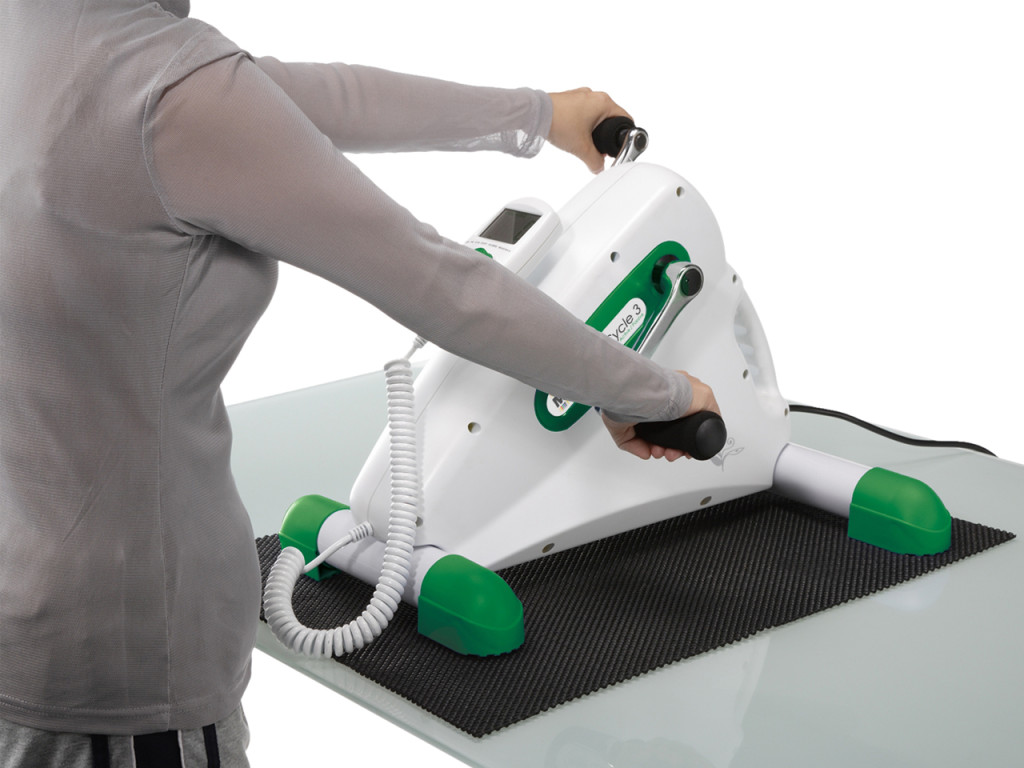
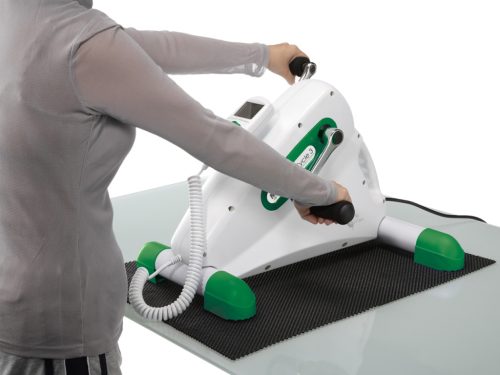
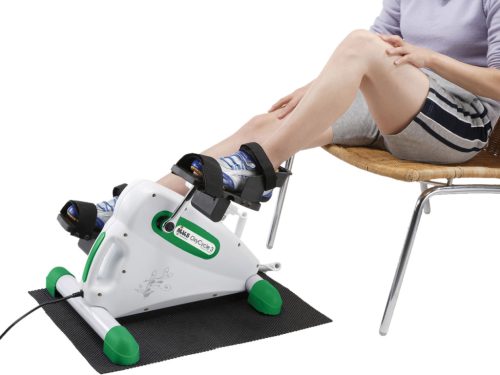
Place the device on a smooth, level surface on the supplied anti-slip mat. For leg pedalling position it on the floor in front of the armchair/chair; for arm pedalling place it on a table at a comfortable reachable height. Sit comfortably with a straight back and knees slightly bent. The distance between the pedal and your knee should allow a full rotation without the knee fully extending to a stop or bending excessively beyond 90°.
2
Fitting the correct pedal
For leg pedalling use the full-foot pedals (non-slip surface). For arm pedalling switch to the hand pedals — the grip strap secures your palm to the pedal so it won’t slip off even with weak grip strength. The swap can be done by hand without tools.
3
Selecting the mode: passive or active
In passive mode the built-in motor rotates the pedal at the set cadence (between 25–65 revolutions per minute). The patient simply rests on the pedal, muscles are elongated, and joints are mobilised. In active mode the motor stops and the patient provides the propulsion against the set resistance. The two modes are switched with a control.
4
Setting cadence and direction
Cadence is continuously adjustable between 25 and 65 RPM. Start with a low value (25–30 RPM) — the goal is gentle, slow mobilisation, not athletic speed. In passive mode the rotation direction can be selected forward or backward, and can be changed during the session (see next section). Changing direction activates different muscle groups, so it’s worth alternating within a session.
5
Using the timer and LCD display
The 15-minute timer automatically stops the device after the set time elapses. The LCD display shows, either simultaneously or alternately: elapsed time, current cadence (RPM), total rotations, and estimated calories burned. These data are useful for the physiotherapist or treating physician to objectively follow progress.
6
Training rhythm: 1–2 hours daily, 30 min blocks
Manufacturer recommendation: maximum 1–2 hours daily, in 30-minute training blocks. Shorter 5–10 minute blocks are appropriate initially. The exact rhythm should always be determined by your treating physician or physiotherapist based on current condition and rehabilitation goals.
What is included in the package?
Everything needed to start using the device is in the box:
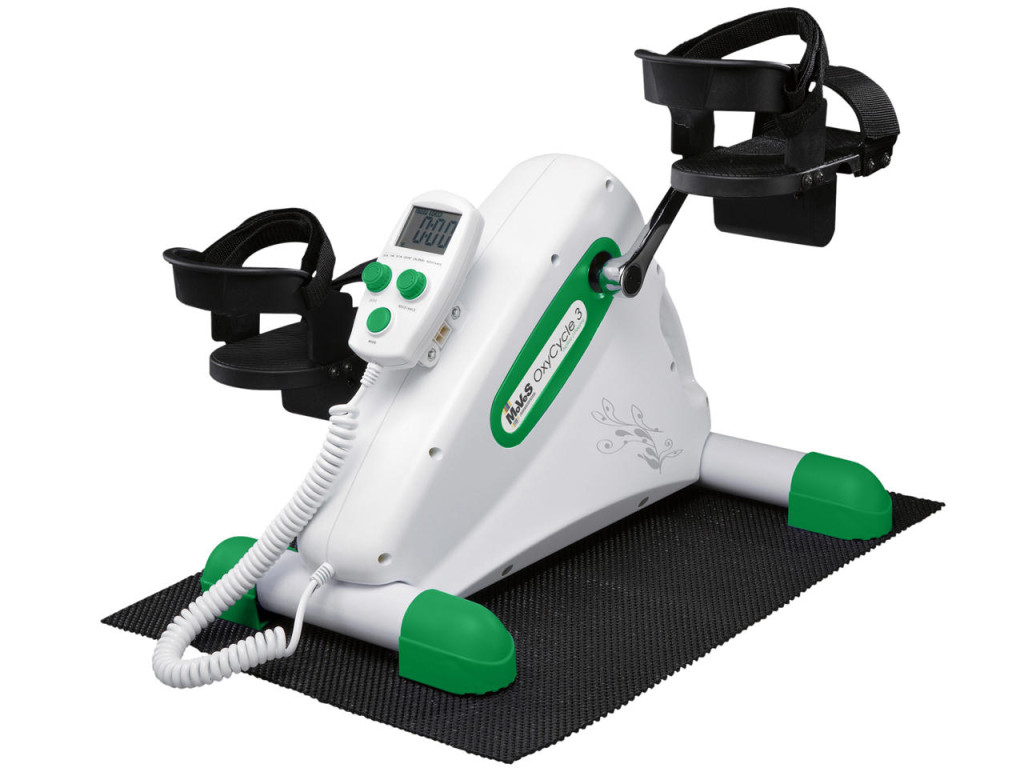
- 1 pc MoVeS OxyCycle 3 pedal trainer (80 W motor, LCD display, timer, adjustable resistance)
- 1 pair full-foot pedals (non-slip surface)
- 1 pair hand pedals with grip straps (secure hold even with weak grip strength)
- 1 pc anti-slip mat (for stable positioning)
- 1 pc EU-plug power cable (50 Hz)
- 1 pc user manual
After use wipe the pedals and the area around the display dry. Pedals can be wiped with mild soapy water; for disinfection use a 70% alcohol wipe — only on surfaces, not on connectors! Occasionally soak the anti-slip mat in warm water. Never open the motor housing and do not pour water on it. Unplug the power cable before long periods of disuse.
Technical specifications
| Product type | Active-passive pedal rehabilitation ergometer |
| Dimensions (W × D × H) | 50 × 46 × 38 cm |
| Weight | 8.5 kg |
| Motor power | 80 W |
| Adjustable cadence | 25–65 RPM (revolutions per minute) |
| Rotation direction (passive mode) | Forward and backward, changeable during operation |
| Modes | Passive (motor-driven) / Active (adjustable resistance) |
| Timer | 15 minutes |
| Display | Multifunction LCD: time, RPM, total rotations, calories |
| Safety feature | Built-in cramp-stop (automatic stop on resistance increase) |
| Power supply | 50 Hz, EU plug |
| Pedal types (in package) | pair of foot pedals + pair of hand pedals with grip straps |
| Accessory | Anti-slip mat |
| User load | 1 person at a time |
| Recommended daily use | 1–2 hours/day, max. 30 min/session |
| Usage category | for home use |
| Certification | CE-marked (Fitness/rehabilitation equipment, MDR-compliant) |
 When NOT to use the device?
The pedal rehabilitation ergometer is strictly contraindicated without medical consultation in the following conditions:
- Fresh surgical wound on the affected limb, or orthopaedic/vascular surgery within the last 4–6 weeks — do not use without the operating physician’s permission.
- Acute, confirmed deep vein thrombosis (DVT) or embolic risk — moving the limb may be risky.
- Acute joint inflammation, active arthritis flare, fever, or an infectious process in the affected limb or systemically.
- Severe cardiovascular instability: untreated arrhythmia, unstable angina, recent myocardial infarction, uncontrolled high blood pressure — cardiologist approval required.
- Fresh fracture or non-consolidated fracture of the limb in use, unstable joint prosthesis.
- Severe osteoporosis — even gentle passive movement should be used only with medical advice.
- Uncontrolled spasticity or severe contracture with very limited joint range — assessment by a movement therapist required.
- Pregnancy — only with permission and guidance from the treating obstetrician.
- Severe cognitive impairment where the patient cannot signal discomfort or pain — use only under supervision.
- Children under 14 — only under the direction of a paediatrician or paediatric rehabilitation specialist.
Unsure? Always consult your treating physician or physiotherapist before use — the rehabilitation plan is individual and your condition should determine when and how to start.
 Important information
The MoVeS OxyCycle 3 pedal trainer is a CE-marked device classified in the fitness/rehabilitation category, for home use. The information in this description is general and does not replace medical or physiotherapy advice. The exact rehabilitation programme (duration, cadence, mode, direction, resistance) should always be based on an individual assessment by your treating physician, neurologist, orthopaedic specialist, or physiotherapist.
Long-term improvement is achieved gradually, with regular use — do not expect immediate results and do not exceed the recommended daily duration. If any unusual symptoms occur (severe pain, swelling, skin discolouration, shortness of breath, chest complaints) stop training immediately and seek medical attention.
The product is marketed in accordance with the EU Medical Device Regulation (MDR). The scientific references cited support the principle of active-passive ergometers; specific use always requires individual medical assessment.
Scientific references
The use of active-passive pedal ergometers in rehabilitation has decades of research backing. The following peer-reviewed publications analyse ergometer cycling in post-stroke and general rehabilitation:
- Soulard, J. et al. (2024). Biomechanical and neuromuscular outcomes during cycling help inform lower limb sensorimotor function after stroke: A systematic review. Annals of Physical and Rehabilitation Medicine. PROSPERO: CRD42022342113. PubMed
- Stoller, O. et al. (2019). Ergometer Training in Stroke Rehabilitation: Systematic Review and Meta-analysis. Archives of Physical Medicine and Rehabilitation. (28 studies, 1115 stroke patients). PubMed
- Aydoğan Arslan, S. et al. (2019). Ergometer cycling improves the ambulatory function and cardiovascular fitness of stroke patients—a randomized controlled trial. Journal of Physical Therapy Science. PubMed
- Kaupp, C. et al. (2018). Rhythmic arm cycling training improves walking and neurophysiological integrity in chronic stroke: the AcceleRATE study. Journal of Neurophysiology. PubMed
 More rehabilitation ergometers →
 Rehabilitation devices category →
 Ergometer in home rehabilitation – guide →
 Managing residual stroke symptoms at home →