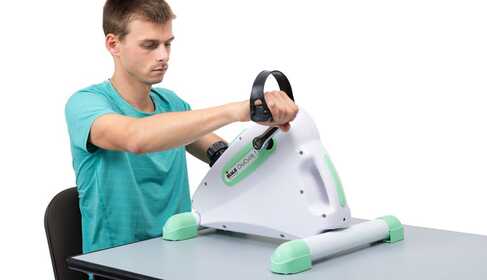
Ergometer in Home Rehabilitation
The home ergometer is an effective aid for recovery from serious illness, that is, for rehabilitation. In this article you can learn more about these devices.

What is an ergometer?
An ergometer is an exercise machine that allows you to strengthen certain muscle groups while precisely controlling the amount of effort required on the device. This makes the load precisely dosable and allows you to track the pace of strength recovery. An ergometer is an exercise machine that enables you to perform cardio exercises in standing, seated or lying positions using either your arms or your legs.
Types of ergometers
There are various types of ergometers, including leg, arm, seated and recumbent ergometers, and treadmills also fall into this category.
In clinical exercise testing and rehabilitation, bicycle and treadmill ergometers are used most often. These can also be used in home rehabilitation.
Recumbent ergometers are specialized devices used for exercise stress ultrasound tests (for hospital use).
For recovery from more severe illness, small rehabilitation ergometers that can be placed on a table, bed or floor are commonly used. They are most often used after stroke, transplantation, joint prosthesis implantation or other major illness when the patient is not yet able to leave the bed or armchair. They effectively assist cardiovascular and respiratory muscle rehabilitation.
Rehabilitation ergometer
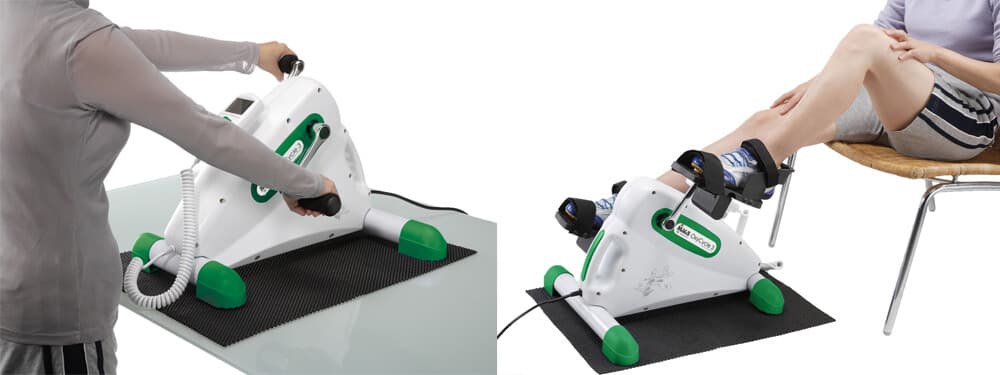
Cycle ergometers that can be driven by both hand and foot provide excellent opportunities for recovery. They can be used to train both the upper and lower limbs. Wheelchair users can roll up to a device placed on a table.
Research has shown that using an arm ergometer or a leg bicycle is beneficial for post-stroke recovery. They help improve arm and leg strength as well as cardiovascular health. The resistance of the bicycle is set by the physiotherapist according to the current condition. Setting the appropriate resistance ensures that the effort required is suitable for the patient.
The purpose of using an arm crank bicycle is to strengthen the arms and legs so that a stroke patient can better perform tasks such as eating, dressing and walking.
Athletes, such as swimmers or triathletes, may also use them during recovery from injury, for example in the rehabilitation after arm and shoulder injuries or surgery.
Active and passive ergometer
There are active and passive ergometers. An active ergometer does not "turn by itself", meaning it is always driven by the user's physical strength.
With a passive ergometer you can set an "automatic" operation. In this mode the ergometer virtually "pulls" the limb along, assisting the movement, and can even move a completely immobile, paralyzed limb. This assistance is needed when, after a stroke, the patient has not yet regained the ability to move.
Severely weakened patients need an active/passive ergometer. Initially the device's assistance is very important; in many cases the patient can use the ergometer only with this help.
As strength is gradually regained, the work done by the device should be reduced and the patient's own effort increased.
The physiotherapist determines the ideal settings, taking the current condition into account.
Preparing to "pedal"
Rehabilitation ergometers are generally supplied with pedals and hand grips. These are easily interchangeable. Choose depending on whether you will work with your feet (pedal) or your hands (handle).
The ergometer should always be rotated in the same direction as the clock hands, whether driven by hand or foot.
Seat position and device placement height can be adjusted to control which muscle groups work harder. For example, align your shoulders horizontally with the machine's axis of rotation. If your shoulders are higher than the axis, you will engage different muscles than if they are lower.
Sit at a distance from the pedals so that your elbow (or in the case of the leg, your knee) is not fully extended but slightly bent (5–10 degrees). If you place the device too far away, you will unnecessarily overload the joints.
Work with a lower load and slower cadence for the first few minutes. This is the warm-up. Circulation in the limb slowly "starts up" and the muscles warm up. Then increase the load.
Training the heart and lungs
One goal of ergometer training is to improve muscle strength and motor coordination. The other — equally important — goal is to improve the conditioning of the heart and respiratory system.
With an ergometer you can gradually develop your endurance, slowly building up to 30 minutes or more of "pedaling". This way you can burn several hundred calories per hour.
The intensity of ergometer training can be set by specifying a target heart rate. The weaker your general condition, the less trained you are, the more your heart rate will rise. You must not overexert yourself.
Load and intensity should be dosed while watching the rise in heart rate. During the first sessions your heart rate may be high even at very low resistance. Slow your pedaling cadence and reduce resistance so that the heart rate increase is moderate.
Each condition (stroke, heart attack, heart surgery, heart failure, etc.) has its own "tolerance" for exertion. Your physiotherapist must tell you what heart rate is permissible! Meet regularly and agree on training intensity and target heart rate. Then follow these at home.
When is an ergometer recommended?
Injuries
- Rotator cuff surgery or shoulder bursitis
- Proximal humeral fracture
- Elbow fracture
- Tennis elbow or golfer's elbow
- Clavicle fracture
- Shoulder dislocation or labral tear
- post-fracture joint stiffness
Conditions
- myocardial infarction (heart attack)
- cardiomyopathy
- heart failure
- stroke
- lung disease (COPD, pneumonia)
- post-transplant
- preparation for and rehabilitation after prosthetic surgery
- severe lack of movement
Ergometer in stroke rehabilitation
One of the leading causes of long-term adult disability is stroke. One of the most common consequences of stroke is hemiparesis, that is, paralysis affecting the muscles on one side of the body. It often results in the patient being unable to walk without assistance and dependent on others. They may even need help with activities such as eating, bathing and dressing.
Walking problems, muscle weakness, spasticity, poor motor control and coordination, balance disturbances and loss of sensation can present major challenges for stroke patients.
After a stroke it is recommended that the patient take part in specialized physiotherapy treatments as soon as possible to begin retraining the body for proper movement, improve blood flow and maintain muscle strength.
Because recovery from stroke can take months or even years, the home ergometer is an important tool in stroke rehabilitation. It is one of the most advantageous movement and rehabilitation methods for stroke patients.
Stimulating arm and leg muscles after stroke can help improve movement and walking ability.
It promotes voluntary movement – Walking requires continuous and repetitive motion, which can be difficult or impossible after stroke. The cycle trainer enforces coordinated and symmetrical movement with both legs, which over time can lead to improved walking.
Can be used almost immediately after the life-threatening phase has passed – In the initial period the patient is not able to practice walking. The cycle trainer can help rebuild the damaged muscles and neural pathways.
Not only useful during rehabilitation. Even after daily and weekly therapy sessions are no longer necessary, the cycle trainer is a great tool for a healthy lifestyle. Many stroke patients find it difficult to maintain an active lifestyle, so incorporating time on the cycle trainer can help build a healthy routine. This daily activity may even help prevent stroke recurrence.
Very safe in post-stroke recovery – With a seated or standing cycle trainer there is no need to balance, so the risk of falls and fear of falling is greatly reduced, and most patients can use it almost entirely independently.
Progress can be tracked – Cycling results are trackable and visible as the patient's condition improves.
The training program is easy to modify. Most ergometers provide adjustment options allowing the user to tailor the workout to their needs.
- High resistance and low cadence focus on muscle building.
- Low resistance and high cadence improve cardio-respiratory endurance, i.e., the efficiency of the heart, circulation, lungs and breathing.